Showing posts with label Popeye. Show all posts

Friday, July 4, 2025

A "Cartoony" Spatial Paradigm? pt. 7 (Platformer character analysis)

Taxonomy of Virtual Spaces

This post continues my exploration toward evaluating a spatial paradigm of "cartoony" digital games, which evolved through the early 1980s. Part one analyzed two important early titles, namely Cutie Q and Pac-Man. Part two looked at some Pac-Man clones and FroggerPart three analyzed some "maze shooters" and "maze looters." Part four explores how maze games evolved into platform games. Part five examined "maze tunneler" games where the player digs their own mazes as they explore. Part six looks at games that use a mix of elevation projections.

This post analyzes the development of character designs in early platformer arcade games from 1980-1984, when "cartoony" games were particularly popular. Unlike the typical connection of platfomers with jumping, most of these games were "climbing" or "ladder" games where the player cannot jump (Space Panic, Bagman, BurgerTime, Monster Bash, Popeye, Kangaroo, Elevator Action, Mr. Do's Castle, Mappy, Mr. Do's Wild Ride). Following this is an analysis of Monster Bash, a 

Early Platformer Game Characters


Early arcade platformer game characters 1980-1984

  • Space Panic - Side view. See my analysis of this game here and details on the transition from maze games to platformer games. The "Spaceman" is simply and orthographically illustrated with little more definition than a stick figure. The character is limited to a three color palette (2 bits per pixel of color data (allows for palette of 3 colors + transparency) times 256 pixels (16 rows x 16 columns) equals 512 bits or 64 8-bit bytes per frame of sprite information).
  • Donkey Kong - Side view. See my analysis here. Mario is far more detailed than the Spaceman protagonist of Space Panic. Both characters are limited to a three color palette and the same sprite size, but Mario has far more detail that would be recognized as cartoon-like. Still, his projection reads as orthographic.
  • Bagman - Side view. This game's character graphics are closely adapted from Donkey Kong. The legs are shaped the same as Mario's, along with the convict's sideburns and the guard's hair and hat.
  • BurgerTime - Side view. See my analysis here. Peter Pepper's sprites have around 7 different colors and so probably use 3 bits per pixel for color data.
  • Donkey Kong Jr. - Side view head, 3/4 view body. DK Jr.'s sprite is 32 pixels wide, twice as wide as Mario and most other sprites shown here. This allows for more horizontal character details and pixels for illustrating a 3/4 view for Junior, though it makes for an awkward platformer character shape.
  • Monster Bash - Side view. See below for further analysis. 
  • Popeye - 3/4 view. See my analysis here. It is easy to see just how huge the characters in Popeye seemed in comparison to most other arcade games of the era. Popeye is about twice as wide and four times as tall as the typical 16 x 16 pixel sprite and the Brutus sprite is even bigger. It is well-known now that Donkey Kong started out as a Popeye-licensed design, but changed before the game was completed. According to research by Kate Willaert, one reason was because it was difficult to create a recognizable Popeye illustration in a 16 x 16 image. One year later, Ikegami Tsushinki developed some innovative arcade hardware capable of displaying very large sprites for Nintendo with Popeye
  • Kangaroo - Side view. A female protagonist, a rarity at the time. "Mama Roo" is a mother kangaroo fighting and climbing to rescue her "Baby Roo" from monkey kidnappers. The large image size and wide color palette allow for a lot of details, though Mama Roo is still illustrated only in a side view.
  • Mario Bros. - Side view head, 3/4 view body. Mario grows up, with 16 x 32 (or maybe 16 x 24?) sprites and a 7 color palette (3 bits per pixel).
  • Elevator Action - Side view. Agent 17 has tall 16 x 24 sprites and a 7 color palette with effective animations, though his standing image is flatly illustrated.
  • Mr. Do's Castle - Side view. See my analysis here.
  • Mappy - 3/4 view. Hiroshi "Mr. Dotman" Ono's pixel art skills are on display here with his illustration for the titular mouse police officer working to defeat a gang of cat thieves. Appears to be a 7 color palette.
  • Arabian - Side view.
  • Flicky - Side view. Small birds in the Sonic the Hedgehog series of games would take the name of "flicky" from this game.
  • Bomb Jack - Side view head, 3/4 view body. The character's body is at a slight 3/4 view with two "buttons" visible on the front of his costume.
  • Mr. Do's Wild Ride - Side view. Mr. Do returns in another platformer, this time with an outline drawn around his sprite.
  • Pac-Land - 3/4 view. The 32 x 32 image gives Namco's artists plenty of room to add details to Pac-Man in his in a platformer. This game's character models were modified from Namco's original designs when imported to the United States to better match Hanna Barbera's Pac-Man animated TV series that debuted in 1982. The original Pac-Man design had different eyes and sported a jaunty Tyrolean hat, making him look like a Bavarian hiker. 
Aesthetically speaking, Nintendo and Namco the best-looking "cartoony" sprites of this group. In the few short years examined here, sprites became more colorful as 7-color palettes replaced earlier 3-color palettes. Larger sprites could certainly catch one's attention, but the 16 x 16 standard remained a viable character size for many games through the 1980s.

Analysis of Monster Bash

This curious 1982 platformer game from Sega has the hero climbing ladders and fighting against classic monsters from films like Dracula and Frankenstein. The game is a good example of the transitional period from maze games to platformers as the game has both platforming and maze game levels with no change in character graphics or movement.

Monster Bash intro screen
The intro screen serves as a map of the three different levels in the game. Dracula House and Frankenstein Castle are both illustrated in orthographic, elevation projection with a front view. Chameleon Man Graveyard is illustrated in oblique, plan projection in with a bird's-eye view. This makes the map look disjointed, but each projection matches the method used in each different level.

Monster Bash "Dracula House"
"Lil' Red" the hero must face off against Dracula in his house, lighting candles and touching a sword to power up a zapper weapon to defeat the vampire. Lil' Red and the bat enemies are illustrated in orthographic side and front/back views. The larger Dracula sprite is illustrated in 3/4 view. They all explore the environment illustrated in front elevation projection.

Monster Bash "Frankenstein Castle"
This level has the same visuo-spatial configuration as Dracula House, above.

Monster Bash "Chameleon Man Graveyard"

In the Chameleon Man Graveyard, gameplay shifts to that of a maze game with an overhead view, although there is no change to character graphics or movement controls. The relatively small Chameleon Man "boss" character is illustrated in the same orthographic side and front/back views as Lil' Red. The environment is completely different from the other levels, with a plan oblique projection.

This game further supports the theory that early platformer games, especially "ladder" games, evolved from and are derivations of maze games. 

Sunday, August 27, 2023

A "Cartoony" Spatial Paradigm? pt. 4 (Platformer Evolution)

Taxonomy of Virtual Spaces

This post continues my exploration toward evaluating a spatial paradigm of "cartoony" digital games, which evolved through the 1980s. Part one analyzed two important early titles, namely Cutie Q and Pac-Man. Part two looked at some Pac-Man clones and Frogger. Part three analyzed some other maze games that do not feature "dot eater" gameplay: "maze shooters" and "maze looters."

This post looks at how maze games evolved into platformer games.

Heiankyo Alien/Digger

The original Heiankyo Alien (The University of Tokyo's Theoretical Science Group (TSG), 1979, NEC PC-8001 computer game)

The Japanese arcade version of Heiankyo Alien (Denki Onkyō Corporation, 1980, arcade game)

The USA arcade release of Digger (Sega-Gremlin, 1980, arcade game)

Heiankyo Alien is little-known in the west, but may be one of the most influential digital games. The player avatar is a Kyoto policeman 1000 years in the past when the then-capital city of Japan was called Heian-kyō. The player is pursued by alien invaders roaming the maze-like streets of the city. Our heroes only defense is to dig holes in the street for the aliens to fall into, then refilling the holes before the alien escapes.

This maze game was released before Pac-Man and could have easily been an influence on Pac-Man. Like Frogger, which I analyzed previously, this game has a concept gravity and layered space. An alien may fall "into" the holes, falling below the main layer of the streets.

Heiankyo Alien/Digger Visuo-Spatial Analysis: The original game was developed by students at the University of Tokyo and was released for NEC's PC-8000 series of computers. Like many other maze games I reviewed previously, the environment is projected in a plan orthographic view. Due to graphical limitations, this first iteration used symbolic representation of the game agents, as seen by the yellow spade (player avatar) and red circles (aliens) seen in the top image above. Gameplay space is not continuous, but is instead limited to a layered, 2-D grids of discrete spaces and gravity in the z-axis of the screen. This single-screen game has a fixed frame.

Denki Onkyō Corporation created an arcade version and upgraded the game's graphics and spatiality. The player character is shown in profile with an orthographic side elevation view. The aliens are shown in more of a 3/4 view, with an orthogonal horizontal oblique view. This version features layered, continuous, 2-D spaces

Sega-Gremlin changed the game slightly for the USA arcade audience, changing its name to Digger. Any story of alien invasion and the Heiankyo policeman are replaced with the player in a "maze-like desert canyon" digging holes to defeat spider-like "creatures" (Digger Arcade Flyer, Sega-Gremlin, 1980).

Crazy Climber

Crazy Climber screen shot. No, that is not Donkey Kong!

Crazy Climber (Nichibutsu, 1980) is an early "climbing" game that was released to the Japanese arcades in November, 1980 (Masumi Akagi, Arcade TV Game List, Domestic/Overseas Edition (1971-2005), Japan: Amusement News Agency, pg. 55) and in the USA by Taito one month later (Akagi, pg. 127). The player avatar hero climbs to the top of a building while overcoming obstacles that include a giant ape - 10 months before the release of Donkey Kong!

This game can't really qualify as a "platformer" as it is missing an important ingredient: platforms. The player constantly climbs the building until they reach the top, almost like a platformer level comprised of nothing but ladders. It features an unusual two-joystick system: one each to navigate the player avatar's left and right hands. Left/right movement is possible, but the primary direction the player moves is up (they can't go down unless they fall).

Lupin III Visuo-Spatial Analysis: Spatially, this game is very similar to later "smooth scrolling" platformer games. The environment and agents are shown in an orthographic front elevation view (well, "rear" view for the player avatar). Gameplay happens on a continuous, layered 2-D space with a background layer (inside the building, where "antagonist" residents (Crazy Climber Service Instruction, Nichibutsu, 1980, pg. 4) hide behind windows). It features a smooth-scrolling framing device with vertical mobility (up only). It also has a mini-map (on the left edge of screen) and gravity down to bottom of screen.

Space Panic

Player avatar digging a hole in Space Panic


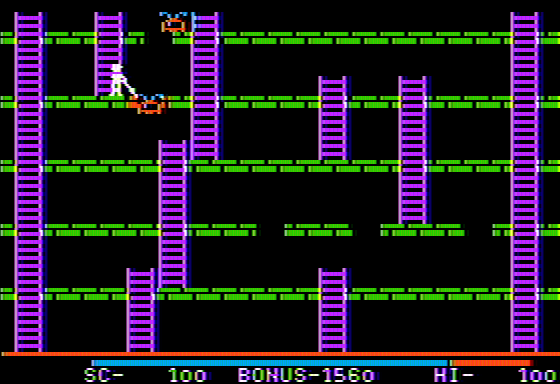
Space Panic (Universal Co. Ltd., 1980) is another "climbing" game, released in Japan one month after Crazy Climber in December, 1980 (Akagi, pg. 15) and in the USA in February, 1981 (Akagi, pg. 165). It is a major leap forward in digital maze games, one that owes much to Heiankyo Alien. The player avatar "man" is in a multi-level structure with limited oxygen (represented by the timer bar near the top of the screen). Three types of aliens, monster, boss, and don, are invading the building and the man's only defense is to dig holes to trap them and then bury them to make them fall (Space Panic Operation, Maintenance, and Service Manual, Universal Co. Ltd., 1980, pg. 3).

The player's view is looking at a series of straight, narrow platforms connected by ladders. The nature of the building is never explained (Space station? Alien structure? Exoplanet cave system?), but oxygen is in short supply here. The platforms are malleable enough that the man may punch holes in them with what looks like a simple shovel. The existence of platforms, ladders, and gravity give credence to calling this the first platformer game. It is missing one key ingredient of platforming as we know it - jumping.


Digging holes and burying aliens in Space Panic (above) and Heiankyo Alien (below)

The Retrogame Deconstruction Zone blog has a thorough comparison of Space Panic and Heiankyo Alien on their site. The gif above is referenced from that page, showing the actions of moving, digging, trapping, and burying in both games. That site is under the impression that Space Panic should not be considered as "the first platformer" as it does not fit the definition of platformers as we know them now (must include jumping). However, they also admit that genres are fluid and they aren't really convinced of their own argument.

What makes sense to me is that Space Panic is the first of a different kind of platformer: one that involves climbing ladders, trapping enemies by manipulating those platforms, and no jumping.

Apple Panic screen shot

Where Space Panic was not very successful in arcades in the west, Ben Serki's unlicensed clone Apple Panic (Broderbund, 1981, computer game) was quite successful on Apple II home computers. It was later ported to other popular computer platforms in 1982 and even spawned its own series of clones.

Mr. Do's Castle screen shot

Mr. Do's Castle (Universal Co. Ltd., 1983, arcade game) (a.k.a. Mr. Do! vs. Unicorns in Japan) seems to be Universal's attempt to refine their original Space Panic formula using their successful new character, Mr. Do. Instead of digging, little clown player avatar knocks blocks out of the floors with a hammer. Certain ladders can be moved left or right to change the playfield and there are a number of innovative ways to complete each level.

The environment (platforms) and background (windows in castle wall) are drawn in elevation oblique view, allowing some dimensionality and depth to be inferred. There is a sense of space (blue sky) beyond the window, but all gameplay takes place only on a single, 2-D plane inside the castle.

Lode Runner (Atari 8-bit) screen shot

Doug Smith's Lode Runner (Broderbund, 1983, computer game) refined the Space Panic formula further and became a huge hit. It was ported to seemingly every home computer on the market and spawned a number of sequels. The athletic player avatar must collect gold bars (squares) and avoid guards, who can also pick up and carry gold. In addition to ladders, characters can move across horizontal "hand over hand bars." Guards can be dropped into holes to temporarily incapacitate them (and force them to drop any carried gold). Once all gold bars are collected in a level, the player is free to move to the next level by moving to an exit ladder that appears, giving some sense of a page-flip frame mobility that moves the player to another point in space.

One other important development of Lode Runner is this is one of the first commercial games to include its own level editor. This tool allowed the developers to easily create dozens of challenging or aesthetically interesting levels (like the triple-crown Broderbund logo in the screen shot above). It also allowed Lode Runner players (including this author!) to get their first taste of level design.

This "ladder/digger" take on platformer gameplay probably reached its peak with the Lode Runner series, which saw releases through the 1990s and even a Lode Runner for XBOX 360 (2009). Few other titles use the same basic formula in the past several decades, such as Moraff's Escapade (Moraffware, 1996, Windows computer game), The Worlds of Billy (Intense Entertainment Interactive, 1997, DOS computer game), and The Worlds of Billy 2 (Global Star Software, 2002, Windows computer game). The Space Panic style of platforming was completely overshadowed by the run-and-jump style that emerged from Donkey Kong.

Space Panic Visuo-Spatial Analysis: While most previous maze game environments are understood in my analysis as plan (overhead) views, this game has ladders and gravity that reinforce the environment's orthographic side elevation side view. The game agents use similar orthographic front (aliens) and side (man) elevation views. This single-screen game has a fixed frame and gravity down toward the bottom of the screen. All gameplay takes place in a continuous space on a 2-D plane. Except where noted above, the other games of this type use the same visuo-spatial construction.

Donkey Kong

Donkey Kong screen shot


Nintendo first released Donkey Kong (Nintendo, 1981) in Japanese arcades in August, 1981 (Akagi, pg. 57) and Nintendo of America brought it to the USA in October, 1981 (Akagi, pg. 150). Much ink has been spilled about how this game set the stage for the legions of platformer games that followed, notably with the addition of the "jump" button.

Donkey Kong seemed so different that it was hard to classify when it was released. Video Games Magazine editor Steve Bloom called it "another bizarre cartoon game, courtesy of Japan" (Bloom, Video Invaders, 1982, pg. 181) and rightfully noted its similarities to Crazy Climber and Space Panic. Electronic Games magazine lumped all these games together into the category of "climbing games" ("The Player's Guide to Climbing Games," Electronic Games, vol. 1, no. 11, pp 49-56). Game designer Chris Crawford, creating his own "taxonomy of computer games" found Donkey Kong impossible to categorize and described it as "a game that looks a little like a race game with intelligent obstacles" (Crawford, The Art of Computer Game Design, 1984, pg. 29). 

Donkey Kong Visuo-Spatial Analysis: Is almost exactly like Space Panic, which Donkey Kong's first level looks suspiciously similar to. What is different is the incorporation of an overall story structure broken up into 4 different screens as Mario ascends the building. I don't know if Shigeru Miyamoto ever called out Crazy Climber as an influence, but he wanted this game to have a smooth-scrolling climb to the top of the structure. However, that wasn't possible due to the Radar Scope (Nintendo, 1980, arcade) hardware this game had to be based on. Instead, Miyamoto and his team implemented a simple page-flip framing device for different sections of the building to be played as individual game screens.

[Addendum 5 Sep 2023]

BurgerTime (a.k.a. Hamburger)

BurgerTime (Data East/Midway, 1982)

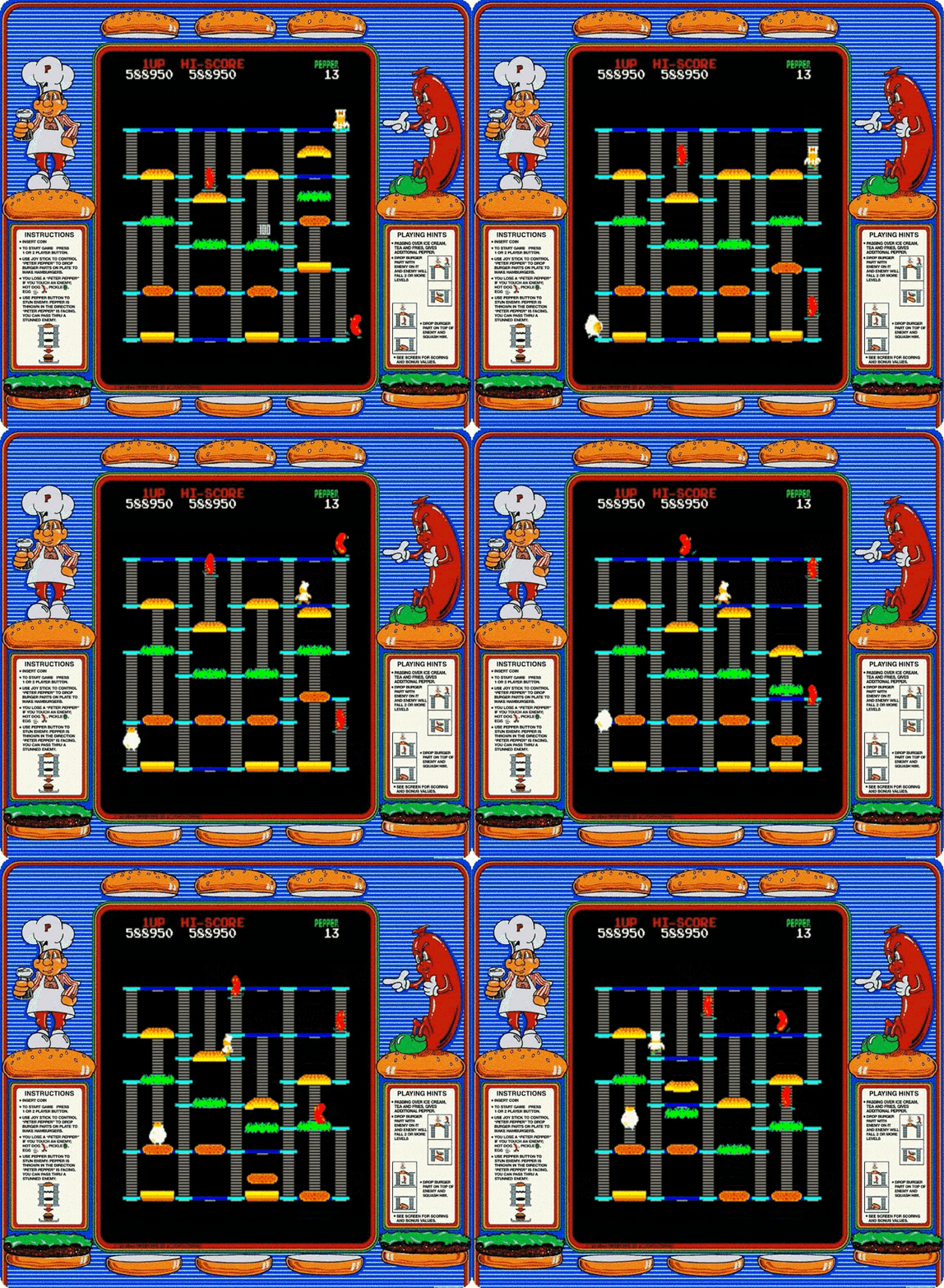
Data East released this game as Hamburger in Japanese arcades in August 1982 (Akagi, pg. 47) and Data East USA rebranded the game as BurgerTime, launching the game with Midway for the US audience in December of that year (Akagi, pg. 115).

After the release of Donkey Kong in 1981, many platformer games with run-n-jump gameplay followed in its wake. Notable games that quickly innovated on the DK spatial paradigm (without being outright clones) include Miner 2049er (Big Five Software, 1982), Kangaroo (Sun Electronics, 1982), Chuckie Egg (A&F Software, 1983), Hard Hat Mack (Electronic Arts, 1983), and Jumpman (Epyx, 1983). Each of those games features jumping as an important aspect of navigating space and avoiding hazards.

BurgerTime has no jump button and appears to be influenced by the Space Panic style of "climbing platformer" than DK. Like Space Panic, enemies are defeated by dropping them down by one or more elevation levels or by crushing them by dropping something on top of them. Unlike Space Panic, the theme is about making hamburgers at a fast food restaurant while being pursued by killer eggs, sausages, and pickles. The player avatar has a limited-use pepper weapons that can temporarily stun enemies in case the player gets cornered.

BurgerTime Visuo-Spatial Analysis: Same as Space Panic.


Popeye


Nintendo of America brought the Popeye arcade game to the USA in November 1982 (Akagi, pg. 128) ahead of Nintendo's Japan launch of the game in December 1982 (Akagi, pg. 57).

"Popeye-1" Nintendo design document signed by Miyamoto, March 1981

It is an oft-told story that Donkey Kong started development as a Popeye game licensed from United Features, and Shigeru Miyamoto's design document above bears that out. The level sketch looks almost exactly like the first stage of DK, with Brutus holding a captive Olive Oyl and rolling "beer barrels" at a tiny Popeye. The design had to be changed at the last minute, either due to delays in reaching a licensing agreement or due to technical limitations in displaying detailed "cartoony" sprites of the Popeye characters. Nintendo released an official, licensed Popeye platformer in the following year, one with greater graphical capabilities that allowed it to display large, detailed sprites.

Popeye is another non-jumping platformer. The player avatar climb stairs, ladders, stair-like ship's rigging or simply drop down to reach a different platform. Miyamoto has stated that his original design for DK was about "climbing through a maze" and jumping was only added later. The Popeye/DK transitional design document above bears this out. The control scheme in the bottom right only uses a 4-way joystick (with no jump or punch button) and the "up" direction is only used to climb ladders. Later designs for the two games each added a button, jump for DK and punch for Popeye.

Popeye Visuo-Spatial Analysis: Similar to Space Panic, with a limited elevation orthographic foreground image plane (the "THRU" signs on the right and left sides of the screen and some tufts of grass). Some of the navigable game environment is rendered in horizontal oblique projection (the staircases seen in the gif image above).


To be continued...

Spatial Models: Discrete vs. Continuous

Taxonomy of Virtual Spaces Wardrip-Fruin, Noah. (2020).   How Pac-Man Eats . Cambridge, Massachusetts: The MIT Press. Today, I return to the...