Showing posts with label cute. Show all posts

Tuesday, September 5, 2023

A "Cartoony" Spatial Paradigm? pt. 5 (Maze Tunnelers)

Taxonomy of Virtual Spaces

This post continues my exploration toward evaluating a spatial paradigm of "cartoony" digital games, which evolved through the early 1980s. Part one analyzed two important early titles, namely Cutie Q and Pac-Man. Part two looked at some Pac-Man clones and Frogger. Part three analyzed some "maze shooters" and "maze looters." Part four explores how maze games evolved into platform games.

In the change from maze games to platformers, the view of the game environment changed from a plan view (bird's eye view, like a map) to an elevation view (side or front view). A new type of "maze tunneler" game developed that used a platformer-style elevation view that added an important aspect of gravity to the gameplay. Although characters don't fall, certain obstacles can fall toward the bottom of the screen and crush characters in their paths.

These games share some affinity with Frogger, in that they are maze games with dynamic environments. The major difference here is that the player has the power to create the shape of the maze.

The Adventures of Robby Roto! (a.k.a. Roto)
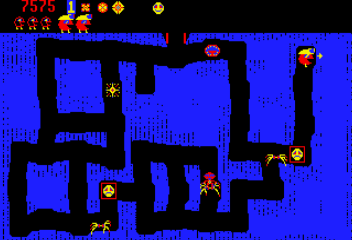
The Adventures of Robby Roto! arcade (1981)


Bally Midway released The Adventures of Robby Roto! (1981), a creation of Jamie Fenton (Datsun 280 ZZZAP, Gorf) and Dave Nutting (Gun Fight, Wizard of Wor).

See some raw footage of Robby Roto exhibited at the 1982 Chicago CES, including "Ron Robot" (a.k.a. Defender and Robotron 2084 designer Eugene Jarvis) trying the game and admitting, "I think it's beyond me."

Robby is a happy red Pac-Man-oid character with a mining helmet and tiny legs. His quest is to find the trapped miners (yellow unhappy faces) and rescue them (turning into happy faces) and lead them to the mine exit. Bally Midway seems to be staying close to cute aesthetic of Pac-Man, which they had license to arcade game for in the USA.

Robby can dig new tunnels in the game environment, but his power is more limited than later examples of this type of game. Robby can only carve out the "soft dirt" blocking the main shape of the maze - the player cannot dig outside of this maze into the "hard rock." Another difference is that there seems to be no sense of gravity in the game. However, this does appear to be the first of the "maze tunneler" type of games. Bally Midway marketing VP Stanley Jarocki described it as "an underground maze game."

The rights to Roto eventually reverted to Jamie Fenton, who has given permission for the game's ROM to be shared and played for non-commercial purposes using a tool like MAME.

Roto Visuo-Spatial Analysis: Just like Pac-Man, except the environment image plane is rendered in an elevation orthographic view.

Dig Dug
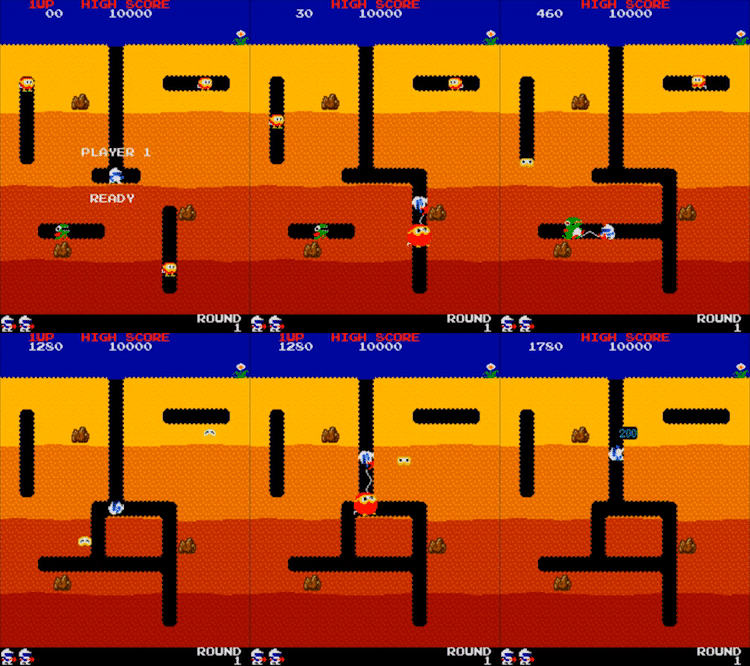
Dig Dug arcade game (1982)

Namco launched Dig Dug in Japanese arcades in March 1982 (Agaki, pg. 52) and Namco and Atari brought it to the USA one month later in April (Agaki, pg. 126). Atari boasted it as "a new and exciting type of maze game" where the player avatar (the titular Dig Dug) can tunnel their own mazes anywhere in the earthen strata of the level environment. Two types of enemies must be defeated: the cute, goggle-eyed "Pooka" and the fire-breathing "Fygar." The player can shoot a limited-range pump weapon in order to inflate and destroy enemies or may trap them under falling rocks before they can reach the surface and escape. Enemies prefer to follow the player-dug tunnels but may also freely "phase" through the untunneled earth.

Dig Dug is one of the first games where the player has agency to design the layout of the environment by tunneling. Lady Bug (Universal Co. Ltd., 1981) is an earlier maze game where the player may move gates to change the environment, which I wrote about previously.

Dig Dug Visuo-Spatial Analysis: The game has similar visuo-spatial structure to that of the early platformer game Space Panic. One difference is that Dig Dug has minor background image plane (the flowers at the ground level) using an elevation orthographic projection.


The Pit
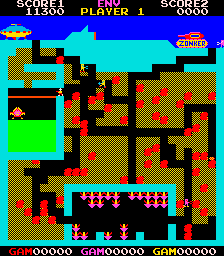

The Pit arcade (1982?)

Centuri released The Pit to arcades in the USA in April 1982 (Agaki, pg. 113) after licensing the game from UK company Zilec Electronics. The Stamper Brothers (who I've written about before) were tasked with rewriting the game code to work with the hardware that would be used in USA manufacturing. I am unsure of the UK release date, but it may have predated the Japanese release of Dig Dug.

The player avatar lands on an alien planet in a flying saucer at the top of the screen. They are tasked with retrieving at least one large diamond in the pit at the bottom of the screen and returning to their ship before aggressors can destroy it with their "zonker" tank.

The Pit Visuo-Spatial Analysis: While other games described on this page feature a continuous spatiality, this game is a simple grid of discrete spaces. The characters and falling rocks move one tile at a time. Otherwise, the spatial structure is much like Space Panic.

Mr. Do!

Mr. Do! arcade (1982)

Universal Co. Ltd. released Mr. Do! in Japan in October 1982 (Agaki, pg. 15) and in the USA in February 1983 (Agaki, pg. 139). Depending on your point of view, Mr. Do! may be seen as a crass copy of Dig Dug or as a refined evolution on the Dig Dug formula.

Mr. Do! was designed by Lady Bug designer Kazutoshi Ueda. The player clears a level by collecting all of the cherries on the screen. Huge apples replace Dig Dug's boulders and Mr. Do has the power to push them. Mr. Do can dig tunnels like Dig Dug and is armed with a bouncy super ball that can kill an enemy instantly.

I previously wrote about the sequel, Mr. Do's Castle (1983), an early platformer that has very different gameplay from this game.

Mr. Do! Visuo-Spatial Analysis: This game is very similar to Dig Dug, although the method of projection for the environment is somewhat ambiguous. Some game literature describes Mr. Do as a farmer collecting the cherry harvest from his orchard, implying a plan view of the orchard environment. However, the digging action and gravity towards the bottom of the screen must show the environment in an elevation view.

Boulder Dash


Boulder Dash for Atari 8-bit computers (1984)

Peter Liepa's Boulder Dash (First Star Software, 1984) was first published for Atari's series of 8-bit computers. Exidy bought the rights to create an arcade version in that same year.

Liepa may have been indirectly inspired by The Pit. Liepa was helping fellow computer game programmer Chris Gray refine and develop the physics for Gray's game, which played a lot like The Pit. Liepa instead developed his own game concept of digging for diamonds underground through a series of large, puzzle-like, challenging stages.

1984 is a bit late for the era of games that I've been looking at for this series, but this game has had a long-running impact with countless ports, sequels, and its own clones (I'm looking at you, Crystal Mines). Later maze-tunneler games tend to be influenced by Boulder Dash and tend to be action-puzzle games rather than pure action games.

Boulder Dash Visuo-Spatial Analysis: Boulder Dash uses the same grid-of-discrete spaces, checkerboard of tiles type of world as The Pit, but with huge game levels. The levels can't fit all on one screen, so it uses a smooth-scrolling frame mobility.


Friday, August 25, 2023

A "Cartoony" Spatial Paradigm? pt. 2 (Maze Games)

Taxonomy of Virtual Spaces

This post continues my exploration toward evaluating a spatial paradigm of "cartoony" digital games, which evolved through the 1980s. Part one analyzed two important early titles, namely Cutie Q and Pac-Man.

In the Wake of Pac-Man

Illustration for "The Real Threat of Pac-Man" by Steven M. Fink, The Philadelphia Inquirer, October 20, 1982

Pac-Man's simple and charming aesthetic helped the game appeal to players of all ages and genders. The yellow circle with an ever-hungry mouth became the first video game avatar (long before that term was coined) with personality and character. That character soon became merchandised, appearing on trading cards, bed sheets, Saturday morning cartoons, toy figurines, board games, canned pasta, and much more. Pac-Man also became video gaming's first mascot, with his round form being used to represent video games, video game addiction, the video game industry, fears of technology, and so on. Take a look at Cat DeSpira's "Mall Rats, Vidiots, and Addicts" (2019) article for a small sample of how Pac-Man appeared in the press via political cartoons and how the video game industry was represented through the 1980s.

The game was popular in Japan, but the USA became swept up in Pac-Mania by the summer of 1981. As often happens, numerous imitators were published that tried to duplicate a fraction of Pac-Man's success.

Lady Bug and Mouse Trap

Lady Bug screen shot
Mouse Trap screen shot

The arcades saw two new cartoony maze games hit the arcades in 1981 that stick close to the basic Pac-Man formula. Lady Bug (Universal Co. Ltd., 1981) and Mouse Trap (Exidy, 1981) do feature gates that empower the player to modify the maze as they play, but don't do much to innovate otherwise. The Japanese-designed Lady Bug features a few cute enemy insect designs with big eyes (see above), not unlike those of the monster enemies in Pac-Man. The American-designed Mouse Trap "cute" characters (like the blue mouse, above) have much smaller eyes.

Visuo-Spatial Analysis: The spatial constructions of these two games are almost identical to Pac-Man, except they are missing the screen-wrap side tunnels that gives Pac-Man a cylindrical topology. Also, Lady Bug agents are projected in plan view (from overhead) rather than front or side elevation view.


Frogger

Frogger screen shot

Frogger (Sega/Gremlin, 1981) does not have obvious influence from Pac-Man, but shares some similarities. In Pac-Man, the goal is to navigate across all points in the maze to clear a level. Frogger's goal is to navigate from the bottom of the screen to the frog homes at the top of the screen five times to clear each level. So, the amount of player movement required before a level is complete is similar between the two games. Second, Frogger's environment is also a maze: a dynamic, ever-shifting, navigable maze of different obstacles. The busy freeway is clogged with traffic and the treacherous river may only be crossed by hopping onto logs, crocodiles, and untrustworthy diving turtles (it isn't clear why our amphibian hero can't simply swim across).

Frogger features a spatial innovation not seen in the earlier titles written about here. Each previous game has the game agents traveling on a single, two-dimensional plane. There is no "background" imagery at all, with nothing but black outside of the agents and environments. The player avatar always collides with another game object, either eating it or getting killed by it. The enemy characters ignore and pass "through" pellets and power ups, but don't really seem to move "over" them. Conversely, Frogger is an example of layered space, where game agents may move over several 2-D planes. As the level starts, the player frog stands atop a ground layer (shown as purple dirt in the image above). At the river, the player frog (and lady frog) may be atop the diving turtles, logs, and crocodiles, all of which are understood as floating above the surface of the water. The diving turtles may also dive under that water layer, thus being behind the base "floor" layer of the water's surface. There is also a sense of gravity into the z-space of the screen, as the player frog may make a misstep and find themself drowned below the water layer.

Frogger Visuo-Spatial Analysis: Most Frogger agents are projected to the screen in an orthographic, plan (overhead) view, which matches the environment's projection. Crocodiles are shown in a side elevation view, which better shows their details (like open, toothy jaws) and prevents them from being confused with logs. The logs are illustrated in horizontal oblique projection, which allows their cylindrical forms to be easily understood. It is a layered, continuous, 2-D game space with a fixed frame and gravity in the z-axis.

Thursday, August 24, 2023

A "Cartoony" Spatial Paradigm? pt. 1 (Cutie Q)

Taxonomy of Virtual Spaces

Many of my previous posts have focused on the "Filmation" aesthetic style as an example of a spatial paradigm in digital games.

This post is an exploration toward evaluating another paradigm through the evolution of "cute" or "cartoony" games, with their genesis in the late 1970s and evolution through the 1980s.

Cutie Q

Cutie Q screen shot

Cutie Q (Namco, 1979) was the third title in Toru Iwatani's Gee Bee series, preceded by Gee Bee (1978) and Bomb Bee (1979). The Gee Bee games were inspired by Breakout (Atari, 1976) which had kick-started arcade game popularity in Japan in a way that Pong (Atari, 1972) and its clones never had. The Gee Bee series mixed block-breaking gameplay with pinball and pachinko aesthetics, featuring interactive items on the playfield like pop bumpers, spinners, and rollover targets. Cutie Q is the first to feature cute characters in the game, such as pink ghost "minimon," yellow "walkmen," happy/unhappy faces, and characters on the rainbow-colored blocks.

Earlier arcade games had featured recognizable characters that were more than simple paddle, car, tank, or rocket ship shapes (such as TV Basketball (MIdway, 1974), Western Gun/Gun Fight (Taito/Midway, 1975), and Circus (Exidy, 1977)). Tomohiro Nishikado's Space Invaders (Taito, 1978) aliens are recognizble as different sea creatures (octopus, crab, and squid). However, none of these earlier characters would be considered to be "cartoony" or "cute" (although the crab space invader is generally considered to be "the cute one").

Cutie Q is probably the earliest example of a "character game"* with intentionally cartoony and cute (it's right there in the name) figures. This concept served as direct influence on Iwatani's next game with Namco, Pac-Man.

Cutie Q Visuo-Spatial Analysis: The game screen emulates an orthographic view of a bagatelle-style playfield, but there is no real sense of gravity to understand which way is "down." The player could be looking down at a plan view of the playfield (like a pinball machine) or across at an elevation view (like a vertically-mounted pachinko machine). The character images are shown in orthographic front and side elevation views, the best way to show character details on a tiny 16 x 16 one-bit-per-pixel (1BPP, i.e. a two-color palette) sprite. The game has a sense of continuous 2-D game space limited to a single screen (fixed frame).

* The term "character game" is also a term used for Japanese "simulation games" (what we call board-and-counter wargames in the west) that are based on manga and anime series. For more on this topic, you should see my other blog for articles and translations I've made of various Japanese sci-fi and anime games (and one German one).

Pac-Man

Pac-Man screen shot

Iwatani's next game, Pac-Man (Namco, 1980) abandoned ball-and-paddle gameplay for the relatively untapped genre of maze games (preceded by few examples like Gotcha (Atari, 1973) and The Amazing Maze Game (Midway, 1976)). Pac-Man is similar to car racing game Head On (Sega, 1979), which is about driving over and clearing the screen of "lane markers" (dots) in a maze of roads before an opponent car can run into you.

Pac-Man, of course, replaces the act of driving with eating as the titular character devours his way through each maze. Bonus point edibles include fruits like cherries, strawberries, and oranges, their graphics reminding the player of "fruit machine" (a.k.a. slot machine) reel images. Pac-Man is pursued by four ghostly, large-eyed monsters that look like they evolved from Cutie Q's pink minimons. Pac-Man features a technical leap past Cutie Q's graphics capabilities: the multicolored monsters and bonus items feature two-bit-per-pixel (2BPP, 4 colors, including transparency) sprites. Iwatani designed his monsters to be "cute," with big expressive eyes that look ahead in the direction they are moving.

The game also included some of the first "cutscenes" seen in a digital game.

Pac-Man first intermission

Pac-Man includes three intermissions that play after mazes 2, 5, and 9. These are short and humorous "cartoons" that reward the player with short breaks between rounds. This is further evidence of bringing visuals from animation into digital games.

Pac-Man Visuo-Spatial Analysis: The game screen emulates an orthographic plan view of a maze (not unlike a hedge maze) seen from overhead. It could be argued that the maze is seen from the side, but the lack of gravity that pulls to the bottom of the screen (this is not a platformer) and similarity to overhead driving games like Head On support a view from above. The character images are shown in orthographic front and side elevation views, much like in Cutie Q. This creates an incongruity between characters and their environment, one that I wrote about before (see the Orthographic Projection section). The game has a sense of continuous 2-D game space limited to a single screen (fixed frame) with a cylindrical topology (characters may move directly from one edge of the maze to the other by using the side tunnels).

From Spinning Disks to Super Scaler (Racing Games pt. 3)

Taxonomy of Virtual Spaces This is a continuing history of the evolution of early car racing games as analyzed according to each game's ...