Showing posts with label virtual world. Show all posts

Sunday, December 4, 2022

Terminology Analysis of Digital Games, part 12

Continued from part 11.

Virtual Subjectiveness: is a model of the "whole user experience" of being in virtual space.

The Visual Subjectiveness (VS) is the mediation element composed of the physical interfaces, the mappings, the logical interface, and the behaviors [of the above, with respect to the Virtual Environment (VE)]. The VS not only mediates the user's experience at a cognitive level, defining for her a specific understanding of the VE, but also... what potentiality she has and how she can apply it in her activity and reactions within the experience. Hence, the user does not directly interact with a VE to obtain an experience; rather, the experience of the user is actually mediated by an intermediary entity that we call the VS (Parés and Parés "Towards a Model for a Virtual Reality Experience: The Virtual Subjectiveness" Presence: Teleoperators and Virtual Environments 2006 vol. 15 no. 5 pp. 532-33).

VS is the relationship between the user and the VE based on the transmission of semantic information to the user through the VS. A VR experience is under control of the user, but VR application creator maintains control over that experience by changing the properties of how the user will "unfold" their participation (how their affordances will be moderated or change throughout the virtual experience (2006 pg. 532)), thus designing the user's VS.

As a digital game level designer, I am intimately familiar with the need to shape and control the user's experience. We create an illusion of a full, rich, vibrant world, but limit the experience to the amount of the world that can be loaded into computer memory at one time. The virtual world only exists around the player's extent of perception, with sections of the world being loaded as they come into view and deleted from memory as they recede into the distance. We use tricks adapted from stagecraft, like facades and forced perspective, to create Potemkin villages of detail that are just beyond the player's reach. We limit the player's freedom of perception to prevent them from seeing "the man behind the curtain," breaking the illusion of their virtual world by seeing that behind apparent solid, brick walls of virtual reality, there exists only void. Players are subjected to the designer's will in order to maintain the illusion of a cohesive world.

N. Katherine Hayles notes that our embodied, cybernetic connection to computers changes our perception and makes us virtual subjects.

We do not need to have software sockets inserted into our heads (as William Gibson envisions in Neuromancer) to become cyborgs. We already are cyborgs in the sense that we experience, through the integration of our bodily perceptions and motions with computer architectures and topologies, a changed sense of subjectivity (Hayles "The Condition of Virtuality" The Digital Dialectic 1999 pg. 91).

Hayles' early look at of virtual subjectivity sees its construction in the adaption of the physical and virtual interfaces into the body schema.

Although the shape of virtual subjectivity is only beginning to emerge and is therefore difficult to envision clearly, certain features are coming into focus. Proprioceptive coherence in interplay with electronic prostheses* plays an important role in reconfiguring body boundaries, especially when it gives the user the impression that her subjectivity is flowing into the space of the screen. When the interface is configured as keyboard and screen, the user will perceive that space belongs to the computer, and flow to the user... whatever the symbiosis is taken to mean, it seems clear that the virtual subject will in some sense be a cyborg (Ibid. pg. 92).

* I prefer to refer to these embodied technological extensions as augmentations rather than prostheses. A prosthesis implies a replacement for a lost body part while the computerized apparatuses I write about are created to extend a human's abilities beyond normal capacity. The metaphor of the cyborg prosthesis is common with digital media academics yet, as Elizabeth Petrick points out, their writings rarely take people with disabilities into account (Petrick "The Computer as Prosthesis?" Abstractions and Embodiments: New Histories of Computing and Society 2022 pg. 401).

Daniel Vella and Stefano Gualeni declare that virtual subjectivity arises, not from affordances and limits, but from the explicit or implicit goals the player pursues in the game world. To many, goals are a defining characteristic of games and few examples of games do not feature set objectives (they cite Proteus (Key and Kanaga 2013) and Second Life (Linden Labs 2003) as exceptions). However, achieving the goal doesn't matter. "On the contrary, its status as an existential project lies in the fact that... the goal is only a pretext that serves to shape the player's comportment in the virtual world into a particular form and, as such, to constitute a particular project of being in the virtual world"  (Vella and Gualeni "Virtual Subjectivity: Existence and Projectuality in Virtual Worlds" Techné: Research in Philosophy and Technology 2019 vol. 23 no. 2 pg. 122). The virtual world exists in order to enact such goals.

Note that digital games have a distinct difference from other forms of computer applications with regard to goals. With productivity software, for example, the user brings their goals to the application (I use accounting software in order to keep track of my business expenses for tax purposes). With games, the application assigns goals to the user (many games give a checklist of mission objectives the user must accomplish in order to advance) (Marc LeBlanc "Mechanics, Dynamics, Aesthetics: A Formal Approach to Game Design" Lecture at Northwestern University 2004).

Of course, a player often has the freedom not to pursue the explicit proscribed goals that the game assigns. They have agency to pursue their own goals and wander the virtual world aimlessly, attack their own allies, or simply hop up and down in one place. In fact, pursuing a game's proscribed goals when they do not align with the player's personal goals might be seen as acting in bad faith, as Sartre would put it: being what one is not. Marta Kania sees this concept of "bad faith" as characterizing the self-avatar's (Kania's term that aligns with virtual subject) condition -- a player must assume the role of the avatar, to be what one is not, in order to realize the self-avatar's condition. "This way, the point of view of the self-avatar participating in the gameplay situation; i.e. her situatedness within the gameworld; constitutes a basis for meaning-making in a game" (Kania Perspectives of the Avatar 2017 pg. 100).

But, argues Kania, the self-avatar/virtual subject is only acting in bad faith when observed from a perspective external to the gameworld. Within the gameworld, the player's situation has the characteristics of an actor. What is otherwise seen as bad faith provides a perceptual frame for the player acting as a self-avatar, and allows the player to perceive meaning and fulfillment in the gameworld (Ibid. pg. 107).

Saturday, November 12, 2022

Terminology Analysis of Coming of Age in Second Life, part 4

Continued from part 3.

After a long, drawn out examination of "virtual," it's time to move on and examine the other terms that Tom Boellstorff posited definitions for in his book, Coming of Age in Second Life (2010).

Homer Simpson in the CyberWorld
Intel and Pacific Data Images, "Homer³," CyberWorld 3D (2000) 

WORLD: As I mentioned before, Boellstorff refers to Second Life as a "Virtual World," following the "Synthetic World" characteristics defined by Edward Castronovo (2010, pg. 17) that assume all virtual worlds are:

  1. Places
  2. Inhabited by people
  3. Enabled by online technologies

Removing the "virtual" (online) aspect of this definition, we are left with Boellstorff's understanding of a world as a PLACE that is INHABITED BY PEOPLE.

I define PLACE as any space that holds meaning or use to someone. Usually, this means it is the location for an event that somebody remembers (as in, "the town where I was born," or, "under the bleachers where I had my first kiss") or makes use of ("the perfect parking spot") or is maybe aspirational ("my dream home").

Boellstorff admits that "world" is less defined than the words it is often paired with (like "cyber"). He sees world as referring to "large-scale social contexts with visual and interactive components, somewhat like 'environment' and 'space'" (2010, pg. 17). He warns against the "naturalistic metaphor" of world, which implies a self-contained entity created without human agency.

[Update 3 Dec 2022]

Game researcher Stefano Gualeni gives a phenomenological definition for WORLD

"The term 'world' generally indicates a set composed of beings that are understood together with all their (detectable) properties and mutual relationships... a world comprises of the set outlined above as experienced by one of the beings involved in it. To be identified as a world (and thus to have the quality of 'worldliness'), such experiences need to be meaningful in the sense that they need to be persistently perceivable and behaviorally consistent (thus intelligible, to a degree) for the being experiencing them. This interpretation establishes a distinction between the experiences of virtual worlds and those of dreams or hallucinations. The virtual worlds of simulations and videogames are in fact recognized as worlds precisely because they can be accessed, experienced, and returned to at will: they emerge in ways that are repeatable and relatively stable in their mechanical and aesthetic aspects" (Vella and Gualeni "Virtual Subjectivity: Existence and Projectuality in Virtual Worlds" Techné: Research in Philosophy and Technology 2019 vol. 23 no. 2 pg. 131).

This definition precludes Boellstorff's need for a world to be simultaneously inhabited by multiple humans and require online connectivity. A world can be a world to just one person.  

[End update 3 Dec 2022]

GAMEWORLD: is related to "world" and is a term that I've adapted, but appears to be infrequently used by others. A gameworld is the entirety of a game’s navigable space that is tangible to the player to interact with and navigate (often through an avatar) as a connected whole. A game may, and often does, feature several gameworlds divided into separate “worlds,” “levels,” or “campaigns,” depending on the game’s terminology.

A gameworld is defined by its topology, dimensionality, spatiality (continuous or discrete), and other characteristics (like, does the game have gravity?). Typically, the gameworlds of a specific game will all feature the same qualities, but not always. 

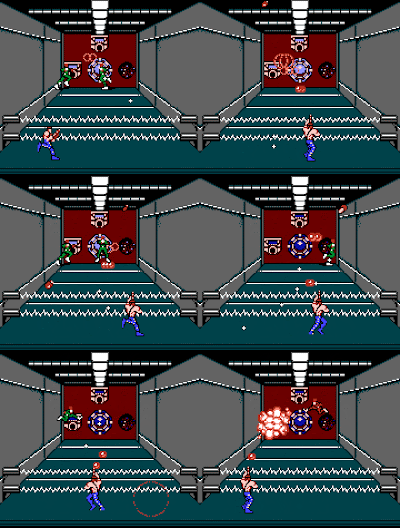
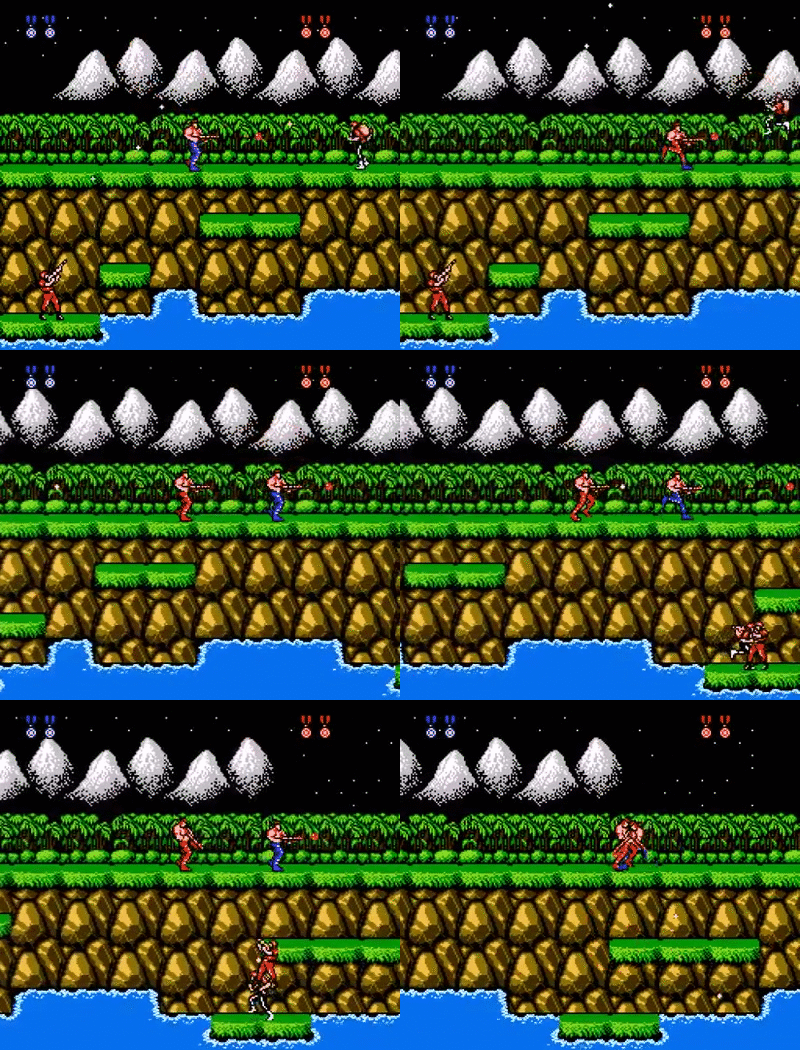
DeepSpace_SuperC.gif

Konami, Contra (1987)

Compare the images above of Stage 1: Jungle and Stage 2: Base 1 from Contra. I define the Jungle as a continuous 2-D game space with rectangular mapping and gravity downward. Base 1 is a continuous 3-D game space (also with gravity downward) in which the player navigates into the screen space rather than across the space. If not for the similarity of the main character sprites, these could be mistaken for two completely different games.

Digital games, like all digital media, are hybrid in nature. Various symbols appear on the screen, sometimes using different means of projection or perspective, yet the player views all the disparate objects as part of a cohesive whole. As we see, there may be a hybrid collection of gameworlds within the scope of a single game, requiring different rules of movement and interaction to successfully navigate those worlds. Yet, they are still part of a cohesive whole "overworld" of the entirety of the game.

Saturday, October 22, 2022

Terminology Analysis of Coming of Age in Second Life, part 2

Continued from part 1.

VIRTUAL: as used in the context of "virtual world."  

"Virtual" is a term too-often associated with virtual reality, specifically human interactions with a computer simulation through immersive interfaces like data gloves, motion trackers, and stereoscopic headsets. Like Boellstorff, I've encountered confusion from others when discussing virtual environments (even the name of this blog) that have nothing to do with VR goggles and other equipment. VR technology should be distinct from virtual worlds. Boellstorff calls for a "rehabilitation and refinement" of the term "virtual," and I agree. However, I have to differ with some of his reasoning.

No, not that type of virtual.
Photo: NASA, "The Virtual Interface Environment Workstation (VIEW)," 1990 (source)

There are several meanings for the word "virtual." Colloquially, it may be used to mean "almost" (as in, "this task is virtually impossible."). But, a virtual world is not "almost" a world - it is a world unto itself (Boellstorff makes this clear, as seen in part 1).

"Virtual" may be understood by what it is not. Where are you when you log off from Second Life? Residents call the world we physically inhabit as "Real Life," "First Life," "The Physical World," or "The Real World." These antonyms for a virtual world imply that technology makes a life less real. "Real" becomes a synonym for "offline."

But, as I hinted at in the previous post, the virtual is also "real." As Gilles Deleuze states, the opposite of the virtual is the "actual."

The virtual is opposed not to the real but to the actual. The virtual is fully real in so far as it is virtual... The virtual must be defined as strictly a part of the real object (Gilles Deleuze, Difference and Repetition, (trans. 1994), pg. 260).

Thus, the Actual World is defined as the place of human culture not realized by a computer. "Virtual" may connote approaching the "actual" without ever arriving there. As Boellstorf states, without this gap, there is no distinguishing "online" from "offline." In this contrast with the actual, the "almost" meaning of the world virtual has some significance for these purposes. I agree and prefer to use "actual" instead of "real" and also was inspired by Deleuze in this regard, but is not really helpful here.

Deleuze, inspired by Bergson, wrote of a metaphysical virtuality unlike what we deal with in digital media. Instead, virtuality is a part of reality that generates the actual (real, extended objects... what we may think of as our present reality). The virtual actually exists contemporaneously with, but is different from, the actual. Taking Bergson's vision of how memory works, recollecting some past event means to look back at a layer of this totality of the past, this virtuality. In its totality, this past (virtuality) has led to (actualized into) what is now. It cannot be said that the past and present are separated (they are contemporaneous). Both past and present are real, yet they are also separate (virtual vs. actual).

The above is my understanding of Deleuze's work, which doesn't seem very applicable to our notion of virtual worlds.

Thursday, October 20, 2022

Terminology Analysis of Coming of Age in Second Life, part 1

Tom Boellstorff, Coming of Age in Second Life (2008) 

Tom Boellstorff's Coming of Age in Second Life is an anthropologist's ethnographic look at the culture of the then-new Second Life (SL) virtual world. His study was novel for the fact that he performed all of his research within SL as a participatory observer and fellow resident (term for an SL user) of a virtual world. He tried to focus on his research subjects as they are presented solely within the context of the digital space of SL, without regard for the living, breathing, fleshy users behind each of those residents.

Boellstorff began his work relatively early in the field of Game Studies, a term that only came into prominence around 2001. How does one even find the words to discuss new concepts that arise from embodying a digitally-created environment such as SL? I've struggled with finding terminology that fits my own studies, as there still isn't a consensus on how we talk about what a virtual space is or how we even come to think of ourselves as being in a computer-simulated space in the first place. I found that his established vocabulary closely matched the one that I've used in my own research.

VIRTUAL WORLD: "Any computer-generated physical space... that can be experienced by many people at once." (Edward Castronovo, Synthetic Worlds: The Business and Culture of Online Games, (2005), pg. 22)

From Castronovo's definition, we understand that virtual worlds are:

  1. Places
  2. Inhabited by persons
  3. enabled by online technologies
"Virtual world" forms the crux of Boellstorff's book in that something like Second Life is a world in some sense, however virtual. It is a world that may be studied by analyzing how its inhabitants ("residents") create a culture through their adaptation to this digital environment (he clarifies that it is a "culture in a virtual world" as opposed to a "virtual culture").

[Update 23 Nov 2022]
Narcis Parés and Roc Parés wrote "Towards a Model for a Virtual Reality Experience: The Virtual Subjectiveness" (2006) for the journal Presence: Teleoperators and Virtual Environments. In the article, the researchers attempt to define a CHI (Computer-Human Interaction) model, one that expresses the relationship between user and VR experience, to use as a guide for "designers, scientists, and developers involved in VR" (pg. 524). They sought to clarify terminology used for digital worlds that are generated by computer after seeing the confusion caused by a multitude of similar terms ("VE, VR, telepresence, cyberspace, etc." (pg. 527)) used in the field.

VIRTUAL ENVIRONMENT: is the "model" of the digital space. It is the static definition of, say, a digital game level's structures, parameters, and functions. Think of this as all the information for a game level as it is saved to disk, ready to be loaded and put into action. It is Castronovo's "place," though not necessarily inhabited by persons.

A virtual environment (VE) is comprised of three types of components, as defined in the earlier article, "Nature and Origins of Virtual Environments: A Bibliographical Essay" (1991), by Stephen Ellis:

CONTENT: "The objects and actors in the environment" (1991 pg. 322). Each object may be described by state vectors (the object's properties) that identify that object's position, orientation, velocity, and acceleration (where is the object, which way is it facing, and how is it moving?) and other characteristics, like color, texture, and energy (the use of "energy" is not thoroughly described). An actor is a type of object that has certain capacities to initiate interactions with other objects. The self is a distinct actor which provides a point of view for observing the environment (or, more precisely, the point of view from which the environment may be constructed), what we think of as the player avatar (though, from a first-person point of view, there often is no visual "avatar" object to be seen). This methodology continues today, as shown in modern game engines like Unity and Unreal.

GEOMETRY: "A description of an environmental field of action. It has dimensionality, metrics, and extent" (1991 pg. 322). This is the "environmental space" in which all the game objects are positioned. In the game industry, we used to use the word "geometry" for all of the static 3-D objects that define the player's navigable environment (ground plane, walls, buildings, ceilings, etc.). We sometimes erroneously called this the "background," a term that shows its roots in 2-D game production. Here, Ellis defines geometry as the entire area, measured by Cartesian coordinates, within which a virtual environment may exist, the tabula rasa upon which a game world is defined.

DYNAMICS: "The rules of interaction" among an environment's contents, "describing their behavior as they exchange energy or information" (1991 pg. 322). A physics system  that simulates Newtonian dynamics, applying a constant pull of gravity on content in the environment, would be an example of dynamics.

VIRTUAL REALITY: is "the structures of virtual environment put into action" (2006 pg. 528, emphasis in original). This is the user-centric, real-time experience of a VE. For example, a video game level, loaded into the game engine, and being simulated and evolving over time as the player perceives and interacts with it is considered to be virtual reality (VR).

I find that VR is too loaded of a term to use in this general manner. The researchers specifically don't want to "restrict VR to 3D experiences and... [include] important 2D VR work" (2006 pg. 528), but VR is so much in the public consciousness as something inherently tied to immersive technologies, especially head-mounted stereoscopic display interfaces, as I wrote about elsewhere.

[End Update 23 Nov 2022]

No-one is born a "digital native;" we are all immigrants when we join virtual worlds. As he states, the very notions of selfhood, community, and human nature are not just simulated our recreated from our "actual" world - they are remade and reconfigured new in a virtual world (though his own research shows that residents bring many of their prejudices and worldviews along with them). The virtual world sociality develops on its own terms. Thus, he set out to study that world on its own terms, as a standalone world without a necessary connection to life beyond the screen (note that this goal was somewhat undermined by his subjects often bringing up "real life" (RL) concerns from outside SL during the study).

Boellstorff treats the terms "virtual," "cyber," and "online" as roughly equivalent. He also sees "cybersociality" and "online culture" as terms that are interchangeable with "virtual world."

There is myriad of terms that Boellstorff specifically avoids using:
[Update 23 Nov 2022]
Adding some additional terms not mentioned by Boellstorff:

[End Update 23 Nov 2022]

[Update 29 Nov 2022]

[End Update 29 Nov 2022]

"Synthetic," "artificial," and "mirror" descriptors point to an inauthenticity or unreality of virtual worlds. However, the "virtual" is not the opposite of the "real." You still have a "real" meeting when you meet with co-workers through video conferencing software like Zoom or Skype. You are still "really" playing with others in an online video game. A virtual world is, in some sense, "real" and it is authentic to itself.

"Digital" refers to a world of electronic technology, which sounds a lot like modern everyday existence anyway. 

"Persistent" seems to imply a digital environment that continues functioning even when you are not there (as opposed to single-player video games that only instantiate around the main player character while they play).

"Possible" refers to Liebnizian concept as it is used to construct a model of semantics, more to do with narratology than ludology.

At this point in time, the less said about "Metaverse," the better.

I will further analyze just what Boellstorff means by "virtual" and "world" in another post. Although I agree strongly with his end definitions, I don't always agree with his means of reaching those definitions.

Spatial Models: Discrete vs. Continuous

Taxonomy of Virtual Spaces Wardrip-Fruin, Noah. (2020).   How Pac-Man Eats . Cambridge, Massachusetts: The MIT Press. Today, I return to the...