Showing posts with label genres. Show all posts

Thursday, July 24, 2025

Game Genres, pt. 16: Facet Analysis of Video Game Genres

Taxonomy of Virtual Spaces

This is a continuation of my long-running series examining game spatiality systems that may be related to but are distinctly different from game genres.

Today's post returns to actual game genres with a look at "Facet Analysis of Video Game Genres," a thorough study of different systems found on game websites and in scholarly publications that are used to categorize digital games by genre. This may include gameplay genres (platformer, racing game, shooter) and thematic genres (fantasy, crime, food). This informed the researchers' work to recategorize the various systems into one overarching system of game genres defined by 12 different facets.

"Facet Analysis of Video Game Genres" by Jin Ha Lee, Natascha Karlova, Rachel Ivy Clarke, Katherine Thornton, and Andrew Perti (2014)

The study was performed mostly by researchers at the University of Washington's GAMER Game Research Group and presented as part of the University of Illinois Urbana-Champaign's iConference 2014. GAMER was formerly the GAme MEtadata Research Group, and supporting researchers and archivists with tools for cataloguing and organizing digital games as cultural artifacts is one of the group's primary goals.


Facets and Foci

The thorough system outlined in the paper is based around 12 different facets or aspects by which one can differentiate a game. Within each facet, a game may fall under one or more foci that accurately describe the game:

Table 1: Video Game Genre Facets with Examples of Genre Labels Representing Each Facet


The above table, adapted from the paper, shows only a handful of possible examples of foci defined in this system. The facet of Style alone has 100 different variations. This is a robust system for defining and categorizing all manner of digital games with a singular system. Additionally, game can easily be organized using only the facets that a researcher is most interested in.

For my research, how well does this system categorize the spatial aesthetic qualities of digital games?


Facet Analysis and Spatiality

The concept of spatiality was not a primary concern for the GAMER Group researchers. Their work is based on existing methods for categorizing game genres, which do not tend to focus on spatiality. However, the facet of Presentation encompasses some of the graphic techniques used to project a virtual space to the screen and provides the best comparison.

Presentation and its related foci are described in the paper exactly as follows:

Presentation is defined as “the manner or style of game display” containing the following ten foci:
  • 2D: Representation of space in two dimensions. (e.g., A Boy and His Blob, Odin Sphere)
  • 3D: Representation of space in three dimensions. (e.g., God of War, Uncharted)
  • Isometric: Games that use isometric projection to render three-dimensional objects in two dimensions. (e.g., Final Fantasy Tactics, Age of Empires)
  • Static background: Games with a background display that does not move or change. (e.g., Peggle, Princess Maker)
  • Vertical scrolling: Games with a display that scrolls vertically where characters typically move from bottom to top. (e.g., 1942, Raiden)
  • Side scrolling: Games with a display that scrolls horizontally where characters typically move from left to right. (e.g., Muramasa, Castlevania: Symphony of the Night)
  • Grid-based: Games featuring a display that is made up of a series of intersecting vertical and horizontal axes. (e.g., Bejeweled, Tetris)
  • Video backdrop: Games based on interacting with a motion-video backdrop, either as scenery or an enemy (modified from mobygames.com). (e.g., Area 51, EyeToy Groove)
  • Text-based: Games that use text as the main display method.
  • Perspective manipulation: Games where characters are able to switch between multiple display methods (e.g., 2D to 3D or vice versa). (e.g., Super Paper Mario, Perspective)
Defining this facet presented another challenge: what is the nature of the relationship between the Presentation and Artistic style (see below) facets? After lengthy discussion and examination of extant terms and screenshots of game displays, we determined that it would be useful to separate the technical aspects from the artistic or aesthetic aspects of game display. Thus two different facets in our scheme describe the visual aspects of video games.

This is a mix of terms that can describe the spatiality of the gameworld (2D, 3D), frame mobility (scrolling, static background), and even a non-project method of spatiality (text-based). I'll show how each focus aligns with terminology in my taxonomy.

Comparing Presentation to Taxonomy of Virtual Spaces

  • 2D: Aligns with Gameworld Spatiality: Continuous, 2-D. There is not delineation in the Facet Analysis system between continuous and discrete (individual nodes in a network, like a chessboard) spatiality.
  • 3D: Aligns with Gameworld Spatiality: Continuous, 3-D
  • Isometric: The researchers' definition of this term, according to what is in the paper, is unclear. The examples given above (Final Fantasy Tactics, Age of Empires) are generally described as "isometric" (what my Taxonomy defines as an Axonometric Projection (further defined as dimetric in these cases)). However, the paper also refers to Mortal Kombat 3 as "isometric." Do the researchers define any 3-D objects rendered in a 2-D gameworld as "isometric?" In the case of MK3, the characters are based on photographs, the environment is rendered in 1-point perspective, and the background is multiple flat layers rendered in parallax to give an impression of depth. 
  • Static Background: Aligns with Frame Mobility: Fixed.
  • Vertical Scrolling: Aligns with Frame Mobility: Non-Fixed, Smooth-Scroll, Vertical Axis. There is no delineation between normal scrolling (like Ikari Warriors) and Auto-Scrolling (like Raiden).
  • Horizontal Scrolling: Aligns with Frame Mobility: Non-Fixed, Smooth-Scroll, Horizontal Axis.
  • Grid-Based: No real equivalency. 
  • Video Backdrop: No real equivalency. Defined with the Taxonomy by the projection method used in the video backdrop.
  • Text-Based: Aligns with the Non-Projection Method: Text Description.
  • Perspective Manipulation: Such games are defined by the different possible perspectives as options in my Taxonomy.


Comparing Artistic Style to Taxonomy of Virtual Spaces

    The Artistic Style facet compare the graphics used in a game to other forms of visual media (like manga or watercolors) and most don't really align with the concept of spatiality. The Artistic Style focus of Abstract would seem to align with my Taxonomy Non-Projection Method: Ambiguous, but the two concepts are different.

    The Abstract examples include Lumines and Dyad. While both games may commonly be referred to as "abstract," everything in the game is strictly representational. A square of light in Lumines is still recognizable as a square of light that aligns to the game's 2-D plane. A spinning cylinder of fog in Dyad is still recognizable as a cylinder rendered in a 3-D perspective. These may not represent anything found in the real world, but they are unambiguous and project specific objects that exist in the space of the gameworld.

    Ambiguous means that part of the game image is strictly non-representational: the player is not supposed to have a clear sense of space in this case. An example that I've referred to before is in the battle screens of Earthbound.


    EarthBound (Ape Inc., 1995 (originally Mother 2 in Japan, 1994))

    The background is completely ambigous: an ever-morphing, undulating fog of squiggly shapes with no sense of space. The Starman Jr. enemy is clearly rendered and represented, but the player has no sense of where they are in the gameworld. We don't know how far that "fog" goes behind the enemy, or if this is all just an effect meant to convey the mind-altering aspects of psychic combat. It is left as a mystery, which makes it ambiguous.




    Friday, July 4, 2025

    (Not) Game Genres, pt. 15: Graphical/Spatial Game Characteristics from Understanding Video Games

    Taxonomy of Virtual Spaces

    This is a continuation of my long-running series examining game spatiality systems that may be related to but are distinctly different from game genres.

    This post covers the system of graphical/spatial game characteristics defining the geography and representation in a gamespace presented in the book Understanding Video Games.

    Understanding Video Games, 4th edition (Egenfeldt-Nielsen, Smith, and Tosca, 2020)

    The authors of this text are Simon Egenfeldt-Nielsen (CEO of Serious Games Interactive and dibl), Jonas Heide Smith (head of digital communication at the Statens Museum for Kunst), and Susana Pajares Tosca (Associate Professor and co-founder of Game Studies journal). The book is intended as a textbook to introduce students to game studies and the concepts of of analyzing game history, game aesthetics, games as culture, games as narrative, and serious games.


    Video Game Aesthetics

    The chapter on video game aesthetics opens by exploring the concept of a gamespace, defined as "the entire space (or world, or universe) presented by a game." This is similar to my definition of a gameworld, although a game may contain numerous gameworlds which may have different visuo-spatial configurations (see my link for an example of different gameworlds in Contra).

    A gamespace is defined in part by its physical laws (pg. 126) (what I've described as the underlying dynamics that determine the rules of action of a virtual environment), perspective (how the player perceives the gamespace), dimensions (2-D or 3-D), space type (what I call gameworld topology), off-screen space (can off-screen elements affect the on-screen player?), scroll (what I call frame mobility), and exploration (can player explore gamespace at their own pace?).


    Graphical/Spatial Game Characteristics 

    Basic Graphical/Spatial Game Characteristics (adapted from pg. 131)
    According to the authors, aspects of gameworlds, except for physical laws, may be defined using the graphical/spatial game characteristics in the chart above. The following compares this system to my own Taxonomy of Virtual Spaces.

    • Perspective (1st person/3rd person) - My work does not focus on a game's ocularization. This section does refer to "isometric perspective" and describes "top-down perspective" and "bird's-eye perspective" as the same thing (pg. 131). My own work uses Projection Angles and defines a top-down camera angle as about 60° and bird's-eye camera angle as 90° (keeping in line with the Game FAVR system). I find estimated camera angles are less ambiguous than terms like "top-down."
    • Dimensions (two/three) - The authors account for 3-D gamespaces that are "faked" with 2-D methods. Examples include Wolfenstein 3D with its 3-D world populated by 2-D sprite enemies, Sim City 2000 creating a sense of depth with isometric projection, and Moon Patrol using parallax scrolling to create a sense of a deep and distant background behind the gameplay. My system differentiates continuous spatial systems (of two or three dimensions) and discrete spaces of nodal networks (like a game of chess).
    • Space Type (torus/abstract/free) - This aligns with what I call gameworld topology. The authors use Torus to describe both topologies that I define as toroidal and cylindrical (games with wraparound screens). It is unclear what is meant by Abstract and Free in the chart above, as these terms do not seem to be extrapolated on in the book's text. In fact, it describes torus space as "abstract" (pg. 136). The text does describe different types of multiscreen games (going beyond early single-screen games like Pong), mirroring my characteristics of Frame Mobility that define the Framing Device. Unconnected Levels include games where new game screens are not necessarily connected to the previous screen, like Bomb Jack and Pac-Man. I define these as Fixed Frame or single-screen games. I argue that games like Donkey Kong imply that the game levels are connected as a single building that Mario must climb (Donkey Kong is seen climbing out of the screen to the next level). Zone-Based Multiscreen Spaces fall under what I call Discrete (or Page Flip) Frame Mobility. This includes games like Atari's Adventure. Seamless Multiscreen Spaces fall under what I call Smooth Scroll Frame Mobility.
    • Off-Screen Space (Dynamic/Static/None) - None would include single-screen games with no off-screen space. Static means that off-screen space is "passive" and cannot affect the player. Dynamic means that off-screen space is "active" and can affect the player, such as in a strategy game with fog of war.
    • Scroll (Vertical/Horizontal/Free/None) - The text claims that "horizontal scroll was common in many arcade games of the 1970s and 1980s" (pg. 139). I'd argue that horizontal scrolling was extremely rare in the 1970s, with few examples like Sega's Bomber (1977). The text does not offer any examples games that date from the 1970s. The characteristics for this category are similar to my terms defining Frame Mobility Direction of the Framing Device. Vertical and Horizontal match my characteristics of the same names. Free is what I call Any Direction. None matches what I call Fixed Frame.
    • Exploration (Forced/Free/None) - This is a concept I don't specifically explore in my taxonomy. My concept of auto-scroll frame mobility is an example of Forced Exploration, but so is any game level with a time limit.


    Conclusion

    I should add this system to my post about Comparing Visuospatial Configurations and Terminologies. The system expressed here covers much of the same ground as the Evolution of Spatial Configurations in Video Games by Clara Fernández-Vara, José Pablo Zagal, and Michael Mateas (the same system that I analyzed earlier in this series). The authors of this book chose terminology that is generally more common than the terms used in the earlier Evolution of Spatial Configurations system (gamespace instead of gameworld, dimensions instead of spatial representation, scroll instead of spatial configuration). The book cites other works by Fernández-Vara in the bibliography, but not this paper.

    I am surprised by the aforementioned errors found in the book (horizontal scrolling common in the 1970s, no explanation of abstract and free space types), especially since I have the 4th edition of this book. However, my biggest issue with this system is that it cannot easily account for the inherently hybrid nature of digital games. There is mention of "faked" 3-D gamespaces inhabited by 2-D characters, but no accounting for a gamespace that features multiple different types of visuo-spatial configurations in one game (like my example from Contra). I don't know what they'd do with a game like Wario Ware.

    Wednesday, May 10, 2023

    Game Genres, pt. 8: Turn-Based Strategy and Game Studies

    Continuing my previous work on game genres and not game genres...


    Media/Culture Journal founder Nicholas Caldwell came to game studies from film studies and soon realized that our field lacks a vocabulary for discussing the formal qualities of digital games. "Where was the grammar of the game?," he asked. Like other game studies scholars, he expressed frustration at not having a common language to discuss core aspects of a game's aesthetics.

    In his "Theoretical Frameworks..." paper, linked above, he documented his attempts to introduce a framework for a specific type of game: turn-based computer strategy games. He chose this type due to his familiarity with them and the relative homogeneity in representational and temporal approaches in them. The exemplar game of his analysis is Civilization II (1996).

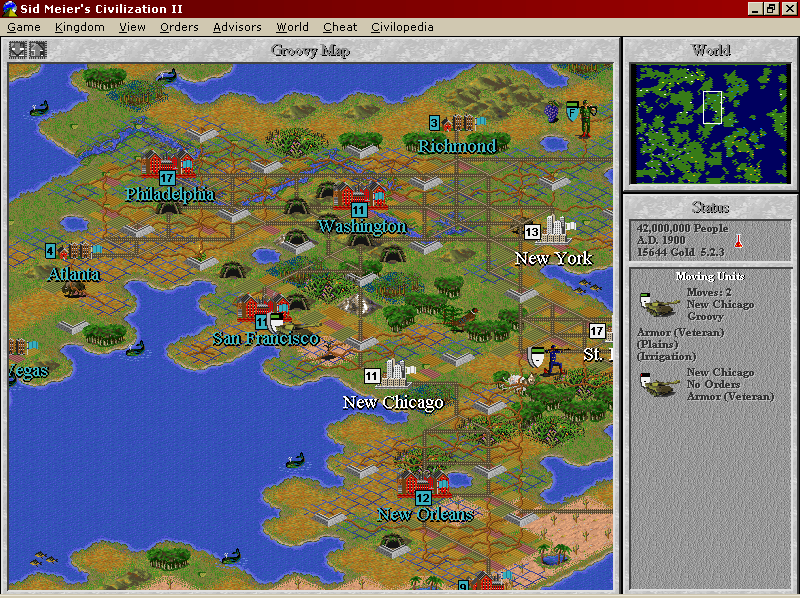
    Civilization II (MicroProse, 1996, Windows 3.1) screen shot

    Caldwell adopts a semiotic approach to analyzing a game's visuals, using Charles Peirce's typology of signs, as processed by Stephen Poole in Trigger Happy: The Inner Life of Video Games (2000). Caldwell attempts to describe the Civ II screen, like the one above, using his terminology for the formal characteristics of the symbolic visual display. However, his chosen terms immediately come in conflict with my own terminology and other standards for game graphics terminology, such as the University of Montreal's Game FAVR system ("Game FAVR: A Framework for the Analysis of Visual Representation in Video Games," Arsenault, Côté, & Larochelle, 2015), which I have written about before.
    The screen space is dominated by the main map window, which displays (with  a  term borrowed from architectural drawing) an isometric view of the game space, which is a forced perspective rendering of the elements of the map, giving the illusion of depth to the image.
    The main map window uses a dimetric projection using a 2:1 grid line ratio ("isometric" in gamer vernacular, this is the same method used since Zaxxon and Q*bert, and at least one artist calls it "pixel isometric." But formally, this is a dimetric view. Newer games like Monument Valley are truly isometric, but it is a difficult projection for older games like Civ II). This game space uses projection, not perspective, and there is little or no illusion of depth in the image. The illusion of depth would require perspectival clues like convergence, vanishing points, and size difference as objects get further from the game camera. Other minor techniques can give an illusion of depth, such as parallax motion, aerial diffusion, tonal separation, textural (detail) difference, but none of these are in Civ II (I adopt the Visual Story teachings of Bruce Block, who I studied under, to digital game visuals). The only depth cue is the fact that some game elements overlap other game elements, implying they are "closer" to the viewer.

    Such a projection does not imply a single, favored, subjective viewpoint as there is no perspectival organization of space from which a virtual camera may be assumed to observe the game environment. All game objects are presented equally, all being about the same size on the screen.
    Unit icons (hereafter referred to as ‘sprites’ — a term in game design used to refer to any animated element on a computer screen)...
    The term sprite has been used in a number of ways in game development, but it typically refers to a two-dimensional game object, which typically uses a bitmapped graphic, that can move across the game environment. Sprites may or may not be animated. This is in contrast with environmental objects that do not move and often take the form of tiles, though tiles also may or may not be animated.

    Caldwell continues to analyze Civ II and its foundations in the philosophy of Cartesian Perspectivalism. This has little to do with the visual presentation of game space and everything to do with the player as a postmodern, rational, disembodied subject whose very gaze organizes and controls the world within its focus. He adopts Foucault's metaphor of the panopticon as the game's mechanics are based on supervision and surveillance, as supported by the technology of the interface.

    Caldwell never gets the chance to analyze the temporal organization of games like Civ II, something he regrets at the end of the paper. So far, I haven't been able to find a follow-up article written by him that continues this analysis. 

    Monday, March 20, 2023

    Winter 2023 Research Review and Spring 2023 Plans

     Winter 2023 Review

    Preliminary cluster diagram of coding similarity, "Video Game Space and Motion" (Rowe, unpublished)

    Spring 2023 Plans

    My theory posits that a distinct way that humans experience digital games as aesthetic objects is through the embodied, "cyberkinaesthetic" experience of navigating virtual spaces.

    The visuo-spatial configuration of a virtual space is the geometry of that space (defined by dimensionality, metrics, and extents), and the methods used to project that space onto the screen (or pair of screens, for binocular vision) of the game apparatus that serves as interface with the player.

    A player has certain affordances within the game's field of action allowing them to take actions with other actors and navigate within virtual space. These affordances are moderated by the dynamics that determine the rules of interaction within the virtual space.

    A game's spatial paradigm is defined by both the visuo-spatial configuration of its virtual space and the player's affordances for navigating that space.

    I will be pushing my research toward defining specific spatial paradigms in my existing body of data.

    • Fine-tune Taxonomy of Virtual Spaces based on analysis of what attributes should be included or removed in order to be informative for my research. Make edits to Taxonomy document to match.
    • Complete existing qualitative analysis of game spaces for a broader selection of digital game titles using Taxonomy of Virtual Spaces.
    • Analyze player navigation in the above games and develop system for codifying the results.
    • Use statistical analysis to find patterns of similarity that signify Spatial Paradigms, Spatial Refinement, and Paradigm Shifts.


    Sunday, March 19, 2023

    (Not) Game Genres, pt. 6: Wolf's Elementary Spatial Structures of Video Games (part one)

    In my last post, I analyzed a system of video game genres developed by game scholar Mark J. P. Wolf and published in his book, The Medium of the Video Game (2001). This time, I am switching to the topic of spatiality, a chapter subject that Wolf included in The Medium of the Video Game, but was previously published as the article "Inventing Space: Toward a Taxonomy of On- and Off-Screen Space in Video Games" published years earlier in Film Quarterly (Fall 1997, vol. 51, no. 1).

    Film Quarterly (Fall 1997, vol. 51, no. 1)

    This means that 25+ years ago, Wolf devised a taxonomy of digital game spatiality, much the same as my current research. I previously analyzed Wolf's taxonomy in my own unpublished essay, "A Taxonomy of Virtual Spaces" (Rowe, 2021). Our works don't completely agree, but certainly applaud his early stabs in the dark at defining something so nebulous and undefined as game spaces.

    He based his analysis of the spatial structures of digital games on his background of film and television theory, but made a prescient call that "video games are certainly deserving of their own branch of theory" (Wolf, 1997). Within a few years of that quote, game studies (or ludology) started to be recognized as an academic study and the first journals dedicated to the subject started to be published.

    Wolf felt that video game theory would likely be "in close kinship to film and television theory" (1997), and much of early game studies reflects this notion. When he first published the essay, many game developers sought to converge digital games with cinema. 1997 was in the midst of the "Silliwood" (Silicon Valley/Hollywood) era when studios invested heavily in making "interactive movies" using full motion video (FMV) of live action actors mixed with digital elements. The fad boomed with the proliferation of CD-ROM drives, but most FMV games simply weren't very good. It isn't easy to create a dynamic and interactive world from pre-recorded film clips and many of these games were sold more for spectacle and star appeal than for substance. [As a personal aside, I got my start in the industry in 1996 as a tester for Voyeur II by Interweave Entertainment and later worked for DreamWorks Interactive, publisher of games like Steven Spielberg's Director's Chair. So, my game design career is a product of this Silliwood era.]

    Inside Adventure's Blue Labyrinth and Black Castle image from "Space in the Video Game" (The Medium of the Video Game, Wolf, 2001)

    As Wolf's essay title alludes, he was interested in how games create a sense of space, both on and off the screen, to create a sense of a cohesive world. He notes how, in games, these connections between spaces may create impossible, non-Euclidean worlds that cannot exactly be mapped on a rectangular topology (such as the example of Atari's Adventure, shown in the image above from Wolf's revised 2001 version of the essay, where screens have impossible connections to one another and an entire multi-screen labyrinth is "inside" of a smaller castle object). He likens these spaces to similar "impossible" spaces in film and television, the the TARDIS from Doctor Who

    Wolf's 11 Elementary Spatial Structures of Video Games

    1. No visual space; all text-based
    2. One screen, contained
    3. One screen, contained, with wraparound
    4. Scrolling on one axis
    5. Scrolling on two axes
    6. Adjacent spaces displayed one at a time
    7. Layers of independently moving planes (multiple scrolling backgrounds)
    8. Spaces allowing z-axis movement into and out of the frame
    9. Multiple, nonadjacent spaces displayed on-screen simultaneously
    10. Interactive three-dimensional environment
    11. Represented or “mapped” spaces

    I'll go into more details on Wolf's spatial structures and compare them to my own spatial topology in the next post.

    Thursday, March 16, 2023

    Game Genres, pt. 5: Mark J. P. Wolf's Interactive Genres for Classifying Video Games

    Previously, I reviewed early game genres as developed through the lenses of marketplace leaders, an expert player, and a professional game developer. This set of game genres was developed by an academic, Mark J. P. Wolf. Wolf was one of the earliest scholars in the field of game studies and has written and published 23 books, mostly on the subject of digital games.

    The Medium of the Video Game, Wolf (2001)

    Wolf's The Medium of the Video Game (2001) includes the chapter "Genre and the Video Game" where he outlines what he sees as the core categorizations for digital games.

    Wolf takes guidance from Ed Buscombe's essay "The Idea of Genre in the American Cinema" in that genre elements may appear in a film's iconography, structure, and theme. Iconographic genres like "Western" and "science fiction" (what I previously referred to as milieu) may work for narrative games, especially those inspired by cinematic tropes, it doesn't really work for nonnarrative and abstract games. Additionally, two different games in the same iconographic genre or theme may be very different experiences for the player. Wolf moves away from these cinematic concepts of film genre by focusing on the classifications of interactivity seen in digital games.

    Wolf notes that games may best fit into multiple genres (Pac-Man is primarily a "Collecting" game, as the player's primary objective is to eat all of the dots on the screen. Secondarily, it also falls under the "Escape" and "Maze" genres).

    • Abstract - Arkanoid, Breakout, Q*bert, Tempest (with Shoot 'Em Up), Tetris (with Puzzle)
    • Adaptation - Games that are adapted from card games (Casino), cartoons (The Simpsons), comic books (X-Men), film (Star Wars), sports (Atari Football), etc.
    • Adventure - Games set in a freely explorable "world" usually made up of multiple, connected rooms or screens, involving an objective more complex that catching, shooting, capturing, or escaping. Adventure, Tomb Raider, Venture.
    • Artificial Life - Games involving the growth or maintenance of digital creatures. The Little Computer People, The Sims (with Management Simulation).
    • Board Games - Board game adaptations and digital games that play like board games. Culdcept, Monopoly, Quest for the Rings.
    • Capturing - Capture objects or characters that move away from and evade the player character. Keystone Kapers, Surround (with Escape).
    • Card Games - Card game adaptations and digital games that play like card games. SolitaireUno, Casino (with Gambling).
    • Catching - Catch objects or characters that do not move away from or evade the player character. Stampede, Circus Atari, Kaboom!
    • Chase - "See Catching, Capturing, Driving, Escape, Flying, and Racing."
    • Collecting - Collect objects that do not move. Pac-Man (with Maze and Escape), Amidar (with Abstract).
    • Combat - One vs. one shooting challenge. Combat, Outlaw.
    • Demo - Demonstrate games or system.
    • Diagnostic - Test the functioning of a system.
    • Dodging - Avoid projectiles. Frogger (with Obstacle Course), Journey Escape.
    • Driving - Night Driver, Pole Position.
    • Educational - Games designed to teach. Basic Math, Mario Teaches Typing.
    • Escape - Escape pursuers or get of of an enclosure. Pac-Man (with Collecting and Maze), Surround (with Capturing).
    • Fighting - One on one fighting without the use of firearms. Boxing (with Sports), Mortal Kombat, Tekken.
    • Flying - Flying games where shooting an opponent is not the main objective. Flight Unlimited (with Training Simulation), Solaris. 
    • Gambling - Slot Machine, You Don't Know Jack (with Quiz).
    • Interactive Movie - Dragon's Lair, Space Ace.
    • Management Simulation - Aerobiz, M.U.L.E.
    • Maze - Dig Dug, Lode Runner, Tunnel Runner.
    • Obstacle Course - Frogger (with Dodging), Pitfall!, Jungle Hunt.
    • Pencil-and-Paper Games - 3-D Tic-Tac-Toe, Noughts and Crosses, Hangman.
    • Pinball - Pachinko!, Sonic Spinball, Video Pinball.
    • Platform - Crazy Climber, Donkey Kong, Lode Runner (with Maze).
    • Programming Games - Player writes short programs to control an agent in the game. Omega, CRobots.
    • Puzzle - Tetris (with Abstract), 7th Guest, Myst (with Adventure).
    • Quiz - Fax, You Don't Know Jack (with Gambling), Trivial Pursuit (with Adaptation).
    • Racing - Win a race or cover more ground than an opponent. Mario Kart 64 (with Driving), Slot Racers (with Dodging).
    • Rhythm and Dance - Keep time with a musical rhythm. Beatmania, PaRappa the Rapper, Samba de Amigo, Space Channel 5.
    • Role-Playing - Diablo, Phantasy Star, Ultima, Interstate '76.
    • Shoot ’Em Up - Shoot at and destroy a series of opponents or objects. Asteroids, Berzerk, Galaga, Zaxxon, Missile Command.
    • Simulation - "See Management Simulation and Training Simulation"
    • Sports - Atari Baseball, Bowling, Fishing Derby (with Catching), Pong (with Table-Top Games), Sky Diver.
    • Strategy - Ataxx (with Abstract), Chess (with Board Games), M.U.L.E. (with Management Simulation).
    • Table-Top Games - Table-top games that require physical skill or action. Battle Ping Pong, Electronic Table Soccer!, Pocket Billiards!, Pong (with Sports), Virtual Pool.
    • Target - Primarily aim and shoot at targets that are not in motion. Air-Sea Battle, Carnival, Shooting Gallery.
    • Text Adventure - Planetfall, Zork.
    • Training Simulation - Games that simulate a realistic situation for the purpose of training and usually the development of a physical skill (such as driving or piloting). Comanche 3 (with Flying), Flight Unlimited (with Flying), Police Trainer.
    • Utility - Have a purpose beyond that of entertainment, although they may be structured similarly to games. Basic Programming, Diagnostic Cartridge (with Diagnostic), Infogenius French Language Translator, Sped Reading.
    This is a highly detailed system of genre classification. I see the usefulness of classifying games by a core game mechanic (like Capturing, Escaping, or Target), but some categories are non-games (Utility and Diagnostic), confusing (I would expect Table-Top Games to be board, card, and role-playing games), or questionably applied (in what way is Q*bert abstract?).

    Looking closer at Wolf's definition of "Abstract" games, he describes them as having "nonrepresentational graphics" and often a non-narrative objective, which may involve "visiting, filling" or "destroying the screen," though they may have characters that are "anthropomorphic in design" (2001, pg. 117). Wolf's non-narrative objective aspect puts his definition in line with "abstract strategy" board games and puzzles, such as chess, checkers, Othello, and peg solitaire. However, he specifically does not include digital versions of such board games in this genre.

    My problem is that almost all of Wolf's "Abstract" examples (Arkanoid, Amidar, Ataxx, Block Out, Breakout, Marble Madness, Pac-Man, Pipe Dream, Q*bert, and Tetris) use representational graphics. Ataxx and Pipe Dream play like abstract strategy board games, which he would exclude from the genre if they were adaptations. Arkanoid, Block Out, Breakout, and Tetris all feature shapes that are more than abstract geometric forms (the shapes are meant to represent bricks and blocks). Amidar, Marble Madness, Pac-Man, and Q*bert all feature cartoonish characters existing in representational, if sometimes impossible, spatial structures (Q*bert is no more abstract than the famous works by M. C. Escher).

    Some of his examples arguably have abstract elements. Tempest's high-speed, neon world of geometric shapes in conflict is akin an electronic edition of Lissitsky's Suprematist Bolshevik propaganda works like Beat the Whites with the Red Wedge (1919). [Side note: for a true digital game version of Suprematist works, you must play Chris Totten's Lissitsky's Revenge (2015).] In both cases, the shapes are more symbolic than abstract.

    Qix (Atari, 1982, arcade game)

    Qix is one case of a game with a truly abstract element: the titular Qix, a shapeless series of rainbow-colored lines that undulate around the environment and threaten the tiny, diamond-shaped player avatar. Where Tempest's lines create identifiable and distinct shapes (bow tie-shaped "flippers," the staple-shaped "blaster" player avatar), the Qix has no specific form. It is an unpredictable, chaotic force that the player must work to contain and control as they claim the game's territory by drawing walls on the screen.

    EarthBound (Ape Inc., 1995 (originally Mother 2 in Japan, 1994))

    A good example of what I'd consider abstraction in digital games is seen in battle sequences in the Super NES game EarthBound (see image above). Most of the game world is presented with typical CRPG spatial structures (with some brilliantly unexpected breaks in reality, as I've written about before). When a battle starts, the environment is replaced with a truly abstract background comprised of multiple colored, morphic shapes layered on top of each other. This puts the scene in ambiguous space, a term I adapted after attending Bruce Block's lectures on cinematic production, which he later collected in The Visual Story (2013). The subject of the scene (the Starman Jr. enemy) is clearly represented but its location in the world is unspecific, non-representational, and non-symbolic (in other words, abstracted). Wolf did not use EarthBound as an example of an abstract game in this essay.


    Next, I'll review Mark J. P. Wolf's classification of game spaces, something much more applicable to my own research.


    Tuesday, March 7, 2023

    Game Genres, pt. 4: Chris Crawford's Taxonomy of Games (1984)

    Continued from part three.

    The first two genre systems I analyzed were developed by manufacturers for purposes of marketing and informing consumers. The third genre system was developed by an expert player based on experiential analysis of each game. This fourth genre system is the first (that I know of) developed by a game designer and programmer, someone who understands the mechanical and technical underpinnings of digital game's systems and creation.

    Chris Crawford's "Taxonomy of Computer Games"

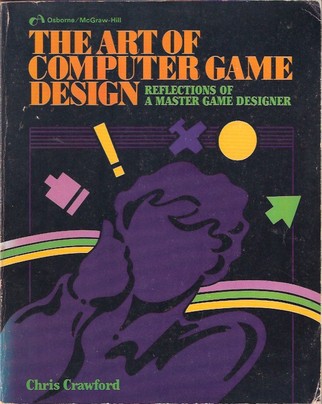
    The Art of Computer Game Design (Crawford, 1984)

    Chris Crawford wrote what is now considered the first "game studies" text with his pioneering book, The Art of Computer Game Design (1984). Chapter two of the book describes his "Taxonomy of Computer Games," his attempt "illuminate the common factors that link families of games, while revealing differences between families and between members of families" (pg. 19).

    Crawford explains that we game designers can "learn a great deal about game design by establishing a taxonomy of computer games." A well-constructed taxonomy would "suggest previously unexplored areas of game design," and, "reveal underlying principles of game design" (pg. 19). Crawford does not consider his definitions to be definitive, he admits that "a number of games do not fit into [his] taxonomy" (pg. 29), but it serves as an early effort to study and understand this then-new aesthetic form.

    Crawford states that a taxonomy "is only one way of organizing a large number of related elements" and that "[constructing] several alternate taxonomies may be a useful way to examine the common traits of computer games" (pg. 29). This is exactly why I am undertaking this examination of early game genre systems and will incorporate all the information from these blog posts into my personal game research database.

    Crawford broadly groups most games into "Skill and Action" games ("emphasizing perceptual and motor skills" (pg. 19)) and "Strategy" games ("emphasizing cognitive effort" (pg. 19)).

    Skill and Action

    • Combat Games ("direct, violent confrontation" (pg. 20))
    • Maze Games (including Maze Craze, Dodge 'Em (driving game, but in a maze), and Pac-Man)
    • Sports Games
    • Paddle Games (covers the "PONG-based games" (pg. 28), what is otherwise called the ball-and-paddle genre (like in Video Games (Len Buckwalter, 1977, pg. 33)))
    • Race Games (standard driving games like Night Driver, but also includes Dog Daze (1981), a game where two players (as dogs) race to be the first to "tag" fire hydrants that appear on the screen)
    • Miscellaneous Games (games that Crawford couldn't decide how to characterize, including Donkey Kong, Frogger (or Preppie in the book's first printing), and Apple Panic (an unlicensed Apple II clone of the arcade game Space Panic))

    Strategy

    • Adventures (text adventure and graphic adventure games)
    • D&D Games (CRPGs)
    • War Games (like Computer Bismarck and Crawford's own best-selling Eastern Front 1941)
    • Games of Chance (includes craps and blackjack. He states that these games "have not proven very popular" on computer and "show the folly of mindlessly transporting games from one medium to another" (pg. 37). I recall casino skill games like blackjack and poker being fairly ubiquitous during the 1980s. Perhaps their popularity was due to the string of strip poker titles published once home computer graphics reached a certain level of fidelity.)
    • Educational and Children's Games (includes classic mainframe computer simulation games like Hammurabi and Lunar Lander, as well as Warren Robinett's pioneering Rocky's Boots, designed to teach kids about logic gates)
    • Interpersonal Games (an undeveloped category at the time of writing, but one that would include Crawford's unpublished Gossip (1983) and later games like The Sims, Facade (2005), and probably the entire dating game genre)
    It is a sign of the times that Crawford's Miscellaneous Games category shows he had difficulty classifying early platformer games like Donkey Kong and Apple Panic. This was still a fairly new concept and earlier titles (like Space Panic and Crazy Climber) were often referred to as "climbing" or "ladder" games. Crawford describes Donkey Kong as "like a race game with intelligent obstacles" (pg. 29) and Apple Panic as "like a maze game in some ways and like a combat game in others" (pg. 30). He concluded that he would need to "wait for other developments" (pg. 31) before refining his taxonomy. Donkey Kong was only the first button to include a jump button, and the platformer genre would quickly evolve to be a dominant game mode by the late 1980s. Looking at the games now, I am tempted to personally classify platformer games without jumping (including games like Lode Runner) into the category of Maze Game.

    Crawford realized that his taxonomy would soon be obsolete due to the faced-paced evolution seen in the computer game industry. His Interpersonal Games category is a sign of that, a prescient game categorization for a portion of the game industry that hadn't even developed at the time of publication. 

    Game Genres, pt. 3: The Gamester's Types of Video Games (1983)

    Continued from part two.

    After reviewing two different game manufacturers' systems of "game genres" used for marketing and selling their titles, here is a player's-eye analysis of different arcade game types. The author takes an almost phenomenological approach: he classifies each game type by the interface through which he experiences the game. Delineating titles by these distinct interface designs, shared among games of a common genre, happens to tend to classify games by their affordances given the player to navigate virtual spaces. Each interface is built around those affordances of navigation and action. This probably wasn't Kordestani's intent with the system, but I see it as a side effect that correlates with my own studies of cyberkinaesthetics.

    The Gamester's "Types of Video Games"

    The Gamester's Guide to Arcade Video Games (Paul Kordestani, TAB Books Inc., 1983)

    Paul Kordestani's The Gamester's Guide to Arcade Video Games (1983) is a hard-to-find, early guide to winning arcade game strategies. Many early texts about digital games are focused on tips and tricks to impress the other players at the arcade or maybe get ahead at tournaments. Kordestani is billed as a business consultant and arcade game enthusiast and founder of GAMESTER, Inc., "an arcade game player's support group."

    The book's publisher, TAB Books, is better known for publishing guidebooks on all manner of technical subjects: electronics, lasers, robotics, and computers (I've owned TAB books on all these topics). TAB's other book on video games (that I know of), How to Repair Video Games (1978), is much like the other tinkering and repair guides they publish. Kordestani's Gamester's Guide is unusual as it is a different type of technical guide that describes gameplay and techniques more than electronics design or computer architecture.

    Part I of this book consists of general information about games gleaned from Kordestani's "17 months of research and writing" (pg. vii). As the title implies, this book focuses on video arcade games, and there is information on game cabinet styles, general functionality, popularity, terminology, history, and even controversies. Chapter 3 is where Kordestani describes his "Types of Video Games," a sort of game taxonomy based on control methods and movement affordances. This is an unusual take on the concept of game genre, but is one that ignores in-game representation and focuses mostly on the human-computer interface through which the game is controlled. Each game type is classified by letter.

    • Type A: One-Lever Maze Games ("lever" is Kordestani's term for joystick. These games focus on movement in a 2-D plane, especially maze games like Pac-Man and similar games like Q*bert.)
    • Type B: Lever Plus Action Button Games (these games focus on movement through an environment in a 2-D plane with the addition of one button for taking an action like jumping (Donkey Kong) and punching (Popeye). It is unknown how Kordestani would classify more maze-like games that have an action button (like Wizard of Wor and Mr. Do!)
    • Type C: Upward-Shooting Games (Space Invaders started this genre that encompasses (in 1983) what Kordestani estimates to be "approximately one-third of all video games" (pg. 15). The player controls a vertically-shooting base that is restricted to movement along the horizontal axis near the bottom of the screen. Some examples have an additional button for some limited power effect (presumably, like Phoenix and its Force Field button).)
      • Variations of Type C (upward-shooting games where the player's base may move vertically in a restricted area at the bottom of the screen, like Centipede)
    • Type D: Automatically Sideways-Moving Games (side-scrolling games with an auto-scrolling framing device (also called "Authoritarian" by Dominic Arsenault and his team in "The Game FAVR: A Framework for the Analysis of Visual Representation in Video Games" (2015)). Examples include Moon Patrol and Scramble.)
    • Type E: Total Maneuvering Games (rightly called "the most challenging control boards" and Kordestani incorrectly asserts that "Asteroids was the original of this type" (pg. 19). Maybe he never played Computer Space or Space Wars before. This type of game is a momentum-based multidirectional shooter. The controls allow the player to rotate their avatar right and left, thrust forward, shoot, and often include an additional action like shield or hyperspace.)
      • Variations of Type E (side-scrolling but freely moving games like Defender and its sequel, Stargate.)
    • Type F: Three-Dimensional Games (first-person games showing a perspectival view of a 3-D environment, like Red Baron and Battlezone. This category is not classified by its interface, though Kordestani notes that the controllers in the example games (one 4-way joystick in Red Baron, two 2-way joysticks in Battlezone) are "substantial" and "much larger than the usual control levers" (pg. 20). These "substantial" joysticks contribute to the experience that the player is controlling a military aircraft or armored fighting vehicle.)
    • Miscellaneous Games (games that don't quite fit into the other categories, like Missile Command and Tempest)
    It does not appear that Kordestani's "types" influenced any other genre system. Kordestani doesn't even use the system in the book's Part II, playing techniques for 41 different games that were prevalent in 1983-era arcades. However, it does stand out for classifying games by interface rather than representation (eschewing milieu categories like "science fiction" or "horror").

    Monday, March 6, 2023

    Game Genres, pt. 2: Mattel Intellivsion's Networks (1979)

    Continued from part one.

    Another early attempt at categorizing digital games into specific genres was taken up by Mattel Electronics to organize their own line of game cartridge titles, which appears to have begun with the system's test market launch in late 1979. Note that this appears to predate Atari's own "contents" system of genres by at least one year.

    Mattel Intellivision's "Networks"

    Example of different game boxes for different "networks," Intellivision Catalog (1983)

    Mattel's take on game genres is that each game belongs to a specific "network," capitalizing on the Intellivision being an "intelligent television." Each Intellivision game cartridge comes in a colorful box matching the color of its home network. This system of color-coded networks appears to have been designed from the earliest days of Intellivision: game cartridges were color-coded even during the early days of test marketing. The system evolved over time, with new networks like Space Action Network and Arcade Network added later.

    • Major League Sports Network (high-quality sports games with unrivaled graphics set Intellivision games apart from their Atari VCS competitors. Mattel shows their love for licenses with NFL Football, PGA Gold, NHL Hockey, and other sports licenses.)
    • Action Network (most arcade-style games are in this network. Note that Space Action is a spinoff from this network.)
    • Gaming Network (casino-style games, many with a "Las Vegas" moniker at the start of their title. Note that Horse Racing falls under this network rather than Action Network.)
    • Strategy Network (mostly games based on classic board games, with the addition of Don Daglow's Utopia, one of the first examples of a real-time strategy game. ABPA Backgammon uses a license from the somewhat obscure American Backgammon Players Association.)
    • Children's Learning Network (only two games released were Electric Company Word Fun and Electric Company Math Fun in 1980. Interestingly, the TV show Electric Company had ceased production in 1977, but Mattel used the strength of licensing to lend an air of legitimacy to their software titles.)
    • Space Action Network (this network is an offshoot of the Action Network. Two early games in this category, Space Battle and Space Armada, were first published in the red boxes of the Action Network.)
    • Special Intellivoice Cartridges (games designed to use the Intellivoice voice synthesis hardware module released in 1982.)
    • Arcade Network (only Vectron was added to this short-lived network. Later arcade game ports like Burgertime were released without a network classification)
    Like Atari's system, Mattel's genre system is designed around marketing needs and informing a population of consumers. It serves as another data point of how early digital game manufacturers organized their own individual works as they saw best.

    Game Genres, pt. 1: Atari's Catalog Contents (1981)

    My research work is focused on the development of an "art history" of digital games, a diachronic view of game history as the creation and development of aesthetic styles, rather than simply a history of technological advancements. My work is often confused with the establishment of game genres (platformer, FPS, RTS, etc.), which isn't exactly correct. However, I realize that certain spatial paradigms are commonly shared by certain game genres and I thought it would be a good idea to look at how the concept of "genre" came to be applied to video games.

    One early attempt at categorizing games into specific types comes straight from Atari, a dominant force in arcade video games and home console games throughout the 1970s and early 1980s.

    Atari Catalog CO16725-Rev. D

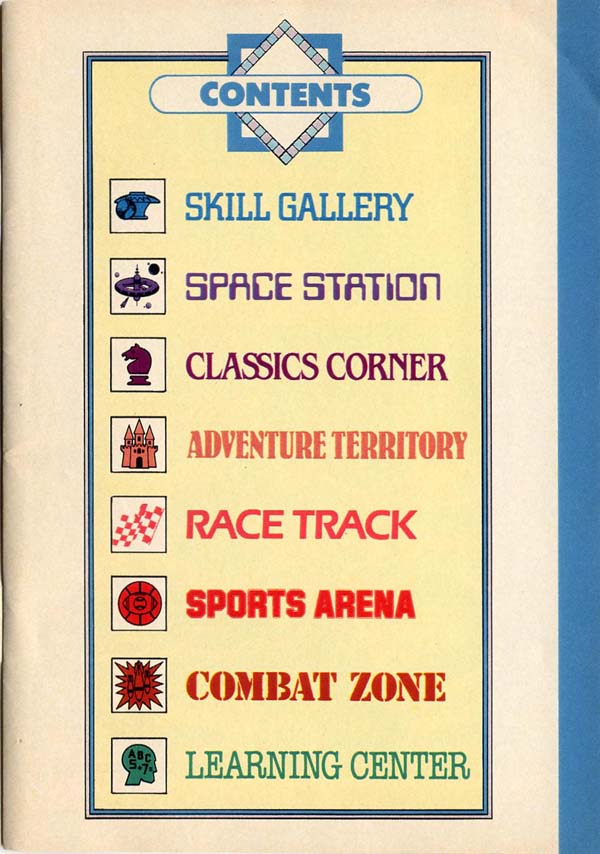
    Contents page from Atari Catalog CO16725-Rev. D (1981)

    Atari produced several different full-color catalogs to showcase the "Video Game Program cartridges" available for their programmable Atari VCS (later renamed the Atari 2600) home console. Previous Atari consoles were dedicated to play only one game or a small selection of games that were stored in fixed ROM chips. The VCS was their first console where the game programs could be swapped out, allowing for a potentially unlimited number of games to be played.

    Atari's first "Innovative Leisure" catalog features the eight different game cartridges that were available near the system's launch in 1977. By early 1981 when catalog CO16725-Rev. D was published, the VCS catalog had grown to 45 different cartridge titles (not including titles that had been dropped from production in the intervening years). For the first time, Atari needed to organize the expanding catalog into chapters, breaking up the titles into a number of game genres.

    These genre categories remained consistent, almost unchanged through 1983's catalog CO21776-Rev. A. By 1983, Atari had also released the Atari 5200 system and the VCS was newly dubbed the 2600. 1984's catalog CO25618-Rev. A showed off the then-new (and ill-fated) Atari 7800 system, in addition to the 2600 and 5200, and the genre categories were given revised names. [The 1984 names are noted in brackets, below.]

    • Skill Gallery [Skill & Action] (Breakout, Pac-Man, Circus Atari, Video Pinball)
    • Space Station [Space] (Space Invaders, Missile Command, Asteroids)
    • Classics Corner (casino and board games)
    • Adventure Territory (Haunted House, Adventure, Superman)
    • Race Track [More Adventures] (car driving games)
    • Sports Arena [Sports and Atari RealSports] (sports games, including Video Olympics (a collection of Pong variations))
    • Combat Zone [More Adventures] (Air-Sea Battle, Combat, Outlaw, Warlords)
    • Learning Center [Kid's Library] (BASIC Programming, Codebreaker (includes Nim), A Game of Concentration, Hangman)
    The implied purpose behind this system is one of informing consumers about a product line and as a marketing tool to show the wide variety of games available from Atari (important in the light of competitors like Activision cropping up to produce VCS cartridges that competed with Atari's own line). So, it may be less useful as a tool for research than a system intended to be a formal taxonomy of digital games would be. However, there are still some formal aspects that can be teased out of this organization.

    Some of these game genres are similar to film genres (Space Station/science fiction, Combat Zone/war movie). These are categories focused on the aspects of representation rather than qualities of interaction (Thomas H. Apperley, "Genre and Game Studies: Toward a Critical Approach to Video Game Genres," Simulation & Gaming, Vol. 37 No. 1, March 2006 pg. 7) that describe the milieu (pg. 11) of a specific game. Presumably, from a marketing standpoint, fans of related forms of entertainment in other media (film, television, or literature) may be inclined to play digital games in a related genre (sports fans may tend to choose games from Sports Arena, for example).

    Some categorization options are puzzling. Space Station game Missile Command is about defending cities against attack in a nuclear war, which thematically seems more appropriate for Combat Zone. Combat Zone game Warlords can mechanically be described as 4-player Breakout, but it is not included in Breakout's Skill Gallery category. Hangman and A Game of Concentration (the flipped-card matching game variously called pairs or memory) are "classic" game examples, seemingly fitting of Classics Corner, but are included in Learning Center. I suspect that Atari wanted to give the impression that the VCS had plenty of educational titles and padded out their Learning Center category with games that are playable by younger children.

    Interestingly, all categories are named after a type of place (gallery, station, corner, territory, track, arena, zone, or center). This implies a location where games of a certain genre may be found and experienced. Flipping through an Atari catalog is almost an early, transmedial, analogue version of navigation through digital media. 10+ years later, this same sort of locational language would often be used to organize locations for different types of digital files on web sites (and even on BBS services before that). Together, they form the World of Atari.

    The Adventure Territory games all happen to share a common mechanical quality. Adventure, Haunted House and Superman are games where the player's on-screen avatar explores a large, multi-screen environment. As the avatar reaches one edge of the screen, it reappears on the opposite edge with the screen framing the next section of the gamespace. 

    Atari's genre system can be used as a contrast to the more analytical types of systems that I analyze in the following Game Genres blog posts.

    Spatial Models: Discrete vs. Continuous

    Taxonomy of Virtual Spaces Wardrip-Fruin, Noah. (2020).   How Pac-Man Eats . Cambridge, Massachusetts: The MIT Press. Today, I return to the...