Showing posts with label Cutie Q. Show all posts

Thursday, September 7, 2023

Summer 2023 Summary and "Cartoony" Game Conclusions

I am happy to say that I was able to wrap up summer with some hands-on research at a terrific pinball parlor and video arcade while on an out-of-state road trip.

The author on a research trip to Spinners Pinball Arcade

I always prefer to experience these works on original hardware and in their proper context, and this location did not disappoint. There was a lot of machines, including many that I've recently been writing about. Also, I got to play some rare finds like Hercules (1979), the largest production-model pinball table and Atari's swan song in the pinball industry. 

This summer, I completed a digital project prototype and researched the evolution of game structures in the 1979-1982 period.


Taxonomy of Virtual Spaces Project


I completed a prototype of my project to explore different spatial paradigms seen in digital games (spatial paradigm defined as the visuo-spatial configuration of a virtual space and the player's affordances for navigating that space). My first test paradigm is the "Filmation" paradigm that became popular on the ZX Spectrum in the 1980s and is still used in games to this day (such as in Elephantasy: Flipside). My prototype approximates the environment and navigation of Knight Lore, probably the first game to use this spatial construction.

"Filmation" games use a pixel dimetric method of screen projection, common for "isometric" games of the era (such as Zaxxon and Q*bert). The prototype allows the player to press the "T" key to change projection method to true isometric (like Monument Valley) or pixel trimetric (like Crystal Castles). Some room arrangements become unclear or ambiguous with certain projection methods, making the spaces difficult for the player to comprehend or navigate. This may or may not be intended, as the level designer may use an ambiguous layout to trick the player with an illusion or create a difficult navigational puzzle to solve.

In true isometric projection, my character appears to be in the corner of the room...


...but it turns out that there is space between the top platform and the walls

My development blog posts:

Initial plans and research

Refinement of terms

Preproduction

Production

Conclusions:

I have been able to replicate the "fake 3-D" environment from and older computer game and replicated it fully 3-D, polygonal game data. Reconstructing in this manner allows me to quickly test different projection systems (three options so far) without having to redraw or recalculate all of the art assets needed to display the space.

Next steps:

In the future, I need to expand my project to project other types of spatial constructions and navigation methods. My work on researching a "cartoony" spatial paradigm (see below) gives guidelines for what types of projections, "camera" angles, and types of environments would be best to start with.

The intent is to create a tool for testing and remixing different game qualities on the fly to see how these options change the player's phenomenological experiences of the same virtual spaces (say, playing a 2-D platformer game in first person). The point is not to replicate an entire game experience, but focus on the spatial qualities and navigation affordances. This type of tool is helpful in game development and other forms of research. This will also serve as a "museum piece" of various spatial paradigms in games, not dissimilar to Traversing Virtual Dimensions, my other project presenting the early development of digital avatar navigation.


Toward a "Cartoony" Spatial Paradigm

Pac-Man (Namco, 1980) paragon of cartoony gaming

Additionally, I performed some research on the 1979-1982 game era when what I call "cartoony" graphics developed and became popular both in the USA and Japan.


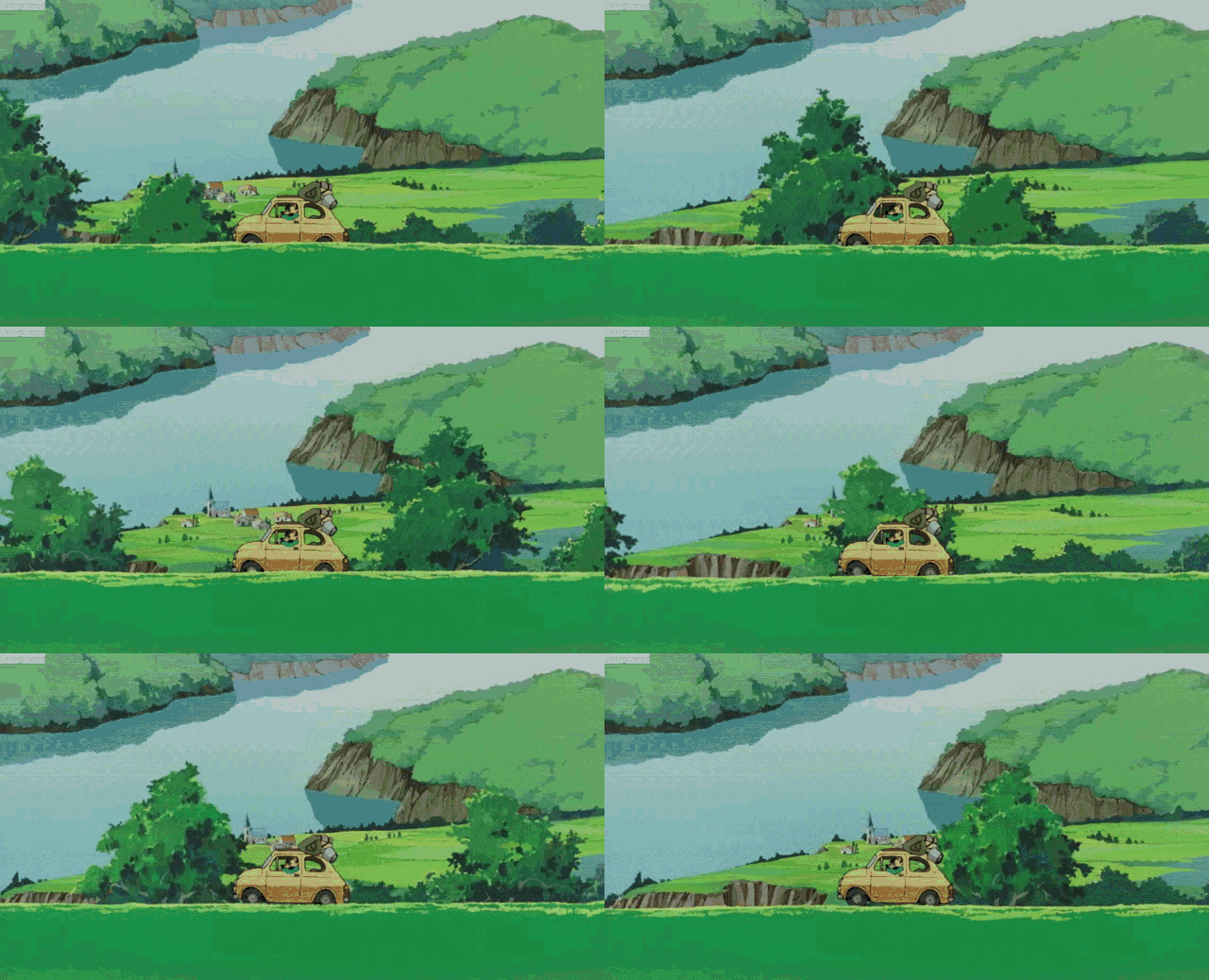
I see a lot of correlation between the visual techniques of early digital games and traditional cel animation, so I feel there is something to uncover at this point where games started to hew closer to cartoons (and I don't just mean Dragon's Lair). Both forms of media can use similar techniques to create a sense of space and enhance visuals.

Parallax motion conveying deep space in Lupin III: The Castle of Cagliostro (1979)

Parallax motion conveying deep space in Moon Patrol (1982)

Both examples above use scrolling graphics on layered planes to create hybrid, yet cohesive, images. In each case, the vehicle appears to move through deep space, yet the two vehicles never change their x positions in the respective images.

Many other techniques are common to both cel animation and game graphics: limited color palettes, simple shapes, repeated animation cycles, characters with big heads to show facial details, etc.

Conclusions:

My research uncovered that there is not one but several "cartoony" spatial paradigms that evolved from one another during this golden era of arcade games with character. These will be directly useful in expanding my own lexicon of paradigm variations and options to incorporate into my digital project.

Also, even though my work specifically does not deal with game genres, I found myself coining new terms to understand these related families of games ("maze looter," "maze tunneler," "ladder/digger platformer").

This work is closer to the diachronic "art history" of evolving aesthetic styles I seek to create and I feel that my taxonomy of virtual spaces successfully conveys the exact spatial changes between game styles. 

How did digital games get a "cartoony" look? Part of the reason is because of technological advancement was required before detailed player avatar graphics and animations (think sprites) could convey a sense of character. ROM chips allowed far more detailed graphics than earlier diode-based images. ROM chips started to be used in arcade games by 1974 but the first "cartoony" game Cutie Q wasn't made until 1979. Toru Iwatani was likely inspired by the immensely popular anime Obake no Q-Tarō that he watched as a kid when he made an aesthetic decision to incorporate big-eyed, round, ghost-like characters in the game (he admits it was his influence for Pac-Man). Note also the similar "Q" designs in the titles of both:

Obake no Q-Tarō title card with upside-down smiling obake "Q" from the 1965 anime series

Japanese Cutie Q arcade instructions with similar "smiling Q" logo at top

It seems clear from my research that platformer games evolved from maze games. This is not surprising as "ladder" games have been considered a type of maze game. What is interesting is that Heiankyo Alien*, a little-known game here in the USA, may have been an influence on the biggest games of 1980 and 1981: Pac-Man and Donkey Kong (through influence on Space Panic).

*Fun fact: I bought my copy of Heiankyo Alien for Game Boy from fellow Drexel instructor and game history researcher Adrian Sandoval.

This section of study ends at 1982, which means there are plenty of other important examples that followed. 1983 would bring Bag Man, Bomberman, Congo Bongo, Crystal CastlesMappy, Mario Bros.Tapper, Track & Field, and more. All this in the midst of an arcade market slump and an outright crash of the home game market in the USA. I plan to continue developing this series in the future.

Thursday, August 24, 2023

A "Cartoony" Spatial Paradigm? pt. 1 (Cutie Q)

Taxonomy of Virtual Spaces

Many of my previous posts have focused on the "Filmation" aesthetic style as an example of a spatial paradigm in digital games.

This post is an exploration toward evaluating another paradigm through the evolution of "cute" or "cartoony" games, with their genesis in the late 1970s and evolution through the 1980s.

Cutie Q

Cutie Q screen shot

Cutie Q (Namco, 1979) was the third title in Toru Iwatani's Gee Bee series, preceded by Gee Bee (1978) and Bomb Bee (1979). The Gee Bee games were inspired by Breakout (Atari, 1976) which had kick-started arcade game popularity in Japan in a way that Pong (Atari, 1972) and its clones never had. The Gee Bee series mixed block-breaking gameplay with pinball and pachinko aesthetics, featuring interactive items on the playfield like pop bumpers, spinners, and rollover targets. Cutie Q is the first to feature cute characters in the game, such as pink ghost "minimon," yellow "walkmen," happy/unhappy faces, and characters on the rainbow-colored blocks.

Earlier arcade games had featured recognizable characters that were more than simple paddle, car, tank, or rocket ship shapes (such as TV Basketball (MIdway, 1974), Western Gun/Gun Fight (Taito/Midway, 1975), and Circus (Exidy, 1977)). Tomohiro Nishikado's Space Invaders (Taito, 1978) aliens are recognizble as different sea creatures (octopus, crab, and squid). However, none of these earlier characters would be considered to be "cartoony" or "cute" (although the crab space invader is generally considered to be "the cute one").

Cutie Q is probably the earliest example of a "character game"* with intentionally cartoony and cute (it's right there in the name) figures. This concept served as direct influence on Iwatani's next game with Namco, Pac-Man.

Cutie Q Visuo-Spatial Analysis: The game screen emulates an orthographic view of a bagatelle-style playfield, but there is no real sense of gravity to understand which way is "down." The player could be looking down at a plan view of the playfield (like a pinball machine) or across at an elevation view (like a vertically-mounted pachinko machine). The character images are shown in orthographic front and side elevation views, the best way to show character details on a tiny 16 x 16 one-bit-per-pixel (1BPP, i.e. a two-color palette) sprite. The game has a sense of continuous 2-D game space limited to a single screen (fixed frame).

* The term "character game" is also a term used for Japanese "simulation games" (what we call board-and-counter wargames in the west) that are based on manga and anime series. For more on this topic, you should see my other blog for articles and translations I've made of various Japanese sci-fi and anime games (and one German one).

Pac-Man

Pac-Man screen shot

Iwatani's next game, Pac-Man (Namco, 1980) abandoned ball-and-paddle gameplay for the relatively untapped genre of maze games (preceded by few examples like Gotcha (Atari, 1973) and The Amazing Maze Game (Midway, 1976)). Pac-Man is similar to car racing game Head On (Sega, 1979), which is about driving over and clearing the screen of "lane markers" (dots) in a maze of roads before an opponent car can run into you.

Pac-Man, of course, replaces the act of driving with eating as the titular character devours his way through each maze. Bonus point edibles include fruits like cherries, strawberries, and oranges, their graphics reminding the player of "fruit machine" (a.k.a. slot machine) reel images. Pac-Man is pursued by four ghostly, large-eyed monsters that look like they evolved from Cutie Q's pink minimons. Pac-Man features a technical leap past Cutie Q's graphics capabilities: the multicolored monsters and bonus items feature two-bit-per-pixel (2BPP, 4 colors, including transparency) sprites. Iwatani designed his monsters to be "cute," with big expressive eyes that look ahead in the direction they are moving.

The game also included some of the first "cutscenes" seen in a digital game.

Pac-Man first intermission

Pac-Man includes three intermissions that play after mazes 2, 5, and 9. These are short and humorous "cartoons" that reward the player with short breaks between rounds. This is further evidence of bringing visuals from animation into digital games.

Pac-Man Visuo-Spatial Analysis: The game screen emulates an orthographic plan view of a maze (not unlike a hedge maze) seen from overhead. It could be argued that the maze is seen from the side, but the lack of gravity that pulls to the bottom of the screen (this is not a platformer) and similarity to overhead driving games like Head On support a view from above. The character images are shown in orthographic front and side elevation views, much like in Cutie Q. This creates an incongruity between characters and their environment, one that I wrote about before (see the Orthographic Projection section). The game has a sense of continuous 2-D game space limited to a single screen (fixed frame) with a cylindrical topology (characters may move directly from one edge of the maze to the other by using the side tunnels).


Spatial Models: Discrete vs. Continuous

Taxonomy of Virtual Spaces Wardrip-Fruin, Noah. (2020).   How Pac-Man Eats . Cambridge, Massachusetts: The MIT Press. Today, I return to the...