Showing posts with label digital game aesthetics. Show all posts

Monday, November 6, 2023

(Not) Game Genres, pt. 9: Steven Poole's Construction of Space in Video Games

In my previous chapter in this series about game spatiality, not game genres, I reviewed Nicholas Caldwell's paper, Theoretical Frameworks for Analysing Turn-Based Computer Strategy GamesCaldwell based his methodology for analyzing strategy games on Steven Poole's use of Charles Peirce's typology of signs as found in Poole's book, Trigger Happy (2000).

Trigger Happy: The Inner Life of Video Games

Trigger Happy (Poole, 2000, Arcade Publishing)

Trigger Happy was an early text that took a serious look at digital game history and made attempts to analyze the aesthetics of such games, comparing them to techniques established in painting and cinematic arts. This was an era when academia all but ignored video games, one year before Espen Aarseth co-founded the journal Game Studies, back when we still referred to digital media as "new" media. Thus, the task of penning this book fell to a journalist, not an academic. Steven Poole has written articles for The Guardian, Edge, The Telegraph, and other publications, along with a number of other books. Since Trigger Happy's publication, it has been cited many times in refereed journal articles and books.

[References to page numbers in the analysis below refer to the "2007 web download edition" that Poole freely released on his website for a limited time and is under the CC BY-NC-ND 3.0 license. It can now be accessed on archive.org.]

Digital Games as Art

Aside from the aforementioned typology of signs analysis work, Poole's work corresponds with my research in a number of aspects, including the need for a language to speak to the unique aesthetic qualities of digital games: "Videogames are an increasingly pervasive part of the modern cultural landscape, but we have no way of speaking critically about them" (pg. 30). Video games were not generally accepted as a serious form of art. Then again, neither were films or jazz music in the early 20th century, yet now they are generally accepted as important aesthetic forms of human expression worth of critical study and analysis. Poole predicts that digital games will hold the same appreciation by the middle of the 21st century (pg. 32). Hopefully, we are well on our way to beat that timeline.

Game designer Chris Crawford similarly stated that "computer games constitute a new and as yet poorly developed art form" over a decade earlier in The Art of Computer Game Design (1984, Osborne/McGraw-Hill). This pioneering book is now regarded as the first full publication devoted to what would later be named game studies (Wolf and Perron, The Video Game Theory Reader, 2003, Routledge). Crawford stated that we need to establish "a framework for criticism" as part of our "path to understanding" digital games as an art form (1984). Since Crawford's and Poole's books were published, game studies scholars have adapted "frameworks for criticism" from "new art history" methods used in Marxist, feminist, and postcolonial theories, for example.

I argue that the last missing element for Crawford's "path of understanding" is "our principles of aesthetics" (1984). We have the structure to critique digital games, but still lack an agreed-upon language for discussing digital games as an art unto themselves and "speaking critically about them" (Poole, 2000).

Poole cites a French text, L'univers des jeux vidéo (Alain and Frédéric Le Diberder, 1998, la Découverte), which includes digital games as the "tenth art." The six classical arts are music, poetry, architecture, painting, dance, and sculpture. The Le Diberders add new arts for the 20th century: television, films, graphic novels, and digital games (Poole, pg. 29).

The "ten arts" concept reminds me of Henry Jenkins' declaration that digital games are one of the "lively arts" (Jenkins, "Games, the New Lively Art" In Handbook for Video Game Studies, 2005, MIT Press, pp 175-189). Jenkins refers back to Gilbert Seldes and his early critical text on pop culture, The Seven Lively Arts (1923, Sagmore Press). Seldes defends "lowbrow" entertainments that he terms "lively" arts (including slapstick comedies, musical theater, popular music, vaudeville, and comic strips) against the seven major "hibrow" arts. At that time, the classical six arts referenced above had been updated to seven modern arts: painting, sculpture, literature, architecture, theater, film, and music. Jenkins declares that digital games are a new lively art, "one as appropriate for the digital age as those earlier media were for the machine age" (Jenkins, pg. 177).

Art History of Games?

"Videogames have... repeated histories of representation in art, on jittery, caffeine-fueled fastforward. But it is immediately apparent that so far, they have only reached a surprisingly early stage in that development, for by the eighteenth century in painting the classical ideal of beauty based on some cosmic mathematical order was already being challenged, and the shortcomings of perspective were already being identified. Videogame scenery, being an artifact of computers, is clearly still in thrall to the god of mathematics. Of the myriad post-perspectival ways of seeing such as impressionism or cubism, there is as yet no sign in the apprentice draughtsmanship of videogames" (Poole, 2000, pp 236-237).

I often feel that AAA studios seem like the French academic painters of the early 1800s, highly skilled at rendering ever-greater levels of visual fidelity, delicate interplay of light, and beautiful forms. Digital games only slowly creep toward what might be considered our versions of the modern art styles. Occasionally, a Grim Fandango or a Kentucky Route Zero will come along, paying tribute to one or more of these "modern" styles of last century. Rarely does a game attempt a sort of space-bending reality commonly seen in cubist, surrealist, Dadaist, expressionist, and other modern styles.

Digital Game Visuo-spatiality

Trigger Happy also includes a "brief history of the construction of space in video games" (pg. 236) in chapter 6: "Solid Geometry" (pp 199-239). Poole looks at the touchstone moments in stylistic presentations of space that bring developers closer to the "Holy Grail" of game environments: "a 'virtual' space that the player could inhabit" (pg. 204).

These stylistic innovations were afforded by means of technological innovations and advances in display and computing hardware. However, Poole states, "It is important to emphasize... that innovations... did not at once render earlier forms obsolete" (pg. 212). Innovations added more tools to the game developer's toolbox rather than just replacing the old tools. As an example, scrolling screens did not eliminate the need for fixed-screen games. Robotron 2084 (1982) works so well as a frantic, exciting game precisely because the player is trapped on one screen, in a claustrophobic space where there is nowhere to run. An interview with Robotron creator Eugene Jarvis confirms this was a intentional, aesthetic choice:

"With Robotron, I just stuck the guy on one screen... There's two hundred robots trying to mutilate you, and there's no place to hide... It was an incredible sweaty palms experience. It's just confinement. You are stuck in that room. You can't run down the hallway. You can't go anywhere else. You're just totally focused. A lot of times, the games are about the limitations. Not only what you can do but what you can't do. Confining your world and focusing someone in that reality is important." Quoted from Joystick Nation by J. C. Herz (1997, pp 78-79)

Poole intentionally likens the history of the projection of virtual spaces to innovations that developed in art history, especially with painting but also in cinema, "Videogames have rehearsed other histories of pictorial representation and come up with imaginative and original visual strategies themselves" (pg. 206). 

The following is an analysis of Poole's terminology (including some terms from Poole's pseudo-sequel, Trigger Happy 2.0 (2013), as compared to my own Taxonomy of Virtual Spaces. Poole did not name each type of projection method, sometimes merely describing This is similar to my analysis of Mark J. P. Wolf's "Elementary Spatial Structures of Video Games" (1997, 2001) that I posted previously (part one, part two).

  1. No environment - "In the earliest videogames... the environment had no characteristics of its own: it was not terrain, but simply a function of the relations between objects or a means by which time could pass while one object traveled across the screen, so that everything did not happen simultaneously" (Poole, pg. 207). I essentially describe this as no environment image plane, but Poole gives a compelling description for what is essentially nothing.
  2. Fixed screen - "The boundaries of the TV screen limited the play arena to a fixed, small size, and thus limited the type of action available to game designers... The screen was a prison" (pg. 207). This is a fixed framing device with no mobility (in other words, the game "camera" doesn't move).
  3. "Wraparound" screen - "Topologically, the spatial arrangement of Asteroids, though it looked flat, was actually equivalent to the surface of a torus (a doughnut with a hole in the middle)" (pg. 208). Just like Poole describes, I say this is a toroidal topology. Another form of "wraparound" screen may have cylindrical topology (like Pac-Man).
  4. "Scrolling" screen - "The superficial limits of the screen were further eroded by the invention of scrolling" (pg. 208). Poole's example of Defender uses smooth scrolling framing device with horizontal mobility.
  5. "Ineluctable scrolling" screen - "Unstoppable, ineluctable scrolling." "For reasons rarely explained by the developers of arcade games such as Scramble, your ship had a minimum speed below which it could not operate... moving forwards at a certain rate, towards your doom, was existentially obligatory... in sidescrollers and upscroller, the game scrolls regardless of your input. It's more like an enemy than a tool, even as it is also the engine of your apparent progress" (Poole, Trigger Happy 2.0, ebook, 2013, chapter 2). An auto-scrolling framing device.
  6. "Parallax" scrolling - A multi-planar background image plane.
  7. "Isometric perspective" - Regarding Zaxxon, "You could see three sides of an object rather than just one. And now, crucially, the game screen was not just a neutral arena - it had become an environment" (2000, pg. 214). For a time, "the most technologically sophisticated means of building a 3D world" (pg. 216). In comparison to "scientific perspective," "Foreshortening implies a subjective, individual viewpoint, so its absence in isometric graphics, along with the elevated position of survey, conspired to give the user a sense of playing God in these tiny universes" (pg. 216). This is dimetric projection environment plane and agent plane. "Isometric" has become a catch-all phrase for a number of related axonometric methods of projection (isometric, dimetric, and trimetric).
  8. "Perspectival" - Games like Battlezone use "scientific perspective" (pg. 205). The Battlezone example uses 2-point perspectival projection environment plane and agent plane.

Coda?

"I will reinvigorate the retro game-reviewing vocabulary, since that will be the only way to distinguish oneself in an increasingly crowded media-critical space from the hordes of reviewers who are all now like Huizinga this and affordances that" (Poole, 2013).


Friday, July 14, 2023

Digital Project Plans

Taxonomy of Virtual Spaces

Over this summer, I am starting a new digital project to explore the planar geometric projection options I defined in my Taxonomy of Digital Spaces. I plan to create a digital game where the spatial qualities of the game can be changed on the fly, in order to partially show specific spatial paradigms that, I argue, are unique aesthetic qualities of digital games.

The final project should be much like a virtual museum, where different spatial concepts may be explored and examined in an interactive manner. This will be similar to another project I created a few years ago, Traversing Virtual Dimensions (after which this blog is named). In Virtual Dimensions, the player is able to experience some of the earliest developments of a player avatar able to navigate through virtual space in digital game history. Unlike that project, Taxonomy will allow a player to set different methods of projection for the virtual environment and navigate that environment in a game-like manner.


The following are some screen shots of my initial tech prototype:

Game environment test with oblique projection.

Game environment test with orthographic projection.

Game environment test with perspectival projection.

I am using the Unity game editor as my development environment because I know that game engine very well and can work in it relatively quickly. My tech prototype uses the Kenney Game Assets All-in-1 asset pack for game characters. The ability to change the type of projection with Unity's camera is thanks to Art Leaping's Camera Perspective Editor scripts and the background cityscape seen in the prototype. All assets are used under license.

Creating all of the custom art needed, by hand, to project the same environment in many different methods of projection would be an insurmountable amount of work for one person. While I would relish the chance to create several different tile sheets of environmental sprite art and matching 3-D geometry as an exercise in different digital game art styles, I simply don't have the time to tackle that and everything else the game needs. However, if I am able to replicate 2-D game art methods by using a modified game camera, I can project the same set of 3-D scene objects to the screen in many different ways with different camera settings. Adapting to this technology should save a lot of effort.

The first goal for the project is to make project where the navigable environment may be changed to use the different methods of projection outlined in my research. The next step is to be able to change the other two conceptual image planes on the screen: the agents (characters and interactive elements) and the background/foreground objects. Once that is complete, I plan to have different player avatar characters that can move around the virtual environments in as-yet undefined methods of player affordances. These two elements together (the graphical spatial qualities and the player navigation affordances) can be used to define a game's spatial paradigm.

The final goal of my research is to define game aesthetics by their spatial qualities dealing with the embodied phenomenon of navigating virtual spaces, a cyberkinaesthetic experience. I posit that specific aesthetic trends and styles can be traced through our young art form's history and create a new diachronic "art history" of digital games in the process.

Saturday, April 15, 2023

New Digital Project Research and Notes

I've had a recommendation to think about creating a digital game project as a tool for my study of digital game aesthetics and spatiality. This would be similar to my other project exploring the history of virtual navigation in space, Traversing Virtual Dimensions, the inspiration for this blog's title.

This new research project would take the form of a simple digital game or several games. The user would be able to change the form of a game's spatial structure and projection dynamically, yet the core mechanics and spatial extents of the environment would remain the same. Such a project would ideally require several different methods of player navigation, so adapting my earlier work in Traversing Virtual Dimensions would be a good start. This would serve as a good testbed for exploring various spatial paradigms that I theorize are a way of understanding digital game styles across genres and technological platforms.

Eventually, such a tool can be useful for myself and others in research for A/B testing user experience with different spatial arrangements.

This page serves as an exploration of three similar projects that have been created by others.

Morf (Solarski Studio, 2011)

Changing the environment shape in Morf.

Morf was created as an exercise in understanding digital game aesthetics by exploring changes in the overall shape of an environment (in the above image, from "round" to "sharp") and how that changes the player's experience. Chris Solarski, the game's creator describes the project in his 2013 Game Developer feature, "The Aesthetics of Game Art and Game Design."

Morf is a simple browser-based game that I developed to explore the emotional links between character and environment shapes. You, the player, must guide a round character through two environments -- one round, and the latter, sharp. The surprise awaiting players is that, technically, both environments are identical -- it's only the superficial surface graphics that change.

Solarski noted the emotional changes in the different experiences of playing in visual harmony with one's surroundings (round character in round world) contrasted with that of playing in dissonance with one's surroundings (round character in sharp world). Players, especially non-gamers, showed a particularly heightened emotional response to the sharp world, which felt threatening and dangerous.

The game was created in Flash (R.I.P.) and is long gone from Solaski's web page where I played it years ago. Replaying the game required finding the Morf swf file on the Internet Archive, installing Adobe Flash Player debugger software, and finally running the swf file locally. Morf's different projected worlds are experienced in sequence, which is an effective tool for Solarski's purposes (you may not even notice that the two worlds are identical at first). For my purposes, I want to create a project where the game world's projection can be changed dynamically while playing.

Evoland (Shiro Games, 2013)

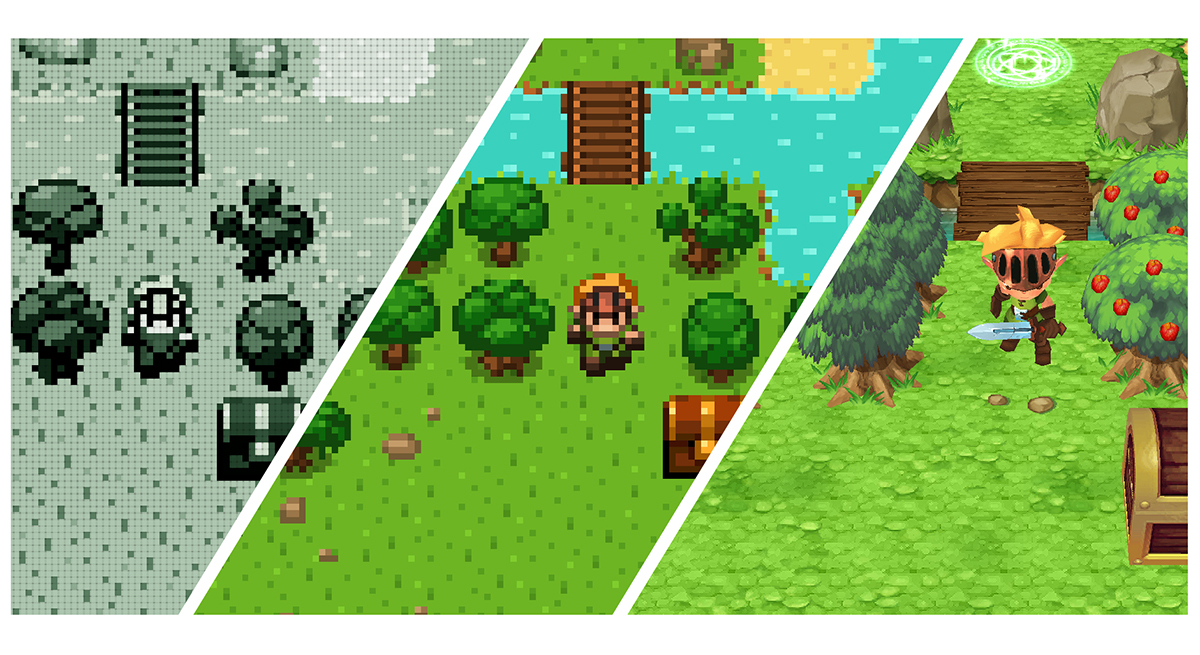
Evolution of the retail game through the course of gameplay.

Evoland started out as the winning entry for the Ludum Dare 24 game jam in 2012, which had a theme of "evolution." Developer Nicolas Cannasse refined the game into a commercial release in 2013, followed by a commercial sequel in 2015. Here is a description of the commercial game from the game's website:

Evoland is a journey through the history of action/adventure gaming, allowing you to unlock new technologies, gameplay systems and graphic upgrades as you progress through the game. Inspired by many cult series that have left their mark in the RPG video gaming culture, Evoland takes you from monochrome to full 3D graphics and from active time battles to real time boss fights, all with plenty of humor and references to many classic games.

The game starts as an action-adventure game in the style of early Legend of Zelda games. The game's visuals run the course of inspiration from Game Boy, NES, SNES (like Mode 7 style overworld environment), N64, and Sony PlayStation. Graphics, sound effects, movement controls, and game mechanics all "evolve" as the player continues their adventure. Some challenges require shifting perspective from 2-D to 3-D and back in order to solve them.

My study is on virtual spatiality, not graphics, although the two topics are corelated (most virtual spaces use graphic projection as a primary interface). I noticed examples of frame mobility early in the game, formal elements I define in my "Taxonomy of Virtual Spaces" (Rowe, unpublished). At first, Evoland uses a single fixed screen. The game quickly evolves with what it calls "basic scrolling," the game jam version has tile scrolling while the commercial version has discrete (or "page-flip") mobility as the player's view pans across the environment. Soon thereafter, the player gains smooth scrolling and primarily stays with that framing device. The game does return to discrete frame mobility when the game evolves to pre-rendered backgrounds in town with 3-D characters, much like Final Fantasy VII.

There are a few other games with similar "evolution through game graphics history" mechanics, such as High Strangeness, Upgrade Complete, and Genetos.

"Measuring How Game Feel is Influenced by the Player Avatar's Acceleration and Deceleration: Using a 2D Platformer to Describe Players' Perception of Controls in Videogames" (Gustav Dahl and Martin Kraus, 2015)

"Players control a rolling ball. Their task is to collect three stars." (Dahl and Kraus, 2015)

I've written about this game before when I reviewed literature about jumping in games. Dahl and Kraus developed a simple 2-D side-scrolling platformer game where the player controls a soccer ball rolling and jumping through a game environment. This is very similar to my project needs, except that I would make the spatial visuals dynamic as opposed to the jumping mechanic.


Monday, March 20, 2023

Winter 2023 Research Review and Spring 2023 Plans

 Winter 2023 Review

Preliminary cluster diagram of coding similarity, "Video Game Space and Motion" (Rowe, unpublished)

Spring 2023 Plans

My theory posits that a distinct way that humans experience digital games as aesthetic objects is through the embodied, "cyberkinaesthetic" experience of navigating virtual spaces.

The visuo-spatial configuration of a virtual space is the geometry of that space (defined by dimensionality, metrics, and extents), and the methods used to project that space onto the screen (or pair of screens, for binocular vision) of the game apparatus that serves as interface with the player.

A player has certain affordances within the game's field of action allowing them to take actions with other actors and navigate within virtual space. These affordances are moderated by the dynamics that determine the rules of interaction within the virtual space.

A game's spatial paradigm is defined by both the visuo-spatial configuration of its virtual space and the player's affordances for navigating that space.

I will be pushing my research toward defining specific spatial paradigms in my existing body of data.

  • Fine-tune Taxonomy of Virtual Spaces based on analysis of what attributes should be included or removed in order to be informative for my research. Make edits to Taxonomy document to match.
  • Complete existing qualitative analysis of game spaces for a broader selection of digital game titles using Taxonomy of Virtual Spaces.
  • Analyze player navigation in the above games and develop system for codifying the results.
  • Use statistical analysis to find patterns of similarity that signify Spatial Paradigms, Spatial Refinement, and Paradigm Shifts.


Thursday, October 6, 2022

Traversing Virtual Dimensions

Welcome to the first post in my research blog.

I am studying the aesthetic qualities of digital games (a.k.a. video games), some of which are distinct to digital media, in order to better analyze the development and history of this relatively new art form.

Digital game history tends to be treated as a timeline of technological achievements or market dominance. Games are stratified into eras based on the types of microprocessors they use: 8-bit, 16-bit, 32-bit, and 64-bit generations. Game evolution is noted by ever-increasing computing power and display technology. Digital games are now a deeply ingrained part of modern culture, but they are still treated as technical artifacts.

How do we instead talk about digital games as aesthetic objects? Much of game discourse focuses on cultural and social aspects of games. Discussions of a game's aesthetics tends to focus on its graphics (all too often with comparisons to cinema or animation). Technologies, stylistic choices, and ludic conventions spurred the development of new aesthetic principles and conventions to define the microworlds of video games, yet we don't have a robust set of terminology to talk about them. Can our traditional methods of art history serve this new media, or do we need a new lexicon to study and discuss their unique aesthetic qualities and cultural contexts?

An early effort in my analysis of the earliest avatar control methods and ensuing "cyberkinaesthesia" that results from them can be found in my interactive project, Traversing Virtual Dimensions (after which this blog is named). Click below to launch in browser:

Click to launch this project on itch.io


From Spinning Disks to Super Scaler (Racing Games pt. 3)

Taxonomy of Virtual Spaces This is a continuing history of the evolution of early car racing games as analyzed according to each game's ...