Showing posts with label virtual space. Show all posts

Wednesday, July 12, 2023

Clarifying: Axonometry, pt. 3 (and Primary and Secondary Geometry)

Taxonomy of Virtual Spaces

In part one of this series, I collated the qualities that define an axonometric projection.

An axonometric projection is one in which a rendered object can be measured across all three axes (x axis, y axis, and z axis).

The object's axes are not parallel and not orthogonal to the projection plane, allowing three faces of the object to be seen in the image.

It is a type of parallel projection in which a 3-D object is transformed into a 2-D image on the projection plane.

It is an affine transformation, meaning that the angles between lines in the image may differ from those found on the object, but straight lines remain straight and parallel lines remain parallel.

Being a parallel projection, lines do not converge and objects do not reduce in size with distance from the projection plane.

In part two of this series, I explored the histories of two different rendering styles that are both referred to as "axonometric" and both match the above description: oblique projection and isometric projection. Now, for a look at what a "projection" means in terms of rendering an image.

Planar Geometric Projections


Planar geometric projection is a geometric construct that seeks to define the abstract act of rendering a drawing of an object. In a planar geometric projection, points on a 3-D object are "projected" onto a 2-D projection plane. The geometry of the 3-D object is transformed in the process. How it is transformed depends on the projection method used to render the object on the plane.

There are three essential elements to this geometrical model (adapted from Drawing Distinctions by Patrick Maynard (2005) pg. 21):
  1. One or more objects (usually straight-edged and cornered)
  2. A planar surface on which the projection takes place
  3. Projectors, straight lines that coordinate points between the other two elements
The illustration above shows a model of a perspectival projection (often known as linear perspective, a term coined by Brook Taylor in the 18th century (Maynard (2005) pg. 20). The object is a cube. Projector lines are projected from the corners of the cube, converging at the observer's eye (also called the station point, a stationary point from which the perspectival view is seen). The corners of the 2-D image of the cube are rendered at the points where the projectors intersect with the projection plane.

Figure 3-6a. Construction of an isometric projection from "Planar Geometric Projections and Viewing Transformations" by Ingrid Carlbom and Joseph Paciorek, Computing Surveys, vol. 10, no. 4 (1978) pg. 479

An isometric projection is a parallel projection where the projectors are all in parallel (not converging on a station point, or, imagining a station point at infinite distance) and are orthogonal (at 90 degrees) to the projection plane. None of the axes are in parallel with the projection plane, allowing three sides of the object to be rendered.

Figure 3-11a. Construction of an oblique projection from "Planar Geometric Projections and Viewing Transformations" by Carlbom and Paciorek (1978) pg. 482

An oblique projection is a parallel projection where the projectors are all in parallel and are at an oblique angle to the projection plane (often at 45 degrees). Two axes are parallel to the projection plane but, due to the oblique angle of the projectors, three sides of the object are rendered.

Primary Geometry and Secondary Geometry

The geometric projection model described above is what Peter Jeffrey Booker distinguishes as "Primary Geometry." This is the 3-D geometry of the lines of projectors from the scene to the eye of the viewer and the intersections of those projectors with a projection plane in order to form an image. He also notes "Secondary Geometry" as the 2-D geometry of the projection plane, itself (from A History of Engineering Drawing (1963))

Booker decried the primary geometry method as having "little practical significance or psychological reality" (as summarized in Art and Representation by John Willats (1997) pg. 38). 
"The modern method, described above, of defining the various drawing systems in terms of three-dimensional projective geometry was invented during the nineteenth century by textbook writers who wanted to give engineering drawing an air of authority by bringing it into line with Renaissance accounts of linear perspective. The idea of orthogonal projection as a variety of perspective with the object moved to an infinite distance away is a mathematical fiction, and engineers rarely, if ever, think of the system that way." Willats (1997) pg. 38
Fig. 2.1 Classification scheme for the projection systems, based on primary geometry. Adapted from British Standard 1192 (1969) from Willats (1997) pg. 39

Willats (still arguing on Booker's behalf) also purports that "defining the various projection systems in terms of their primary geometry leads to a classification scheme which seems counter-intuitive" ((1997) pg. 39). He presents the British Standard 1192 of drawing classifications for technical drawings as such a system. Isometric (and related methods) are classed as a parallel projection with orthogonal methods, based on the fact that their projectors are orthogonal to the projection plane. Oblique (and axonometric, as defined in architecture) methods are in a separate parallel projection class based on the fact that their projectors are oblique to the projection plane.

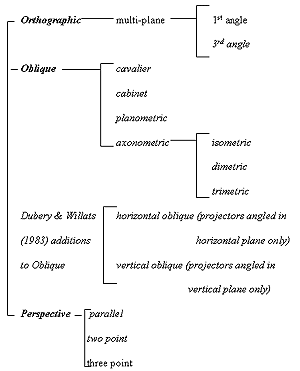
Willat's classification scheme for projection systems based on secondary geometry (as adapted in Drawing as Transformation: From Primary Geometry to Sedondary Geometry by Howard Riley (2001))

Willats instead proposes a new system based on secondary geometry, focusing on the picture surface instead of an abstract system of projection. Here, orthographic refers only to rendered objects that face in parallel to the picture plane. Oblique and isometric are grouped together as methods that render three sides of an object that is at an oblique angle to the picture plane (note that Willats includes a few new oblique definitions first described in Perspective and Other Drawing Systems by Fred Dubery and John Willats (1983) pp 21-28).

Conclusion, and What's Right for Me

Willats rightly cites the primary geometry system of projection as unintuitive and not really how people think about drawing images.

However, my study is in computer graphics and there are a lot of cases where this method is how the computer makes a 2-D image from 3-D data. Graphics shaders make calculations both in eye-space (coordinates on the screen, akin to secondary geometry) and scene-space (coordinates in the virtual world, akin to primary geometry). The digital tools I wish to use in order to affect camera perspective in my digital project also function in a similar manner.

Figure 3-1. Classification of projections from "Planar Geometric Projections and Viewing Transformations" by Carlbom and Paciorek (1978) pg. 475

Insted, the taxonomic system I use is heavily based on the classification system found in "Planar Geometric Projections and Viewing Transformations" by Ingrid Carlbom and Joseph Paciorek, Computing Surveys, vol. 10, no. 4 (1978). This system has been an established standard in computer graphics for decades, and was incorporated (and slightly expanded upon) into Computer Graphics: Principles and Practice, Second Edition by Foley, van Dam, Feiner, and Hughes (1990) pg. 237. This system also matches the one adapted by the University of Montreal academics in their studies of digital game graphics (see "A New Angle on Parallel Languages" by Audrey Larochelle, GAME: The Italian Journal of Game Studies, vol. 1, no. 2 (2013) and "The Game FAVR: A Framework for the Analysis of Visual Representation in Video Games" by Dominic Arsenault, Pierre-Marc Côté, and Audrey Larochelle, Loading…Journal of the Canadian Game Studies Association, vol.9, no.14).

In this classification system, "axonometric" refers to isometric projection and its kin (dimetric and trimetric). Oblique is a separate classification based on the obliqueness of their projectors.

More on my taxonomy system in another blog post...

Tuesday, July 11, 2023

Defining: Axonometry, pt. 1

Taxonomy of Virtual Spaces

Part of my research is in defining a framework and vocabulary for analyzing and describing the concept of spatiality in digital media (especially in digital game environments). This "Taxonomy of Virtual Spaces" (Rowe, unpublished) is a tool for recognizing and clearly defining the aesthetic styles of digital games that I call spatial paradigms. How are these virtual spaces of the game world projected as 2-D images onto the display screen?

One might think that many of the terms used in the creation of graphic spaces would be well-defined and agreed upon. In truth, there are a number of terms that are used in different ways and may have conflicting definitions in computer graphics, engineering, and architecture. Because of this game developers, journalists, academics, and critics may end up picking and choosing the meanings behind these words from different sources.

One particularly troublesome word is axonometric.

Axonometry defined

An axonometric (taken from the Ancient Greek roots axon (axis) + metron (measure)) drawing is one in which a rendered object can be measured across all three axes (x axis, y axis, and z axis). The object's axes are not parallel and not orthogonal to the projection plane, allowing three faces of the object to be seen in the image.
"An axonometric projection usually represents an object so that three adjacent faces are visible, in order to get a three-dimensional representation in one view." from "Planar Geometric Projections and Viewing Transformations" by Ingrid Carlbom and Joseph Paciorek, Computing Surveys, vol. 10, no. 4 (1978) pg. 473
"Axonometric projection is a method of parallel projection in which the axes of the object represented are not parallel to the projective plane in order to represent all three points of views (x, y and z)." from "A New Angle on Parallel Languages" by Audrey Larochelle, GAME: The Italian Journal of Game Studies, vol. 1, no. 2 (2013) pg. 35
Axonometric projection of an object from 3-D space to 2-D screen, from Engineering Drawing for Manufacture by Brian Griffiths (2002), pg. 26

An axonometric drawing is a type of parallel projection in which a 3-D object is transformed into a 2-D image on the projection plane (a.k.a. screen or picture plane or projective plane). This is an affine (from Latin affinis "connected with") transformation, meaning that the angles on the object may differ, but straight lines remain straight and parallel lines remain parallel. Being a parallel projection (or a paraline drawing), lines do not converge and objects do not reduce in size with distance from the projection plane (as seen in perspectival projections (a.k.a. linear projections).
"... allow angles to differ, so long as all straight lines remain straight and all parallels remain parallel. Such transformations are known as 'affine.'" from Drawing Distinctions by Patrick Maynard (2005) pg. 24

"[An] important property of axonometry is its fixed relation between sizes of objects in world space and those on projected space, independent of the positions of the objects in projected space. In linear perspective, objects become smaller when they move farther away; not so in axonometric perspective. This means that you can measure the size of an object of a axonometric drawing and know how big the real object is (you need to know the scale of the drawing and the properties of the projection, but nothing else), something that cannot be done with linear perspective. This leads to the name of the projection: the word 'axonometry' means 'measurable from the axes.'" from "Axonometric Projections - A Technical Overview" by Thiadmer Riemersma (2009)

Testing the Definition

So far, so good. The above defining qualities are valid for any use of the word "axonometric" with regard to rendering an object to a 2-D surface. Well, almost any use, that is:

"3/4 view" here classified as "axonometric," even though it only shows two faces of an object, from "Game Developer's Guide to Graphic Projections, Part 1" by Matej Jan (2017)

Other than that previous exception, axonometric always means a parallel projection in which all three main faces of an object can be seen in one image.

Now, how axonometric renderings developed through history?


Wednesday, February 8, 2023

Presence in Digital Games

An overview of some of the works of measuring a player's sense of spatial presence in digital games.

"Self Assessment Manikin" used to measure subjective telepresence (David Weibel, 2008)

When and How to Assess Subjective Overall Judgments of Presence

Bartholomäus Wissmath, David Weibel, Daniel Stricker (2008)

Abstract:

This study investigates differences between subjective on- line- and post-immersion measures, verbally and pictorially anchored scales, and the effects of content on those different measures. These factors were investigated by means of a 2x2x2 within-subjects-design. Participants (N = 162) evaluated two video clips. Against our expectations the findings suggest on- line- and post-immersion measures to be interchangeable. In line with findings from other fields than presence, pictorially anchored items seem to have major advantages when overall judgments are to be assessed. The advantages of pictorially anchored items apply in particular for language-containing environments.

Conclusions:

This piece of research suggests the adoption of post-rating scales as participants seem to be able to provide ex post highly accurate overall estimation of the presence experienced. However, when temporal variations of presence are of particular interest, our study suggests that overall on-line ratings do not interfere the sense of presence.


This study contributes to findings suggesting advantages of visually anchored measures in terms of efficacy and validity. The presence community could try to establish and investigate more specific (i.e. addressing sub-dimensions of presence) non- verbal subjective rating tools.


When assessing an overall estimation of presence, the advantages of visually anchored measures seem to pay off especially with language-based environments. Researchers should keep that in mind when setting up an investigation focusing on such environments.

A Cognitive-Heuristics Approach to Understanding Presence in Virtual Environments

S. Shyam Sundar, Anne Oeldorf-Hirsch, Amulya Garga (2008)

Abstract:

A strange paradox surrounds the role played by technology in inducing presence. The more sophisticated the technology, the greater the presence, which means greater invisibility of the technology. While we know that advancements in media technology, from larger screens to more interactivity, can enhance the sense of presence, the theoretical mechanisms by which this occurs are yet to be specified. We address this shortcoming by proposing that user interpretation of technology critically mediates the relationship between technological factors and a sense of presence. In particular, we adapt the MAIN model [1] to propose that technological affordances transmit cues that trigger cognitive heuristics leading to perceptions of presence. This paper identifies and describes a sample of heuristics triggered by modality, agency, interactivity, and navigability. Applications to 3D environments exemplify this approach by identifying specific cues and demonstrating the operation of the proposed heuristics en route to generating presence.

Immersion in Computer Games: The Role of Spatial Presence and Flow

D. Weibel, Bartholomaus Wissmath (2011)

Conclusion:

We attempted to examine the relation between presence and flow. The results of exploratory as well as confirmatory factor provides empirical evidence that flow and presence are distinct constructs, the first referring to the sensation of being involved in the gaming action, the latter referring to the sensation of being there. Furthermore, we could show within three different computer games that immersive tendency and the (pre)motivation contribute to presence and flow. Flow in turn influences enjoyment and performance. In addition, flow mediates the relationship between presence and enjoyment. In two of the three studies, flow also mediates between presence and performance. Our study shows that flow is a central construct and may explain the popularity of computer games. Computer Games seem to be ideal to induce flow experiences. This might be because the difficulty level of a computer game is usually varying. As a consequence, it is likely that the balance between challenge and skills is rather given compared to other applications. However, this a mere speculation which should be tested in future studies.

Spatial Models: Discrete vs. Continuous

Taxonomy of Virtual Spaces Wardrip-Fruin, Noah. (2020).   How Pac-Man Eats . Cambridge, Massachusetts: The MIT Press. Today, I return to the...