Showing posts with label spatial paradigm. Show all posts

Wednesday, July 2, 2025

A "Cartoony" Spatial Paradigm? pt. 6 (Mixed elevation projections)

Taxonomy of Virtual Spaces

This post continues my exploration toward evaluating a spatial paradigm of "cartoony" digital games, which evolved through the early 1980s. Part one analyzed two important early titles, namely Cutie Q and Pac-Man. Part two looked at some Pac-Man clones and FroggerPart three analyzed some "maze shooters" and "maze looters." Part four explores how maze games evolved into platform games. Part five examined "maze tunneler" games where the player digs their own mazes as they explore.

This post examines the "facing" of cartoony sprite characters drawn to game screens using elevation projections (side-facing or front-facing). Pac-Man and Super Mario Bros. both use a mix of front and side views with characters sharing the same game space. Mario's sprites evolved through different projections over several games until settling into a 3/4 view: side-facing but slightly twisted to show detail on the front of the character. This matches the acting method of "cheating out," where actors in profile will turn slightly toward the camera or audience to be seen better.

Back to Pac-Man

Pac-Man level 256 glitch

I wrote up a visuo-spatial analysis of Pac-Man way back in 
part one of this series, copied here:

Pac-Man Visuo-Spatial Analysis: The game screen emulates an orthographic plan view of a maze (not unlike a hedge maze) seen from overhead. It could be argued that the maze is seen from the side, but the lack of gravity that pulls to the bottom of the screen (this is not a platformer) and similarity to overhead driving games like Head On support a view from above. The character images are shown in orthographic front and side elevation views, much like in Cutie QThis creates an incongruity between characters and their environment, one that I wrote about before (see the Orthographic Projection section). The game has a sense of continuous 2-D game space limited to a single screen (fixed frame) with a cylindrical topology (characters may move directly from one edge of the maze to the other by using the side tunnels).

Pac-Man characters

The characters of Pac-Man are illustrated in two different types of elevation projections. The ghost monsters look around toward the direction they are moving, but they read as front-facing because both eyes are visible to the player. Pac-Man is seen as side-facing, clearly showing his opening mouth in profile. The characters are drawn as if facing in different directions, yet they still read as if they are sharing the same space.

The Front-Facing Goomba

Super Mario Bros. Goomba, Koopa Troopa, and Super Mario

In Super Mario Bros., most enemy characters are drawn in a side-facing projection with two frames of animation, like the Koopa Troopa above. When such a character moves in the opposite direction, the frames of animation are flipped to face the other way. The Goomba is unusual in that it is a front-facing character with only one sprite frame that is mirrored left and right to give the illusion of a walking animation.

Blooper and Toad are the only other front-facing characters in SMB 1. Lakitu and Cheep-Cheep are drawn in 3/4 view. All other characters are side-facing.

As revealed by designer Takashi Tezuka in an Iwata Asks interview, The Goomba was the last character designed for the game and there were very few bytes available for additional graphics in the game cartridge's CHR-ROM chip. The team only had room for one 32 x 32 sprite that could be "animated" by flipping the image. They settled on a front-facing character that would look fine walking either left or right.

Early Incarnations of Mario

The Australian author and pixel artist known as NFGMan analyzed several different eras or generations of early Mario sprite designs. These sprites are organized by shared qualities in visual style rather than being strictly organized by year. This shows how different artistic styles may overlap in time and a single art style may transcend hardware devices.
"Mario 1.0" sprites, image from NFG Games The Evolution of Mario

Standing Mario sprites in the first image:
  • Donkey Kong (1981, arcade)
  • Donkey Kong Jr. (1982, arcade) (as the villain)
  • Mario Bros. (1983, arcade)
  • Wrecking Crew (1985, NES)
  • Super Mario Bros. (1985, NES) (with Super Mario sprite)
  • Super Mario Land (1989, Game Boy) (with Super Mario sprite).

Each of these early Mario sprites features a side-facing head seen in profile. Each Mario head shares distinctive features, with one visible eye, a crooked nose, sideburns, and bushy long hair.

The sprite bodies are drawn in different facings. The Donkey Kong sprite is close to a side view with one foot in front of the other, ready to move forward. The Donkey Kong Jr., Mario Bros., and Wrecking Crew bodies are drawn in more of a 3/4 view, with the front of Mario's overalls visible. Note that Mario's feet are pointed in both directions, ready to turn on a dime and start running. The Super game sprites all have front-facing bodies with body weight balanced in both the left and right directions.

"2nd Gen Mario" sprites, image from NFG Games The Evolution of Mario

Standing Mario sprites in the second image:
  • Super Mario Bros. 2 (1988, NES) (with Super Mario sprite)
  • Super Mario Bros. 3 (1990, NES) (with Super Mario sprite)
  • Donkey Kong (1994, Game Boy)
This era of Mario sprites is notable for their dark outlines that help the character stand out from many different types of backgrounds.

Mario's hat has undergone a change, now looking more like a newsboy or fisherman's cap than the previous baseball cap appearance. The SMB 2 head is turned in a 3/4 view, with both eyes and both sides of Mario's mustache visible, but the other two games return to a side view profile. SMB 2 and SMB 3 give Mario a cartoonishly round nose while DK '94 gives Mario back his crooked, original nose.

The SMB 2 and SMB 3 bodies are at a slight 3/4 view, with both of Mario's overall buttons visible in his Super incarnations.

The DK '94 design, with its side view profile, crooked nose, and long hair, is intentionally anachronistic to harken back to Mario's arcade Donkey Kong roots. However, he does retain the big eyes and updated cap.

"The Mario Renaissance" sprites, image from NFG Games The Evolution of Mario

Standing Mario sprites in the third image:
  • Super Mario World (1991, SNES) (with Super Mario sprite)
  • Super Mario All-Stars (1993, SNES) (SMB 1 design, with Super Mario sprite)
  • Super Mario All-Stars (1993, SNES) (SMB 2 design, with Super Mario sprite)
  • Super Mario Land 2 (1992, Game Boy) (with Super Mario sprite)
Mario's design did not change much in the transition from the NES to the SNES, but the 16-bit system did allow the characters to be drawn with more colors. Super Mario All-Stars rereleased the original three Super Mario Bros. games with updated art on the SNES.

Super Mario World and Super Mario Land 2 designs closely follow the 3/4 view, round nose, and big eyes seen in the original SMB 2 design. The Super Mario All-Stars designs mostly follow the original games, with the exception that the All-Star SMB 1 uses graphics nearly identical to SMB 3 (not shown)

Over 12 years of development (not counting DK '94), Mario's design evolved from a flat profile view to a full-body 3/4 view, giving an enhanced sense of dimensionality to the character and conveying more facial details.

To be continued...

Wednesday, July 10, 2024

(Not) Game Genres, pt. 14: John Nesky's 2D Game Solid Boundary Types

Taxonomy of Virtual Spaces

In 2022, John Nesky (Feel Engineer on Journey (Thatgamecompany, 2012)) wrote Twitter thread analyzing various stylistic choices a game artist may make when designing the boundaries of a 2-D game (like many 2-D platformer games). He preserved the thread as a Google document and in pdf format for easy reference.

2D Game Solid Boundary Types by John Nesky

Nesky's analysis of visual styles has some crossover with my current work in analyzing the spatial paradigms of many platformer games. Each example image (see illustration above) features Samus Aran from Super Metroid (Nintendo, 1994) in an environment constructed by Nesky according to these different stylistic techniques. His design study tends to focus on 2-D platformers, but he also shows how the techniques work for other types of games.

2D Game Solid Boundary Types

Nesky defines 10 different art styles used convey the "fourth wall" through which the player views the game environment. The world is often presented as if in an architectural cross-sectional view, using the game's plane of action as the cutting plane. The navigable area of the game's environment is clearly rendered, but the internal structure of that environment (inside the walls, floors, and ceilings) may be abstracted (surface layer), hidden (silhouette), or stylistically presented (wide open spaces).

  1. Modular Blocks
  2. Flat Façade
  3. Jutting Floor
  4. Surface Layer
  5. Deep Shadows
  6. Silhouette
  7. Perspective
  8. Fake Perspective
  9. Wide Open Spaces
  10. Thin Walls

Most of these styles are designed around the capabilities of tile-based environment graphics, like those seen in earlier game consoles like NES, SMS, SNES, and Genesis. These styles do not take foreground or background elements into consideration. They only focus on the environment along the game's plane of action.

Analyzing the Analysis

There are three types of projection methods here that line up with my Taxonomy of Virtual Spaces.

Modular Blocks by John Nesky

Orthographic (Modular Blocks, Flat Façade, Jutting Floor, Surface Layer, Deep Shadows, Silhouette, Wide Open Spaces, Thin Walls)

For my purposes of analyzing spatiality, most of the the styles here are different methods of orthographic projection. The examples above all use a side elevation projection for the environment. Styles like Wide Open Spaces and Jutting Floor do convey a small sense of depth, as if the floors or environmental elements break through space into a foreground layer. However, this projection method tends to convey to the viewer that this is a flat space.

Fake Perspective by John Nesky

Oblique (various) (Fake Perspective)

Nesky's Fake Perspective examples each show the receding lines of the game environment's ground plane (or in the case of The Legend of Zelda: A Link to the Past, the dungeon walls). There are several different projection techniques in these examples.

Yoshi's Island uses a vertical oblique projection, where the side face of the front "wall" is flatly rendered orthogonally and the receding lines of the floor plane are rendered vertically (compare to Yo! Noid on my previous post).

Two games use different oblique projections to render a naive perspective view and a sense of depth: Yoshi's Story (elevation oblique) and Link to the Past (planometric oblique). The receding oblique lines in Yoshi's Story are mirrored left and right, creating an illusion that the lines are converging towards the horizon line. Link to the Past similarly mirrors its oblique lines at the corners of the room to convey a similar illusion. These are not true perspective renderings, though they use some of the same visual cues of a perspective projection.

Nesky's own example is also naive perspective, but the receding lines of the short wall in front of the player avatar appears to be inverted naive perspective: the receding lines diverge into the background instead of converging.

Perspective by John Nesky

Perspectival (usually 1-point) (Perspective)

Curiously, Nesky's first example is a vertical oblique projection and is not truly perspectival at all. This is a paraline projection and receding lines do not coverge in the distance.

Nesky's other Perspective examples are presented in 1-point perspectiveMetroid Dread and Link Between Worlds both use full 3-D environments with the camera perpendicular to the back wall (Metroid) or the floor (Zelda). Both games usually retain a fairly flat view of their environments to mirror the gameplay standards of earlier 2-D games in their respective series. Being fully 3-D environments, the camera is also free to tilt and pivot to more dramatic angles as needed, breaking into 2-point or 3-point perspective.

The other example is Contra III, a game I referenced in my previous post). This scene also uses 1-point perspective, although this Super Nintendo title uses a tiled background and no true 3-D models. Another Twitter user joined Nesky's thread and asked, "Why isn't the Contra III example here Fake Perspective?"

Contrast the receding lines of Contra III and Link to the Past environments

I responded to the question with the above altered screen shots and stated that one can trace the receding lines of the environment to see if they converge. Contra III's lines converge almost perfectly on the center of the screen. Each line is projected at a different angle. In contrast, Link to the Past uses a naive perspective technique with the receding lines of each corner of the environment projected obliquely at about 45° from the horizontal. This offers a convincing sense of depth and is fully in line with the art style of the original Legend of Zelda, but it is not a true 1-point perspective.

Odds and Ends

Nesky also gives several separate games as examples of specific uses of these techniques that I think are worth mentioning as they overlap with my research (especially since these are two of my favorite games).

The Legend of Zelda: A Link to the Past

Nesky notes that Link to the Past uses different projection methods for indoor and outdoor environments. He refers to outdoor projection as orthographic, which I define as orthogonal (a classic "top down" view as opposed to a direct overhead view). He does note the unusual fact that you can see the horizon from the pyramid, something that should be impossible from a planometric projection! This is another example where the conceptual image plane of the background is rendered differently from the environment (see here and here).

Horizontal oblique projection in Flashback

Nesky also notes that Flashback's projection is "angled sideways," or in what is called a horizontal oblique projection. As he states, "This visually preserves precise vertical distances while adding depth to the world. Door frames and platform railings are rendered in front of the avatar." There are many doors in Flashback and this aspect is important to making them look like doors instead of walls.

Conclusion

Nesky is not an expert on the technical details of different projection methods, and he fully admits that is the case. But this was never the point of his study. His study focuses on the specific stylistic choices that game artists use (especially those making tile-based "pixel art" games) to define that invisible fourth wall that is coplanar to the player's screen. He has created another method of defining and grouping games by their aesthetic choices rather than purely by technical or genre classifications and I applaud his work.

Tuesday, July 9, 2024

Digital Project Plans Part II

Taxonomy of Virtual Spaces Part II

Over the summer of 2024, I returning to my prototype digital project to explore the planar geometric projection options that I concluded last summer, named for my Taxonomy of Digital Spaces framework and vocabulary for analyzing the different visuo-spatial configurations of virtual spaces (spatial paradigms) in digital games. 

Link to itch.io prototype build that is playable in browser.

The prototype build simulates the "Filmation" spatial paradigm featured in many popular computer games in the UK in the 1980s, 1990s, and is having something of a resurgence today. The game's projection method can be changed on the fly by pressing the "T" key. 

This year's goal is to incorporate spatial paradigms seen in side scrolling platformers, run-n-gun games, and other influential game genres. These stylistic differences in game graphics can change a player's sense of space as they navigate their avatar through a virtual world.

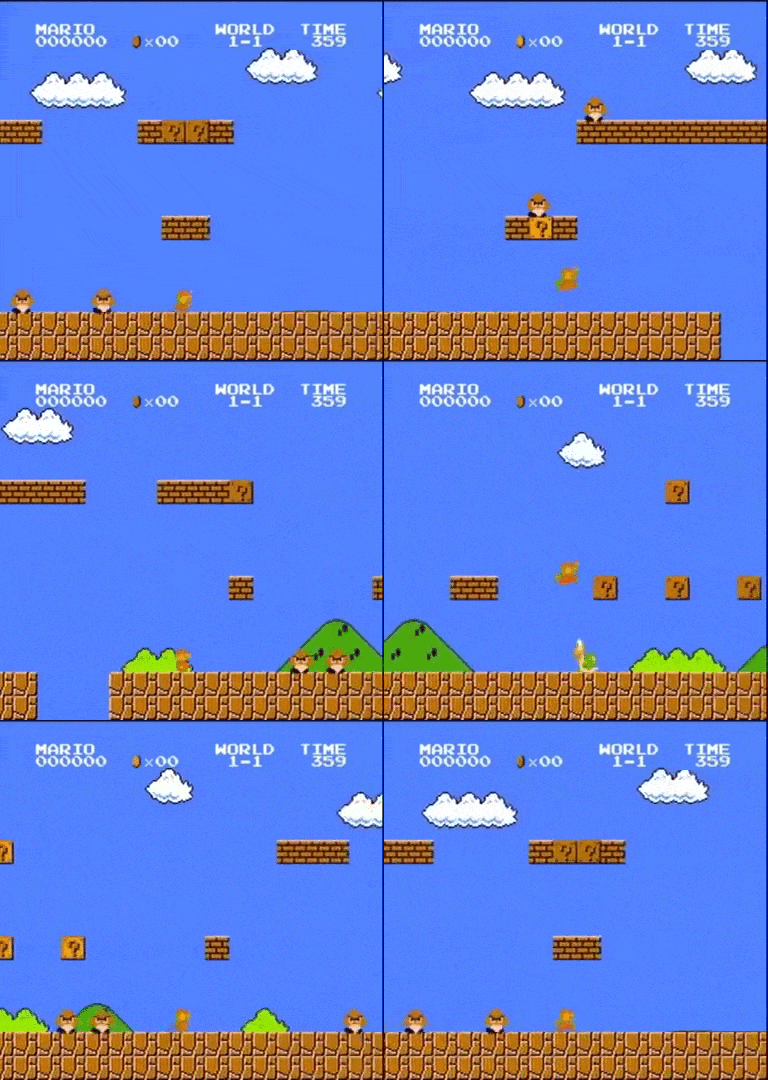
Take Super Mario Bros. as an example. The graphical presentation is very flat, with every game object and environment tile rendered in an orthographic projection. The virtual space has very little sense of depth and Mario's feet land on the top edge of a ground tile.

FlatSpace_SMB_b.gif
Super Mario Bros. (Nintendo, 1985)

However, surviving design documentation shows that SMB creators had a vertical orthogonal (sometimes called vertical oblique) projection method in mind for the environment. This allows the player to see the top surface of the ground plane as well as give a side view of the ground tiles. Mario's feet would land in the middle of a ground surface tile.

Super Mario Bros. design document.

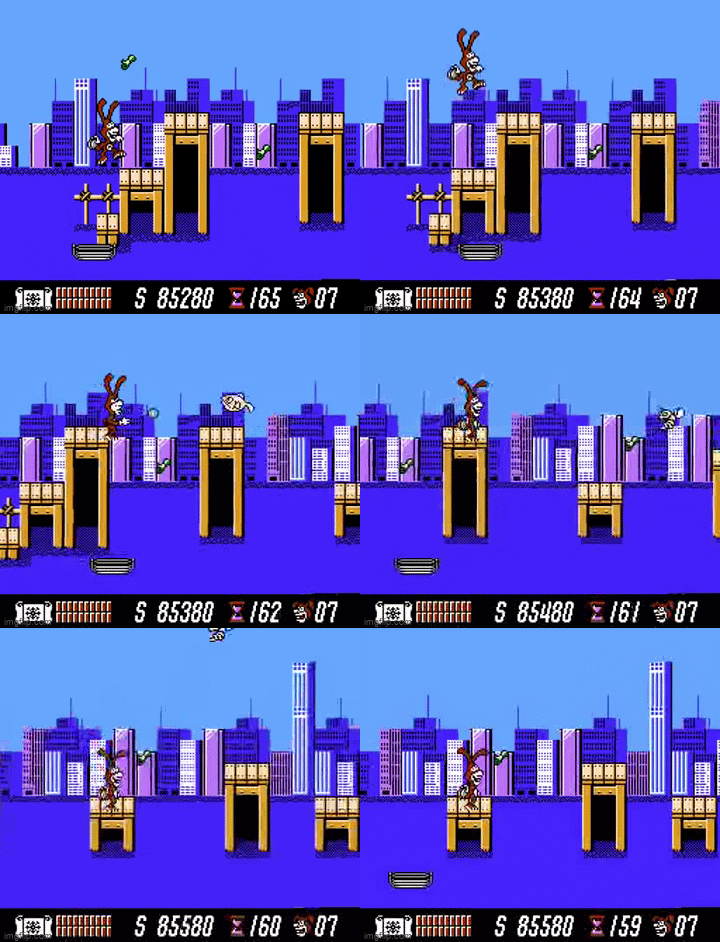
This design document illustration is similar to the spatial paradigm seen in Yo! Noid, where the Noid's feet land near the middle of the ground surface tiles. The receding lines of the ground surface are rendered vertically in parallel on the screen. This appears to give slightly more of a sense of depth than SMB, but still feels fairly flat to me.

Yo! Noid (Capcom, 1990)

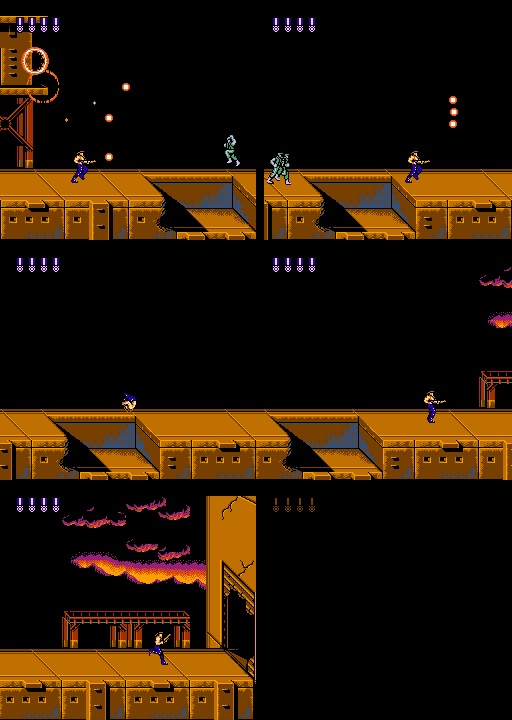
Compare this to Super C with its elevation oblique projection of its environment in the platformer-like stages. The receding lines of the ground plane tiles are rendered in parallel at an oblique angle instead of vertical lines. This technique is also used into the near foreground and background, giving a continuous sense of space for some distance in front of and behind the player character's plane of action. The player avatar appears to be running along a wide surface, not a razor-thin plane.

CavProj_SuperC_b.gif
Super C (Konami, 1988)

All three games above were created for the NES (or Famicom in Japan) game console, but each game had different technical capabilities. SMB uses Nintendo's original NROM memory mapper format with 32KB PRG ROM (game program ROM) and only 8KB CHR ROM ("character" or graphics ROM). Yo! Noid uses the MMC1 memory mapper and 128KB PRG/128KB CHR. Super C uses the MMC3 memory mapper and 128KB PRG/128KB CHR. Noid and Super C could feature more varied graphics in different levels throughout the games while SMB was restricted to a mere 8KB of graphics data for the entire game. It is likely that SMB's CHR ROM size restriction was a factor in not using a more complex projection method for rendering the environment.

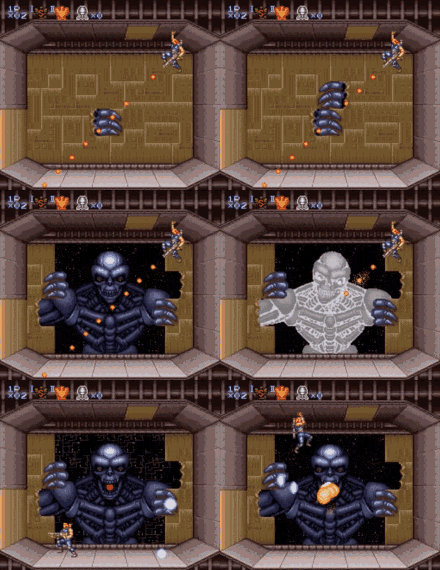
The three different techniques shown above are examples of paraline projections (receding lines do not converge in the distance). Compare this to the 1-point perspectival projection used in Contra III, shown below. In this boss fight, the receding lines of the environment converge on a single point on the horizon. The player avatar moves along the ground, walls, and ceiling of the inside of a room that appears to recede into the background, with a giant boss enemy emerging from the rear wall. This game was created for the Super NES (Super Famicom) console, which features a faster processor and built-in graphics modes for simulated 3-D effects that are not present in the earlier NES console.

Contra III: The Alien Wars (Konami, 1992)

I will be adding these spatial paradigms and more to my digital project. The player will be able to switch between these paradigms at will while still exploring the same virtual world.

The final goal of my research is to define game aesthetics by their spatial qualities dealing with the embodied phenomenon of navigating virtual spaces, a cyberkinaesthetic experience. I posit that specific aesthetic trends and styles can be traced through our young art form's history and create a new diachronic "art history" of digital games in the process.

Sunday, November 19, 2023

(Not) Game Genres, pt. 12: Comparing Visuospatial Configurations and Terminology

Taxonomy of Virtual Spaces

Over the past several posts in my (Not) Game Genres series, I've reviewed numerous systems for analyzing video game space in comparison to my Taxonomy of Virtual Spaces system. This post serves as an overview of the Taxonomy and a summary of the previous posts together in one place.

Each chart below presents the 

Mark J. P. Wolf's Elementary Spatial Structures of Video Games first published in "Inventing Space: Toward a Taxonomy of On- and Off-Screen Space in Video Games" from Film Quarterly (Fall 1997, vol. 51, no. 1). [previous post part 1 and part 2]

Steven Poole's Construction of Space in Video Games from Trigger Happy: The Inner Life of Video Games (2000). [previous post]

Espen Aarseth and his team's Multi-Dimensional Typology of Games from "A Multi-Dimensional Typology of Games" (in DiGRA '03 - Proceedings of the 2003 DiGRA International Conference: Level Up2003). [prevous post]

Clara Fernández-Vara and her team's Ontology of Spatial Configurations from "Evolution of Spatial Configurations In Videogames" (in DiGRA '05 - Proceedings of the 2005 DiGRA International Conference: Changing Views: Worlds in Play2005). [previous post]

Dominic Arsenault and his team's Game FAVR from "Game FAVR: A Framework for the Analysis of Visual Representation in Video Games" (in Loading… Journal of the Canadian Game Studies Association, vol. 9, no. 14, 2015). [no individual post, but discussed here and here]

The Game FAVR system is designed to analyze game visuals, and explicitly does not concern itself with game spatiality. Even so, I've adapted the core structure of Game FAVR (especially with the Three Image Planes) as the basis of my own system to analyze the visuospatial configuration of a virtual environment.

Gameworld

The gameworld is the defining qualities of a game’s virtual environment, as defined here by its topology and spatiality. A game may, and often does, feature several gameworlds divided into separate “worlds,” “levels,” or “campaigns,” depending on the game’s terminology.

The Topology of a gameworld deals with how the game's world is mapped out and what happens when one reaches the edge of the world. There are several single-screen "wraparound" games, most notably Pac-Man (Cylindrical) and Asteroids (Toroidal). Additionally, some smoth-scrolling games use these types of topologies, including Defender (Cylindrical) and Bosconian (Toroidal). These topologies aren't just for 2-D games, either. Hideo Kojima and Guillermo del Toro's horror game demo P.T. also features a Cylindrical topology where the player's path is on a loop. Other spatial systems lump these different topologies under the "wraparound" concept, though Poole does note that games like Asteroids are Toroidal.

As yet, the only game I've found that uses Cubic topology is E.T. for the Atari 2600.

To me, the spatial structure of the gameworld is expressed through the player's affordances in navigating that world, what Clara Fernández-Vara and her team call the "Cardinality of Gameworld." A game's visuals (what Clara Fernández-Vara would call "Spatial Representation") may appear three-dimensional, but a player's movement may only be restricted to a two-dimensional plane, or only a limited grid of discrete spaces.

The Continuous/Discrete Spatiality dichotomy is the only point where Aarseth's system intersects with my own.


This miscellaneous category expresses additional details about how the player understands the gameworld, such as the presence of a Mini-Map or Non-Euclidean Geometry. Gameworlds are also classified by presence and type of Gravity, though this quality has more affect on the player's ability to navigate in a game rather than giving a sense of spatiality. I will probably move this aspect into the player's affordances.


Wolf is the only other author to note that "mapped" spaces (mini-maps) are important to a player's sense of a game's space. A mini-map provides information about what is happening off-screen, allowing the player to think about an entire environment as a whole rather than just what is in front of their eyes. Wolf also makes mention of non-Euclidian geometry, without specifically using that term.

Framing Device

The frame, or the game screen, is the player’s window on the game world. This defines how the frame pans across or trucks through the environment and what directional controls the player has over the frame. 

The frame's mobility across the gameworld deals with what Clara Fernández-Vara and her team call the "Spatial Configuration." The directions the frame may move across the gameworld is what they call the "Cardinality of Gameplay." These are both different from the "Spatial Representation" (if the game looks like it has 2-D or 3-D objects) and "Cardinality of Gameworld" (the axes along which a player avatar may move through the gameworld). Personally, I find the terms Cardinality of Gameplay (defined as "how the player can move around the gameworld") and Cardinality of Gameworld (defined as "the way in which the player can navigate the space") unclear, as the terms "move" and "navigate" are not explicitly defined and differentiated.

Image Planes

Similar to the guidelines of the Game FAVR, each game image is divided into the conceptual planes of Agents, Environment, and Background/Foreground.


The agents are any interactive characters or objects in the game, including the player avatar and projectiles. The environment is the tangible space where agents navigate through and around. Background/foreground was chosen as more commonly understood terminology to replace Game FAVR's “off-game environment.”


Projection methods are formal, detailed qualities about how the objects in the image plane are “drawn” to the screen. This is close to what Clara Fernández-Vara and her team refer to as "Spatial Representation." The Game FAVR deals with formal qualities of game visuals and my system closely mirrors it. I adapted detailed, standardized terminology used in computer graphics from  "Planar Geometric Projections and Viewing Transformations" by Ingrid Carlbom and Joseph Paciorek (in Computing Surveys, vol. 10, no. 4, 1978).


The apparent projection angle is either Dynamic or fixed at a specific angle above the horizon line. Each fixed projection is measured or estimated for the frame and rounded to the nearest 15° increment between (horizontal view) and 90° (overhead view) (see Figure 8). From the initial qualitative research performed, many games use , 90°, 35° (the standard dimetric (or "pixel isometric") projection angle), 15°, and . The Game FAVR is the only other system that deals with projection angles.

Conclusion

Other systems analyzed here focus solely on the spatiality of digital games. The Game FAVR explicitly serves as a tool for analyzing the graphic presentation of digital games. My Topology of Virtual Spaces is designed as a tool for analyzing the visuospatial qualities of digital games and, unsurprisingly, uses many non-overlapping details of the above systems to achieve this goal.

Thursday, September 7, 2023

Summer 2023 Summary and "Cartoony" Game Conclusions

I am happy to say that I was able to wrap up summer with some hands-on research at a terrific pinball parlor and video arcade while on an out-of-state road trip.

The author on a research trip to Spinners Pinball Arcade

I always prefer to experience these works on original hardware and in their proper context, and this location did not disappoint. There was a lot of machines, including many that I've recently been writing about. Also, I got to play some rare finds like Hercules (1979), the largest production-model pinball table and Atari's swan song in the pinball industry. 

This summer, I completed a digital project prototype and researched the evolution of game structures in the 1979-1982 period.


Taxonomy of Virtual Spaces Project


I completed a prototype of my project to explore different spatial paradigms seen in digital games (spatial paradigm defined as the visuo-spatial configuration of a virtual space and the player's affordances for navigating that space). My first test paradigm is the "Filmation" paradigm that became popular on the ZX Spectrum in the 1980s and is still used in games to this day (such as in Elephantasy: Flipside). My prototype approximates the environment and navigation of Knight Lore, probably the first game to use this spatial construction.

"Filmation" games use a pixel dimetric method of screen projection, common for "isometric" games of the era (such as Zaxxon and Q*bert). The prototype allows the player to press the "T" key to change projection method to true isometric (like Monument Valley) or pixel trimetric (like Crystal Castles). Some room arrangements become unclear or ambiguous with certain projection methods, making the spaces difficult for the player to comprehend or navigate. This may or may not be intended, as the level designer may use an ambiguous layout to trick the player with an illusion or create a difficult navigational puzzle to solve.

In true isometric projection, my character appears to be in the corner of the room...


...but it turns out that there is space between the top platform and the walls

My development blog posts:

Initial plans and research

Refinement of terms

Preproduction

Production

Conclusions:

I have been able to replicate the "fake 3-D" environment from and older computer game and replicated it fully 3-D, polygonal game data. Reconstructing in this manner allows me to quickly test different projection systems (three options so far) without having to redraw or recalculate all of the art assets needed to display the space.

Next steps:

In the future, I need to expand my project to project other types of spatial constructions and navigation methods. My work on researching a "cartoony" spatial paradigm (see below) gives guidelines for what types of projections, "camera" angles, and types of environments would be best to start with.

The intent is to create a tool for testing and remixing different game qualities on the fly to see how these options change the player's phenomenological experiences of the same virtual spaces (say, playing a 2-D platformer game in first person). The point is not to replicate an entire game experience, but focus on the spatial qualities and navigation affordances. This type of tool is helpful in game development and other forms of research. This will also serve as a "museum piece" of various spatial paradigms in games, not dissimilar to Traversing Virtual Dimensions, my other project presenting the early development of digital avatar navigation.


Toward a "Cartoony" Spatial Paradigm

Pac-Man (Namco, 1980) paragon of cartoony gaming

Additionally, I performed some research on the 1979-1982 game era when what I call "cartoony" graphics developed and became popular both in the USA and Japan.


I see a lot of correlation between the visual techniques of early digital games and traditional cel animation, so I feel there is something to uncover at this point where games started to hew closer to cartoons (and I don't just mean Dragon's Lair). Both forms of media can use similar techniques to create a sense of space and enhance visuals.

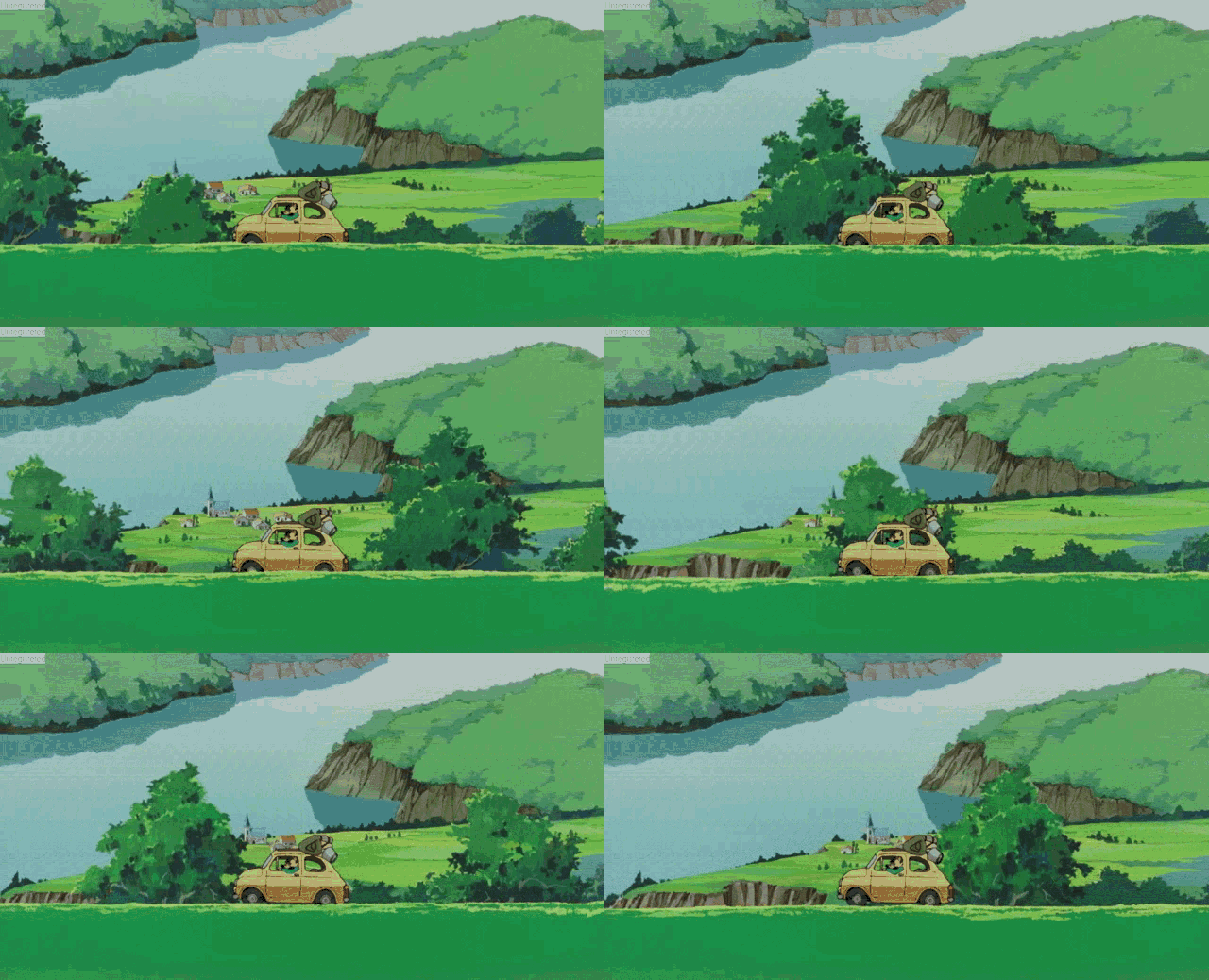
Parallax motion conveying deep space in Lupin III: The Castle of Cagliostro (1979)

Parallax motion conveying deep space in Moon Patrol (1982)

Both examples above use scrolling graphics on layered planes to create hybrid, yet cohesive, images. In each case, the vehicle appears to move through deep space, yet the two vehicles never change their x positions in the respective images.

Many other techniques are common to both cel animation and game graphics: limited color palettes, simple shapes, repeated animation cycles, characters with big heads to show facial details, etc.

Conclusions:

My research uncovered that there is not one but several "cartoony" spatial paradigms that evolved from one another during this golden era of arcade games with character. These will be directly useful in expanding my own lexicon of paradigm variations and options to incorporate into my digital project.

Also, even though my work specifically does not deal with game genres, I found myself coining new terms to understand these related families of games ("maze looter," "maze tunneler," "ladder/digger platformer").

This work is closer to the diachronic "art history" of evolving aesthetic styles I seek to create and I feel that my taxonomy of virtual spaces successfully conveys the exact spatial changes between game styles. 

How did digital games get a "cartoony" look? Part of the reason is because of technological advancement was required before detailed player avatar graphics and animations (think sprites) could convey a sense of character. ROM chips allowed far more detailed graphics than earlier diode-based images. ROM chips started to be used in arcade games by 1974 but the first "cartoony" game Cutie Q wasn't made until 1979. Toru Iwatani was likely inspired by the immensely popular anime Obake no Q-Tarō that he watched as a kid when he made an aesthetic decision to incorporate big-eyed, round, ghost-like characters in the game (he admits it was his influence for Pac-Man). Note also the similar "Q" designs in the titles of both:

Obake no Q-Tarō title card with upside-down smiling obake "Q" from the 1965 anime series

Japanese Cutie Q arcade instructions with similar "smiling Q" logo at top

It seems clear from my research that platformer games evolved from maze games. This is not surprising as "ladder" games have been considered a type of maze game. What is interesting is that Heiankyo Alien*, a little-known game here in the USA, may have been an influence on the biggest games of 1980 and 1981: Pac-Man and Donkey Kong (through influence on Space Panic).

*Fun fact: I bought my copy of Heiankyo Alien for Game Boy from fellow Drexel instructor and game history researcher Adrian Sandoval.

This section of study ends at 1982, which means there are plenty of other important examples that followed. 1983 would bring Bag Man, Bomberman, Congo Bongo, Crystal CastlesMappy, Mario Bros.Tapper, Track & Field, and more. All this in the midst of an arcade market slump and an outright crash of the home game market in the USA. I plan to continue developing this series in the future.

Spatial Models: Discrete vs. Continuous

Taxonomy of Virtual Spaces Wardrip-Fruin, Noah. (2020).   How Pac-Man Eats . Cambridge, Massachusetts: The MIT Press. Today, I return to the...