Showing posts with label Gran Trak 10. Show all posts

Friday, August 7, 2026

Single-Screen Racer to Maze Game Evolution (Racing Games pt. 4)

Taxonomy of Virtual Spaces

This is a continuing history of the evolution of early car racing games as analyzed according to each game's visuo-spatial configuration. Be sure to read part 1 and part 2 and part 3 before continuing.

This post covers the earliest racing games and shows how they may connect to the genre of maze games.

The Grandaddy of Them All: Gran Trak 10

Gran Trak 10 (Atari, 1974)
Photo by PresN (image source)

Atari pioneered the racing genre with the arcade game Gran Trak 10 (1974) (shown above). The game put players behind the steering wheel of a Formula One race car, complete with gear shift and gas pedal. The car is drawn to the screen in plan orthographic view with its extended axles and big tires making a distinctive silhouette. The car's "sprite" graphics data is stored in ROM (a first for a video arcade game) with enough image data to rotate the car in 32 different directions.

Gran Trak 10 (Atari, 1974)
image sourced from
this video

The race course is also drawn in plan orthographic view with the entire circuit on one screen - no scrolling needed. This gives a sense of having an elevated view of the course, as if watching the race from the grandstands instead of seated in a car on the track.

"Cartopia" remote controlled car installation by Kansei Seiki Seisakusho (a.k.a. KASCO)
probably from a sales flyer (1975) (image source)

This feels more like controlling a remote controlled car from afar (see above). This isn't necessarily a bad thing; the all-in-one view allows multiple players to share the same screen.

Indy 800 (1975)
from a Kee Games sales flyer

This same plan orthographic visuo-spatial configuration was repurposed for Atari's Le Mans (1976) and Sprint One (1978) while secret Atari subsidiary Kee Games released Formula K (1974). The two companies reused the overhead view in a number of multiplayer racers: Gran Trak 20 (1974), Twin Racer (1974), Sprint 2 (1976) (the "2" in the title is for the number of players), Sprint 4 (1977), and the astounding eight-player games Indy 800 (1975) (see above) and Sprint 8 (1978). 

As explored previously, Atari co-founder Nolan Bushnell wanted to develop a game that gave more of a first-person driving video game experience like some exciting electromechanical racing games he had played. Atari later met and exceeded those expectations with Night Driver (1976) and by licensing NAMCO's Pole Position (1981). But, that doesn't mean that the overhead view of Gran Trak 10 disappeared from the video landscape.

Destruction Derby and Car Polo

Crash 'n Score (Atari, 1975)

Crash 'n Score (1975) is Atari's modification of a destruction derby competition. In this one or two-player game, the goal is to drive your car through as many illuminated, numbered flags as possible while avoiding oil slicks and collisions with the other car. The controls and plan orthographic car graphics are nearly identical to those of Gran Trak (the two games may have some of the same data in their graphics ROMSs). The race course circuit is replaced by an open arena littered with flags and hazards. The big difference is that Crash 'n Score uses a toroidal topology: driving off one side of the screen causes your car to reappear on the opposite side (just like in Asteroids (1979)).
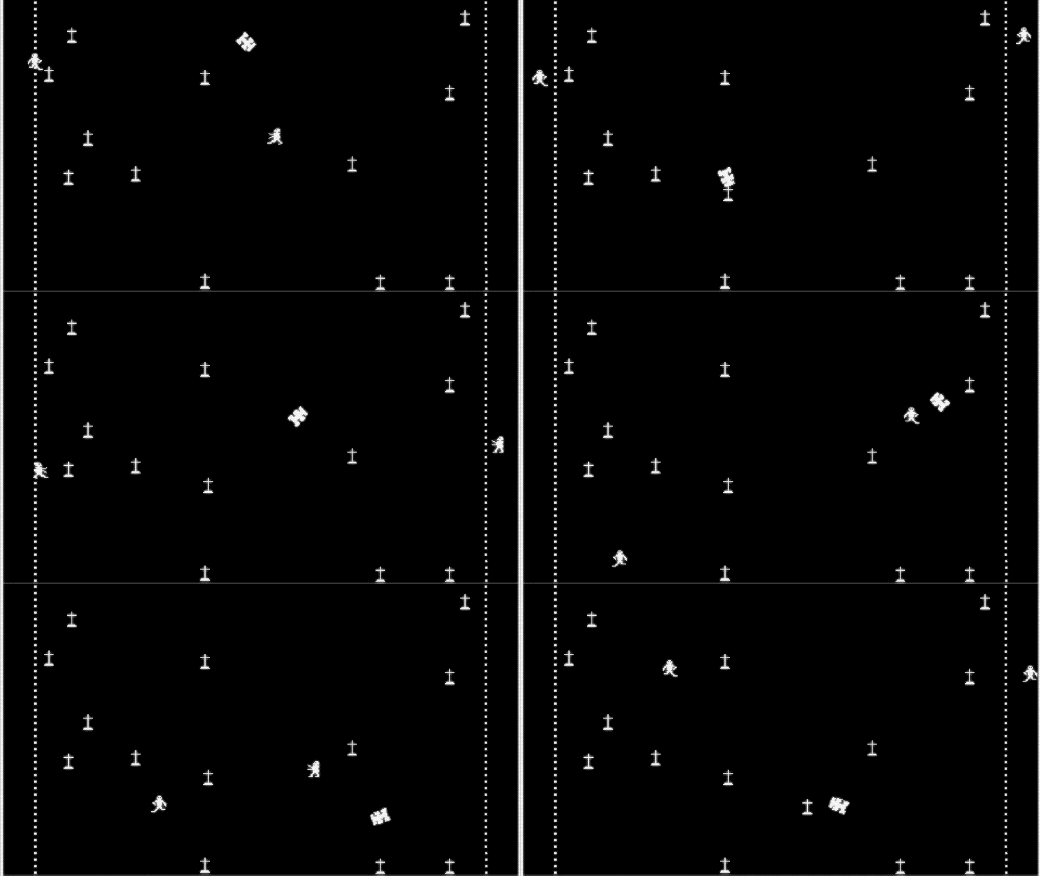
Death Race (Exidy, 1976)

The story behind Death Race (Exidy, 1976) is well known and oft-told, so I won't dwell on it here. Exidy was a small arcade game company when it developed Destruction Derby (1975). The game became popular, but Exidy was too small of a company to meet with demand, so the company gave Chicago Coin an exclusive license to make the game as Demolition Derby (1975). Unfortunately, Chicago Coin went out of business soon after, taking its exclusive license on the game into oblivion. Exidy needed a new design to bring in money, so they turned to hotshot game designer Howell Ivy, fresh from his stint at Ramtek designing games like Clean Sweep (1974) (inspiration for Breakout (Atari, 1976)), to create a new take on the old game. Ivy added "stick figure" targets to the destruction derby arena and a cylindrical topology that allowed players to freely drive between the top and bottom edges of the screen.

Car Polo (Exidy, 1977)


With a color screen and four driving controls, Howell Ivy was able to repurpose the old Destruction Derby design into Exidy's Car Polo (1977). The game features two teams of cars driving to knock a large ball into their opponent team's goal, which seems to be based on the dangerous sport of auto polo from the early 20th century. While the game is not well remembered today, it does eerily predict the success of Rocket League (Psyonix, 2015).

Atari Sprints Into the '80s

Track 7 from Super Sprint (Atari Games, 1986)

Atari returned to the Gran Trak/Le Mans/Sprint arcade racing game series eight years after the previous titles, Sprint One and Sprint 8. Super Sprint (1986) featured the same general overhead view of a racetrack circuit in one screen, but the environment uses vertical orthogonal rendering to give a sense of elevation change on the course. This allowed for banked turns (see the last two hairpin turns, above), jump gaps, and overpasses (see below). The environments are also drawn with perspectival clues, like slightly receding lines at the left and right edges of the image, though this is inconsistent with the rest of the imagery (cars do not reduce in apparent size when they are at the far side of the screen).

Track 8 from Super Sprint (Atari Games, 1986)

The game supported up to three human players to race against one or more computer-controlled "drone" cars. 

Badlands (Atari Games, 1989)

The quickly-released sequel Championship Sprint (Atari Games, 1986) included a few new obstacles and numerous new race courses, but did little to change the Super Sprint formula. Badlands (Atari Games, 1989) (above) added armed and armored cars for autoduelling in a post-apocalyptic future hellscape, but the Sprint series seemed to be overshadowed by a new racing upstart released in the same year as Badlands.

Ivan 'Ironman' Stewart's Super Off Road

Ivan 'Ironman' Stewart's Super Off Road (Leland Corporation, 1989)

The Leland Corporation was a video game company that rose from the ashes of former vector and laserdisc game pioneer Cinematronics. Leland produced the 3-player off-road arena racing game Super Off Road (1989) with a license to use racing star Ivan 'Ironman' Stewart's name and likeness. The smooth race courses of the Super Sprint games are replaced by dirt tracks with hills, jump ramps, pits, water hazards, slopes, corrugations ("washboards"), water hazards, and   other challenges. The Super Off Road environment is rendered in an elevation oblique style, where the face of the back wall is co-planar with the screen. This makes it easier for the players to see these changes in elevation in contrast to the Super Sprint series, where the ground plane is co-planar to the screen.
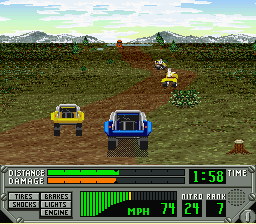
Super Off Road: The Baja for Super Nintendo (Leland Corporation, 1993)

Later games in the Super Off Road series abandoned multiplayer, the video arcade, and the overhead view for single-player home console games with depth horizon/Super Scaler inspired visuals. This line of single screen multiplayer racing games largely disappeared after 1989. 

Head-On?

Let's rewind time back to the late 1970s, in the heyday of Atari's original Gran Trak 10 inspired games. I argue that the lineage of maze games that became so prevalent in the early 1980s owes some inspiration to these single-screen racing games.

Head-On (SEGA/Gremlin, 1979)

As I wrote about extensively in a previous blog post, Head-On (1979) was a successful and influential maze game, probably the first of the "dot eater" genre. Game designer Lane Hauck said the idea for the game "just came to him," but it is hard not to see a Gran Trak 10 influence in the game's Formula One-style car graphics. The connection between the games is not explicit, but Atari's racing games were popular in the arcades and Hauck would have certainly been aware of them. This move from complex driving controls to a simpler single-joystick and "accelerator" button for movement that was both easier to learn and less expensive to manufacture.

The dot-eating (an early form of item collection) of Head-On was somewhat unusual in the post-Space Invaders (TAITO, 1978) era where clearing a game stage required eliminating all enemy targets. This is more similar to the Crash 'n Score flag-collecting model.

Car Hunt (SEGA, 1979 or 1980)

SEGA quickly followed up on the game's success with sequels Head-On 2 (1979) and Car Hunt (dated 1979, but probably 1980). Car Hunt introduced layered 2-D space to Head-On with the inclusion of an overpass.

Head-On was successful in the US and Japan and certainly influenced game designers in both countries. The orthogonal movement, tight passageways, dot-eating, and enemy avoidance are all elements of Pac-Man (NAMCO, 1980). I don't think Toru Iwatani ever admitted to being influenced by Head-On, but it would be quite a coincidence if he wasn't thinking about it when he created Pac-Man. Again, you can read more about this lineage of game development in a previous blog post.

NAMCO's Other Maze Game

Rally-X (1980)

Pac-Man is not the only NAMCO maze game of 1980 that appears to have a strong Head-On influence. Rally-X has the player driving a Formula One inspired car along orthogonal roads avoiding collisions with enemy cars. The player can only move in the four orthogonal directions, though there is a slight diagonal movement for about one frame when turning corners. A set of flags replace the dots to eat/run over (not unlike Atari's Crash 'n Score), but the primary player goal is to complete an exploration of the maze.

Note that a major change with this game is the player is not moving an object on the screen, they move the frame around the game environment. The player car remains stuck in the center of the view and the world moves around it. This frame navigation is not dissimilar to how Pole Position (1982) functions (and NAMCO programmer/hardware designer Kōichi Tashiro worked on both games). It also means that the Rally-X world does not have to be confined to a single screen.

Comparing mazes from Pac-Man and Rally-X (image source)

The Rally-X maze absolutely dwarfs the one in Pac-Man as seen in the comparison image above from the Retrogame Deconstruction Zone. This massive environment is far more than can be viewed on the screen at one time, which spurned the creation of a mini-map in the lower right corner of the screen. It acts like a radar screen, showing the locations of off-screen cars and flags, not the layout of the maze, and is similar to the one seen in Battlezone (Atari, 1980), released in the same month.

The concept of a game with a consistent "off-screen space" was still fairly new. You could not turn your car around and revisit an environment in an upscroller game. Rally-X and Battlezone both feature lasting game environments that don't disappear when you stop looking at them. The mini-map/radar displays enabled the user to think about the gameworld in two different scales: both what is currently in frame and the surrounding area beyond the edge of the screen. This is similar to using an in-car GPS navigation aid while driving, focusing on the road with a mini-map in the corner of your vision.

Beyond the Maze

Bosconian (NAMCO, 1981)

NAMCO's Galaxian (1979) and Galaga (1981) both innovated on the Space Invaders-style "upshooter" game design, but Bosconian (1981) (released a few months after Galaga) combined space shooting action with the free roaming environment and some visual technology of Rally-X.

The player is tasked with flying their "Starfighter" through open space, hunting down the large Death Star-like enemy "Bosco Bases." The visuo-spatial configuration of the game is almost identical to Rally-X, with frame navigation, frame mobility in any direction, plan orthographic projection, and a mini-map. The only real differences are that this game adds 8-way movement and toroidal "wraparound" topology.

Bosconian uses a combination of a Galaga PCB with a Rally-X video board. It appears that NAMCO was working to develop games with more interchangeable technologies, so one game can be replaced by another by swapping out the ROM chips and maybe other minor modifications.

Bosconian multidirectional movement with a simple joystick marked a step away from the momentum-based shooter movement of Asteroids (Atari, 1979) and other games inspired by Spacewar! (1962). Bosconian was likely a direct influence on Time Pilot (Konami, 1982) and Sinistar (Williams Electronics, 1982), though the last game uses object navigation instead of frame navigation.

Next post starts with Head-On once again, as that game's influence hasn't adequately been explored here yet.

Wednesday, July 22, 2026

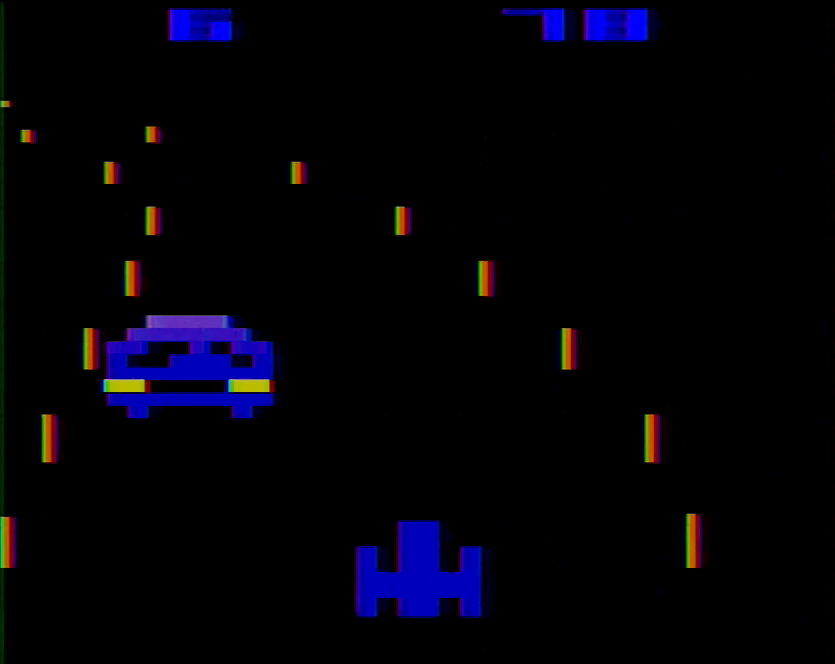
Night Driver to Star Raider Evolution (Racing Games pt. 2)

Taxonomy of Virtual Spaces

This is a continuing history of the evolution of early car racing games as analyzed according to each game's visuo-spatial configuration. Be sure to read part 1 before reading this blog post.

As a refresher, Atari pioneered the genre with the arcade game Gran Trak 10 (1974). Its overhead view shows the entire race course on one screen. That works great for multiplayer games, but doesn't give the player the feeling of being in the cockpit and behind the wheel of the car as they drive it through the race course.

First Person German Engineering

Dr.-Ing. (Doctor of Engineering) Reiner Foerst working on creating a driving simulator when he ended up inventing the first first-person arcade video game. It was nigh impossible simulate a three-dimensional view through a car's windshield using cost-effective 1973-era technology, but Foerst was encouraged when he acquired a Pong (Atari, 1972) arcade machine. The machine was capable of generating white rectangles at different points on the screen. Foerst realized that the rectangles could be repurposed into reflective road markers, illuminated by headlights as one drives along a winding road at nighttime.

Nürburgring 1 (Dr.-Ing. Reiner Foerst GmbH, 1976)

Soon enough, Nürburgring 1 (1976) was born. The game is named for the Nürburgring motorsports track in the German town of Nürburg. Like Gran Trak 10, it includes a steering wheel and gas pedal, but the visuals are completely different. The rectangle "road markers" scale in size and move down the screen in a convincing emulation of driving down a winding road at night.

The graphic techniques are similar to SEGA's Moto-Cross and related games analyzed here. The edges of the road appear to converge in the distance and smoothly adjust left or right to simulate curves in the road. Unlike with other games, Nürburgring 1 has the player navigating the frame across the game world rather than navigating an object on the screen. The front of the driver's car is displayed but it doesn't move. In fact, the car hoodis just part of the plastic screen overlay that includes the speedometer. As the player steers to the right, the road markers move left on the screen in an example of induced movement.

Foerst released a few sequels in the following years, including Nürburgring 2 (1979?) with a motorcycle handlebar replacing the steering wheel and Nürburgring 3 (1980) with a daytime scene and a full color display. In fact, Foerst's company is still working in the car simulation business to this day.

Early Copy Cats

It is said that arcade game developer Ted Michon of Digital Games played an early Nürburgring 1 cabinet in a West German bowling alley and met with Foerst. Upon returning home, he designed a simpler clone version of the game titled Night Racer (1976). Digital Games went out of business by summer 1976 and its assets were bought up by a new company named Micronetics, which manufactured Night Racer. It looks like Micronetics didn't stay in business long, either, as industry magazine Play Meter stopped listing Micronetics' contact info. after January 1978.

Before Digital Games closed its doors, Michon's boss licensed the design to Midway (the video game division of Bally) as Midnite Racer (1976). Midway hired Dave Nutting Associates (not to be confused with Nutting Associates founded by Dave's brother Bill) to develop it. Midnite Racer was renamed as 280 Zzzap (1976) when Midway entered into a tie-in promotion with Datsun for a special edition 1977 Datsun 280Z

Atari Takes "Inspiration"

Atari co-founder Nolan Bushnell stated in a 2017 interview (pg. 33) that he had planned to make a "driving game" "in a week" based on the same methodology used to create Computer Space (Nutting Associates, 1971). He cited Chicago Coin's electromechanical (EM) game Speedway as a direct influence. This driving game would be "the magnum opus," "the big kahuna" hit game design for his burgeoning new Atari company.  

Speedway (Chicago Coin, 1969), image from this video

Speedway has no video screen. The image of a looping race track is projected from a spinning plastic disk. This gives the game a "3-D effect" with "spectacular realism" according to a Chicago Coin sales flyer. The player steers the red race car left and right to pass six other projected car images moving independently on the track. It is not quite a first-person view, but it was an impressive effect for late 1960s technology.

Speedway was Chicago Coin's licensed design of Indy 500 (1968) by Japanese amusement machine manufacturer Kansai Seiki (a.k.a. Kasco). Other similar designs released at that time include Grand Prix (SEGA, 1970) and The Racer (NAMCO, 1970) (more on The Racer in the next post).

Bushnell's vision of creating a video arcade version of Speedway took much longer than "a week," and it appears that Nürburgring 1 that served as Atari's ultimate inspiration. In an undated quote, Atari designer Dave Sheppard remembers being shown "a piece of paper with a picture of a game cabinet" that he remembers being "a German game" with "a few little white squares showing." This was probably Nürburgring 1, and the game may have been "based on a license from a German affiliate" (Atari Inc. - Business is Fun (Goldberg and Vendel, 2012, pg. 211)).

Night Driver (Atari, Oct? 1976)

Sheppard developed Night Driver (1976) using the same techniques as Nürburgring 1. An illustrated plastic overlay over the screen serves as the player car's hood (it's hard to see in the above image. I think the cabinet uses a fluorescent black light hidden under the monitor bezel to illuminate the orange car hood image, but it doesn't appear to be functioning in this example).

This was like Bushnell's vision of a video Speedway, but in some ways better. The Night Driver curves left and right, not just turning left in a circle. The screen flashes bright white if the player crashes into the side of the road. There is only one thing missing in this racer: other cars.

Chicago Connections

At least two of these games made their debut at the AMOA (Amusement & Music Operators Association) show held in Chicago in November 1976. Midway brought Midnite Racer, newly renamed as 280 Zzzap (pronounced "zap"), and Atari debuted Night Driver ("Chicago Chatter" and "Eastern Flashes," Cash Box (18 Dec 1976, pg. 43)). Micronetics may have also featured Night Racer as one attendee noted that there were "about four different night driver games" at the show ("Projection Racing," Play Meter, Jan 1977, v. 3, n. 1, pg. 14).

Midnite Racer sales flyer announcing the name change to 280 Zzzap (Midway, 1976)

In the long run, Atari's Night Driver beat out all competitors in the American market. Play Meter's operator poll of top-earning arcade video games for 1977 ranked 280 Zzzap as #9 and Night Driver as #6 ("Mr. Average and his Operation," Play Meter, Nov 1977, v. 3, n. 21, pg. 25). While 280 Zzzap quickly fell out of the poll rankings, Night Driver was a top 10 earner through 1978 and ranked #11 in 1979.

The Road Home

In 1978, Dave Nutting Associates created a port of 280 Zzzap for Bally's little-remembered home video game console, the Bally Astrocade (a.k.a. Bally Home Library Computer, a.k.a. Bally Professional Arcade, a.k.a. Bally Computer System). It was packaged with an unrelated overhead view racing game named Dodgem.

280 Zzzap/Dodgem for the Bally Astrocade (Bally, 1978)

The home version of 280 Zzzap took advantage of the Astrocade's built-in ability to display 5 x 7 pixel text characters to add text like "FINISH LINE" when a game is complete. The lower HUD displays time remaining, a speedometer (evidently rated in km/h), and distance traveled.

Night Driver for Atari VCS/2600 (Atari, 1980)

In 1980, Rob Fulop ported Night Driver to Atari's home game console, the Atari VCS (later known as the Atari 2600). Fulop made several improvements to the original design by adding color (while still making it look like a nighttime scene), roadside terrain (houses and trees), and oncoming cars with their own headlights (see above). This was another hit for Atari, becoming one of the top-selling VCS games of the year (although it couldn't compare to Fulop's unprecedented hit Space Invaders VCS port (Atari, 1980)).

Atari Leaves Orbit

The "night driver" game formula worked well for creating a fast-moving world from a first person view while restricted by 1970s game graphics technology. The nighttime scene eliminated the need for an environment, background, or horizon line to be displayed; it's too dark to see them! The entire scene is created from scaling, white rectangles: simple "spots" of light that define the edge of the navigable environment. The difficult part was creating a system that calculates the positions to display those spots according to the player's speed and steering, giving the appearance of moving through a continuous, three-dimensional space while traveling across the two-dimensional ground plane of a flat road.

Starship 1 (Atari, 1977)

Atari's Ron Milner, a member of the Night Driver engineering team, used a similar approach when he designed Starship 1 (Atari, 1977). The player flies through the inky blackness of outer space, as distant points of starlight zip past the player. A sales flyer boasts the game's "realistic 3-D graphics" with spacecraft and planets that "[grow] larger as they approach, giving the player the illusion of speeding through space." The control yoke lets the player pitch their view up and down or yaw left and right, creating the illusion of a full, three-dimensional galaxy to explore. An early viewer of the game noted its similarity to Night Driver, stating "the target ships come out at the player much like the pylons on Night Driver do, thereby creating the illusion of depth" ("AMOA Report '77," Play Meter, Dec 1977, v. 3, n. 23, pg. 23, emphasis added).

For all its visual technical prowess, Starship 1 wasn't much more than a target gallery. This was still in the days before Space Invaders (Taito, 1978) set the precedent that video game enemies should feel like a menacing threat. 1977 was the year of Star Wars, and Starship 1 didn't really reproduce the feeling of piloting an X-wing into a dogfight with Imperial TIE fighters. It didn't help that the spaceships in Starship 1 were clearly inspired by Star Trek.

Star Ship (Atari, 1977) was a launch title for the Atari VCS and a home port of Starship 1. However, it does not appear that the game sold well for Atari and it was discontinued within a few years.

Star Raiders for Atari 8-bit computers (Atari, 1980)

Atari engineer Dave Neubauer envisioned mixing a Star Wars-style outer space dogfight with the strategic elements of the text-only mainframe computer game, Star Trek (Mike Mayfield, 1971). He was also inspired by another coin-op game with similar graphics but could not remember the name (maybe Starship 1 or Ted Michon's Star Fire (Exidy, 1978)). Neubauer had experience programming computer-generated starfields in his spare time at his previous job with National Semiconductor. After about six months of diligent work, Star Raiders (1980) was born.

Star Raiders soon became the "must-have" game for Atari 400 and 800 model 8-bit computers. It was a thoughtful mix of short range excitement and long range planning. The game offers multiple views, with a rear view, galactic map view, and a small targeting computer in the lower right corner of the screen. The player's view of the game environment ranges from minutely detailed to galaxy-spanning. The game was ported to other Atari computers and consoles, even an impressive 1982 port for the Atari VCS that required a custom keyboard controller.

Star Raiders paved the way for later important 3-D spaceflight games like Elite (1984), Wing Commander (1990), X-wing (1993), and TIE Fighter (1994) (although David Braben states it did not have a direct influence on Elite: "I know that’s surprising, but the problem is I didn’t have an Atari and none of my friends did."). Star Raiders is often placed on many "most important video games" lists, including the first 10 games of the "game canon" submitted to the Library of Congress.

Epilogue and Prologue

The advent of realtime, three-dimensional, first-person visuals in video games did not start with polygonal graphics. It started with simple shapes, easily repeatable and scalable, that could be moved on a screen to give the impression of embodied, induced movement through a continuous space. This technique was used in evolution from simulated driving on a flat racetrack to the thrill of taking the flight controls and dogfighting in outer space.

In the next blog post, I will examine the evolution of racing games that culminated with the creation of Yu Suzuki's "Super Scaler" SEGA games of fast, 3-D motion using sprite technology. 

Spasim for PLATO (Jim Bowery, 1974)

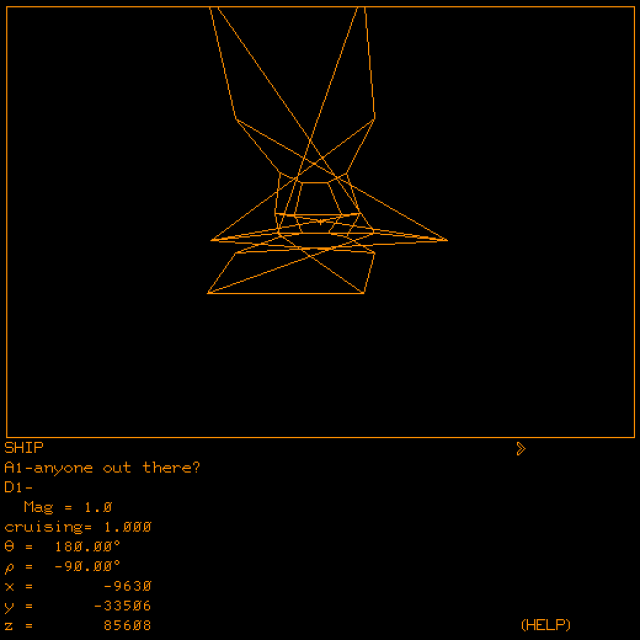
Like so much of computer game history, there is a precedent that can be traced back to the PLATO computer network. Jim Bowery created (and then deleted, and then recreated) Spasim in 1974 at the University of Illinois at Urbana-Champaign, ground zero for the sprawling PLATO IV network. Billed as "An Investigation of Holographic Space," Spasim is a 32-player multiplayer game of realtime dogfights in space with wireframe polygonal graphics.

Some PLATO games are highly influential, but only a select few people had access to the system (mostly university students). Atari was more influenced by EM games and other video arcade games than by relatively obscure computer games of the day (Spacewar! (1962) and Star Trek (1971) are two exceptions, of course). Spasim is one of the first (if not the first) first-person 3-D spaceflight simulator computer games, but its graphic techniques were not feasible for arcade game technologies until the vector graphics era of Battlezone (Atari, 1980) and Star Wars (Atari, 1983).

Monday, July 20, 2026

Upscroller Game Evolution (Racing Games Pt. 1)

Taxonomy of Virtual Spaces

This is a short history of the evolution of early "upscroller" video games (as mentioned previously, a term coined by Steven Poole, Trigger Happy 2.0, ebook, 2013, chapter 2), better known as "vertically scrolling" games. This type of game has been dominated by the shooter genre, with notable games like River Raid (1982), Xevious (1983), Commando (1985), Raiden (1990), DonPachi (1995), and Ikaruga (2001). But, vertical scrolling got its start in the early 1970s in the car racing genre.

The following analysis focuses on scrolling racing arcade games released by Atari, Taito, and SEGA between 1974 and 1981. This is not an exhaustive analysis of the era, but these examples should show an evolution in graphic styles and technical prowess over these years.

Before the Scroll: Early Car Racing

The earliest known video arcade car racing game is Atari's Gran Trak 10 (1974). It features a fairly realistic steering wheel, gear shift, and gas pedal This game has no scrolling, with the entire racetrack presented on the screen in a fixed frame. The design was successful and Atari (and subsidiary Kee Games) followed it with similar racing titles for many years, like Gran Trak 20 (1974), Formula K (1974), Indy 800 (1975), Sprint 2 (1976), Sprint 8 (1978) and Super Sprint (1986).

The Scrolling Ribbon Road (Taito)

Taito game designer and future father of Space Invaders, Tomohiro Nishikado, didn't care for the tight twists and turns of Gran Trak 10's racecourse. He wanted to make a game that was more thrilling, with a greater sense of speed, and turned to his own electromechanical (EM) game designs for inspiration (Alexander Smith, They Create Worlds, pg. 199 - citing information from Florent Gorges' official biography of Tomohiro Nishikado, Space Invaders — Comment Tomohiro Nishikado a Donné Naissance au Jeu Vidéo Japonais!, 2018).


Super Road 7 (Taito, 1970) from this video

Nishikado designed Super Road 7 for Taito back in 1970. This EM game features a "scrolling" two-lane road with scenery projected from acetate drums as the player steers a model car left and right to avoid other cars projected onto the scene. Overlapping another car triggers a crash, causing the player to restart their drive from a standstill.

The scrolling scene is an example of induced movement, where the car appears to be moving forward because the scenery is moving downward. This effect is used in all "upscroller" games, even though the only vertical movement seen is of objects moving down the screen.

Speed Race (Taito, 1974) (image source)

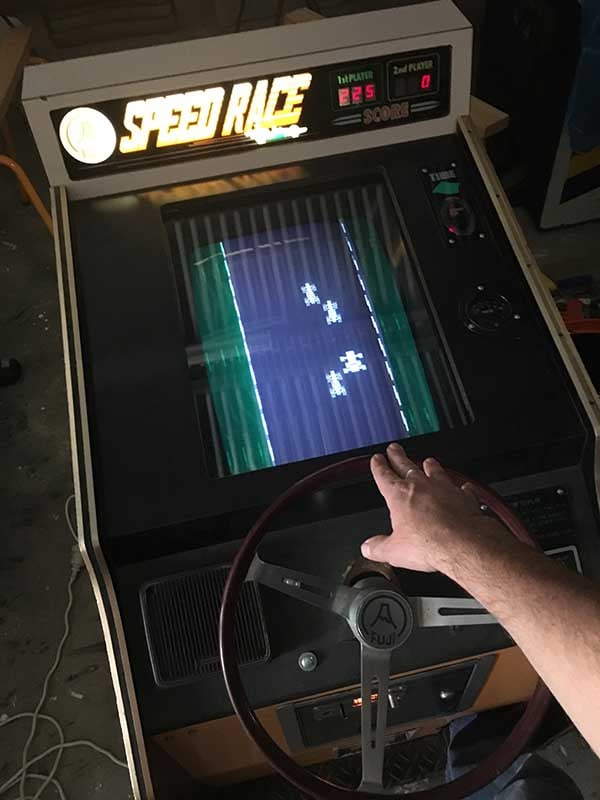
Nishikado's Speed Race plays like a video version of Super Road 7. Dashed lines mark the roadsides, like a "ribbon" zipping down the screen as the player accelerates, creating a great sense of speed and likely the first scrolling video game environment. Like Super Road 7, the player must steer their car left and right on the screen to dodge traffic. The environment and cars are drawn orthographically, as if viewed from directly overhead.

The scenery zooms by, relative to the player's position as well as the car's. Arguably, this gives the player a greater sense of "being there," something closer to the experience of driving an actual car than Gran Trak 10 and similar non-scrolling driving games. Like Gran Trak 10, the overhead view of Speed Race feels flat; there is no sense of depth into the z-space of the screen.

Midway published the game in the US as Racer (1975) and Wheels (1975). Taito added a gear shift lever and a timer to Speed Race DX (1975). The screen was split into two straight racetracks and a second steering wheel allowed for two-player action in Wheels II (1975) and Speed Race Twin (1976). The game was later programmed for a Z80 microprocessor and given color graphics for Super Speed Race (1977). Super Speed Race V (1978) was the #2 top-grossing video arcade game in Japan for 1978 (second only to Nishikado's Space Invaders). Speed Race CL-5 (1978) added forked roads and an illuminated headlight effect for driving in tunnels.

Taito made many refinements and improvements to the Speed Race formula over four years, but the visuo-spatial configuration and navigation control are the same. The cars and road are drawn in plan orthographic view (with some oblique views of foliage) and the player navigates the car object moving on the screen (steer left and right, accelerate up, decelerate down).

That started to change with the next game.


Super Speed Race Jr. (1985)

Taito released Super Speed Race Jr. more than 10 years after the original Speed Race, and this "junior" update added a lot to the series: cartoony graphics, obliquely drawn urban environments, and traffic lights (stop so pedestrians can safely cross the street). One less apparent change is that the player navigates the frame moving across the game world. The player car stays centered on the lower part of the screen. As the player steers left, the game world moves right on the screen, a further example of induced movement. This change in navigation from object to frame is a step towards a more immersive and embodied experience where the player controls their view on the virtual world instead of moving an object on the screen (covered in more detail in the next post).

A Bend in the Road (Atari)

Atari engineers were likely influenced by the scrolling road of the original Speed Race when they developed Hi-way (1975). 

Hi-way (Atari, 1975)

Hi-way takes the straight "ribbon" road of Speed Race and adds curves to it one line at a time. As the road is rendered, scanline by scanline, the x-position of the road image may be adjusted to the left or right. The resulting road curves left or right as it is drawn down the screen. The cars on the road are rendered in a similar way, shearing left or right depending on which way they are veering.

This graphic technique must not have been inspiring for use in other games, probably due to the distorted effect it makes.

SEGA Approaches the Horizon

SEGA released its own series of related upscrolling racing games that are similar to Speed Race. The race car graphics of Road Race (Feb 1976) were soon replaced with motorcycles for Moto-Cross (1976). The game was further revised as Man T.T. (Aug 1976) (named for the annual motocross Tourist Trophy (T.T.) race held on the Isle of Man) and as Fonz (Nov 1976) in the USA. Yes, Fonz is a licensed game named for Henry Winkler's popular Happy Days TV character, Arthur "The Fonz" Fonzarelli. Twin Course T.T. (Jan 1977) uses separate video monitors so two players can race simultaneously, each with their own view of the road.

Moto-Cross (SEGA, 1976), image from a SEGA sales flyer

Each game has minor variations but they all use the same graphical techniques. The road widens from the top of the screen to the bottom, giving a simple impression of road lines converging onto the unseen horizon. The road turns left and right in broad curves that are more convincing than those in Hi-way. The racers (whether race cars or motorcycles) are drawn as if seen from a high angle, but not quite directly overhead. The racer graphics are drawn smaller the closer they are to the top of the screen, as if receding into the distance, thanks to SEGA's custom sprite scaling hardware. 
This series of games starts to create a sense of depth into the z-space of the screen.

The pioneering haptic feedback (vibrating handlebars during each collision) and inventive graphics must have impressed their audience as these were among the highest-earning arcade games of 1976 and 1977.

Monaco GP (SEGA, 1979)

Two of SEGA's last TTL (transistor-to-transistor logic) logic board arcade games were the successful Monaco GP (1979) and Pro Monaco GP (1980) titles. These two play a lot like the Super Speed Race games and do not incorporate the sense of depth and sprite scaling seen in the Moto-Cross series of games.

Turbo Boost! (SEGA)

SEGA's next big scrolling racer brought back depth effects, incorporated new custom sprite scaling hardware, and is programmed to run on a Z80 microprocessor.

Turbo (SEGA, 1981)

Turbo's roadway recedes to a visible horizon line, where a lateral oblique background image of a cityscape hints at the urban landscape the player will be speeding through. A break in the receding road lines marks a rise in the road (see image above) where encroaching traffic briefly sinks out of view. The road follows the seacoast, curves toward mountains, and leads through dark tunnels and snow-covered forests.

The game has a convincing sense of depth, a good variety of environments, and was one of the highest-earning arcade games of 1981 and 1982. However, the game's design and navigation model still don't stray far from the Speed Race model from 1974, with the player controlling a car object moving around the screen.

Epilogue

Over the first eight years of scrolling racing game history, the spatial structure of games tended to evolve from a flat, orthographic, overhead view into "3rd person view" that mimics a three-dimensional scene with depth. This development did not supplant the original Speed Race model, but supplemented the options that developers had to creating virtual game spaces.

Many early racing games on home consoles and computers use the "scrolling road race" Speed Race model: Freeway for RCA Studio II (RCA, 1977), Street Racer for Atari VCS (Atari, 1977), Road Race for Apple II (Softape, 1978), and Speedway! for Odyssey 2 (Magnavox, 1978). The scrolling direction was reversed for numerous downhill skiing games like Alpine Skiing! for Odyssey 2 (Magnavox, 1979), Skiing for Atari VCS (Activision, 1980), and US Ski Team Skiing for Intellivision (Mattel, 1980). 

Mad Alien (Data East, 1980)

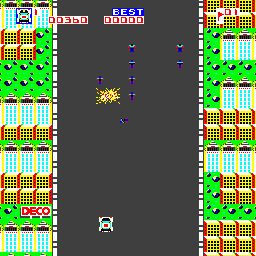
Several "car combat" games add shooting to the Speed Race model. In the unusual Mad Alien (1980), the player pursues a roving (alien?) motorcycle gang and shoots them from a police cruiser in what plays like a remixed Galaxian (NAMCO, 1979). Bump 'n' Jump (Data East, 1982) and Gekisou (Alpha Denshi, 1985) let the player ram opponents off the road or jump over them. Spy Hunter (Bally Midway, 1983) and The Spy Who Loved Me (Domark Software, 1990) add both both weapons and speedboat transformations.

Next blog post, I'll examine a parallel line of development in "first-person view" racing games and how the techniques pioneered in West Germany influenced Atari's early space dogfighting games.

Maze Games to Platformers (again?) (Racing Games pt. 5)

Taxonomy of Virtual Spaces This is a continuing history of the evolution of early car racing games as analyzed according to each game's ...