Taxonomy of Virtual Spaces
This is a continuing history of the evolution of early car racing games as analyzed according to each game's visuo-spatial configuration. Be sure to read part 1 and part 2 before continuing.
Thie post covers the evolution of NAMCO games that foretell Yu Suzuki's "Super Scaler" visual style developed with SEGA.
The Mysterious Racer X
Nakamura Manufacturing Company developed an electromechanical race driving arcade game called The Racer (1970) in Japan. The game was similar to the Chicago Coin game Speedway (1969), covered in in part 2 of this series, although Masaya Nakumura would clarify that the device used for the racecourse is different between the two games ("Projection Racing," Play Meter, Jan 1977, v. 3, n. 1, pg. 13).
 |
| The Racer (Nakamura Manufacturing Company, 1970) (image from BANDAI NAMCO group) |
The Racer has no video monitor. It projects the image of a spinning plastic race track with independently moving model cars on it onto the screen, giving the player a convincing driver's eye view as if from another car on the track. The game proved to be popular and about one year later, the company started using the more familiar brand name of NAMCO.
 |
| Formula-X (NAMCO, 1973) |
Three years later, NAMCO scaled up the projection mechanism seen in The Racer for the creation of the massive Formula-X (1973). This game seated the player in life-sized car chassis, complete with an authentic steering wheel and real racing slick tires. The game used a four-gear gearshift and the player could select from three levels of difficulty. The pro level requires the player to use the clutch when shifting gears while the easiest level features an automatic transmission. The cabinet was massive: about 6' wide, 10' long, and 7' tall. Formula-X was installed mostly in bowling alleys as most other types of establishments did not have room for such a large game.
In 1974, NAMCO entered the video game business when the company bought the assets of Atari's flailing Atari Japan division. NAMCO also became the exclusive distributor of Atari games in Japan, but the company continued to design electromechanical games and did not yet start developing video games in house.
 |
| F-1 (NAMCO, 1976) |
NAMCO repurposed and improved the projection mechanism of The Racer once again for F-1 (1976). This sit-down driving experience had a much smaller footprint than Formula-X, so it could be more easily installed in many locations. Atari licensed the game for the US market, and it proved to be a hit, topping many of the coin-op sales charts in the US and Japan alike.
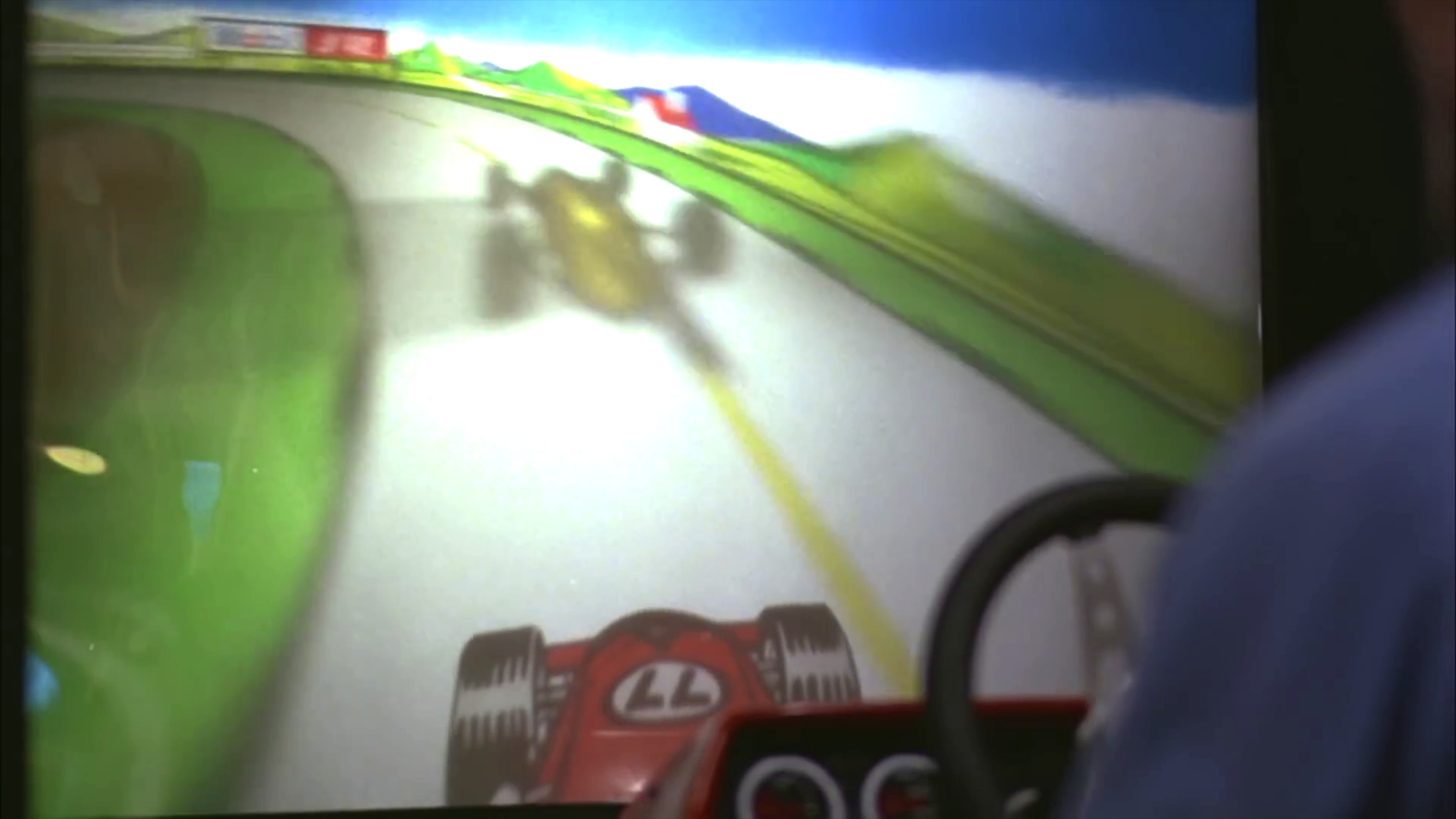 |
| Dawn of the Dead (United Film Distribution, 1978) |
F-1 had some cross-media cultural cache as it was featured in the horror film Dawn of the Dead (1978) (see above).
In an era when most video games were still played on small black-and-white television screens with limited sound effects, F-1 gave players authentic driving controls, loud engine sounds, colorful visuals on a big screen, and a flashing "crash" graphic if they collided with another car. It would be some years before a video game could hope to match that level of immersion and excitement.
Prepare to Qualify
After seeing the success of Space Invaders (Taito, 1978), NAMCO started developing their own video game designs, in addition to licensing titles from Atari. Galaxian (1979), Pac-Man (1980), Rally-X (1980), and Galaga (1981) brought NAMCO international success and experience with digital game development. What Galaxian designer Kazunori Sawano really wanted to make next was a driving game, one to rival the experience of F-1.
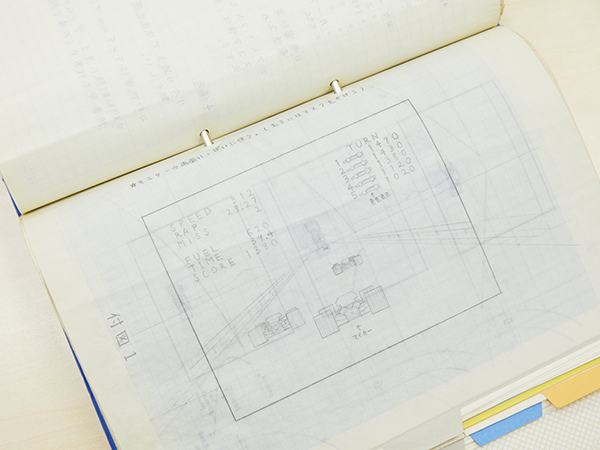 |
| Racing game concept sketch credited to Kazunori Sawano (image from BANDAI NAMCO group) |
Sawano sketched out what the game should look like (see above), an image of several cars facing away from the viewer driving down a straight road in one-point perspective. The car at the bottom center of the image is labeled "my car" (マイカー). Sawano used that image to enlist fellow designer Shinichiro Okamoto to the project while Okamoto was still working on two NAMCO maze games: Tank Battalion (1980) and Warp & Warp (1981). Programmer Koichi Tashiro from Galaxian and Rally-X also joined the team. None of the team had any real experience with 3-D graphic techniques in games when they started to develop Pole Position (NAMCO, 1982).
 |
| Pole Position in Computerspielemuseum, Berlin, by Bsivko (CC BY-SA 4.0) (image source) |
It took about three years for the team to complete Pole Position ("BANDAI NAMCO New Insights Part 2: The Evolution of Car Racing Games (Part 1)", BANDAI NAMCO, 25 April 2019, https://www.bandainamcoent.co.jp/asobimotto/page/carracinggames1.html). The high fidelity of graphics involved required that the team use two 16-bit Zilog Z8000 series microprocessors, probably the only arcade game series to use this type of chip. This was an era when a game like Pac-Man still used one 8-bit Zilog Z80 processor.
 |
| Pole Position (1982) |
The game's visuals were compared favorably to SEGA's Turbo from the previous year. Pole Position used similar techniques to "upscroller" games like Moto-Cross (SEGA, 1976), where a one-point perspective road is drawn to the horizon, then each scanline of the image is adjusted depending on the road curvature, the player car's position on the road, alternation of red/white palette at the road barrier, gray/white palette down the center line of the road, etc.
Most importantly, what really sets this game apart from Turbo and its predecessors, is that the player navigates the frame moving across the game world instead of an object moving across the screen. The logical interface, the player representation in the virtual world (what Sawano dubbed "my car"), never moves on the screen. The car wobbles, vibrates, animates, pivots, and explodes spectacularly in a collision, but it does not move from its position at the center of the screen. "My car" becomes the player's anchor in the Pole Position world and the screen becomes the windshield on their view of that world.
After Pole Position was completed, all electromechanical racing game projects at NAMCO were cancelled. The video game had finally surpassed the quality level set by F-1.
Pole Position II (1983) quickly went into development on the heels of its predecessor's success with three new racetracks. The games were ported to many computers and home consoles of the era. Yet, NAMCO did not develop another racing game in-house for some years afterward. However, that doesn't mean they didn't publish or license any racing games.
Pole Position II (1983) quickly went into development on the heels of its predecessor's success with three new racetracks. The games were ported to many computers and home consoles of the era. Yet, NAMCO did not develop another racing game in-house for some years afterward. However, that doesn't mean they didn't publish or license any racing games.
 |
| TX-1 (Tatsumi, 1983) sales flyer from Atari |
NAMCO licensed and produced TX-1 (1983), an ambitious driving game with three screens developed by Tatsumi Electronics. This widescreen view gives the player an expansive view to the left and right, filling most of their forward vision. The game is sometimes called a "spiritual successor" to the Pole Position family because it is published by NAMCO, and licensed to Atari. The graphic methods used to display the environment are similar to Pole Position with added forking and merging roads, overpasses, tunnels, multiple paths (with a possible influence on Out Run (SEGA, 1986) in the course map design seen above) and smooth transitions between environments (unlike Turbo).
 |
| TX-1 can't render a hairpin turn (image source, Data Driven Gamer) |
TX-1 shows the limits of these Pole Position-derived graphic techniques. When the player has such a wide view and enters a hairpin turn, the graphical calculations don't handle the road doubling back toward the viewer (see above).
.png) |
| Buggy Boy/Speed Buggy (Tatsumi, 1985) |
The game did well enough for Tatsumi to use the same "engine" for the sequel TX-1 V8 (1984) and the more cartoony off-road (sort of) racer pictured above, Buggy Boy (Speed Buggy in the US, 1985). Tatsumi may have learned the limits of their road renderer as Buggy Boy does not seem to have any hairpin turns.
SEGA in the Race
Before Pole Position, SEGA's Turbo was the big arcade driving hit that gave the player a sense of moving into the depth of the game world with one-point perspective drawing cues and custom hardware for scaling sprites as they recede into the distance.
 |
| Buck Rogers and the Planet of Zoom (SEGA, 1982) (image source, Data Driven Gamer) |
SEGA repurposed and improved upon the original Turbo arcade hardware in the creation of Zoom 909 (1982) a.k.a. Buck Rogers and the Planet of Zoom (1982). The vertical monitor orientation of Turbo was abandoned for a horizontal orientation a second Zilog Z80 processor and more VRAM memory were added, allowing for many fast-moving sprites and more colors to be rendered on the screen at once. The environment vary from outer space battles, flights over planet surfaces, Death Star inspired trench runs, and the "tunnel" scene shown above. A Japanese sales flyer touts the game for its "pioneering perspective effects" (パースペクティブ効果を初めて採用).
SEGA needed to evolve beyond their 8-bit Z80 microprocessor architecture to meet the high water mark of Pole Position's own "pioneering perspective effects" rendered by dual 16-bit Z8000 series chips. Yu Suzuki worked on a new hardware design that incorporated dual 16-bit Motorola 68000 microprocessors and a suite of dedicated graphics processors that became the first of the "Super Scaler" series of arcade hardware variants.
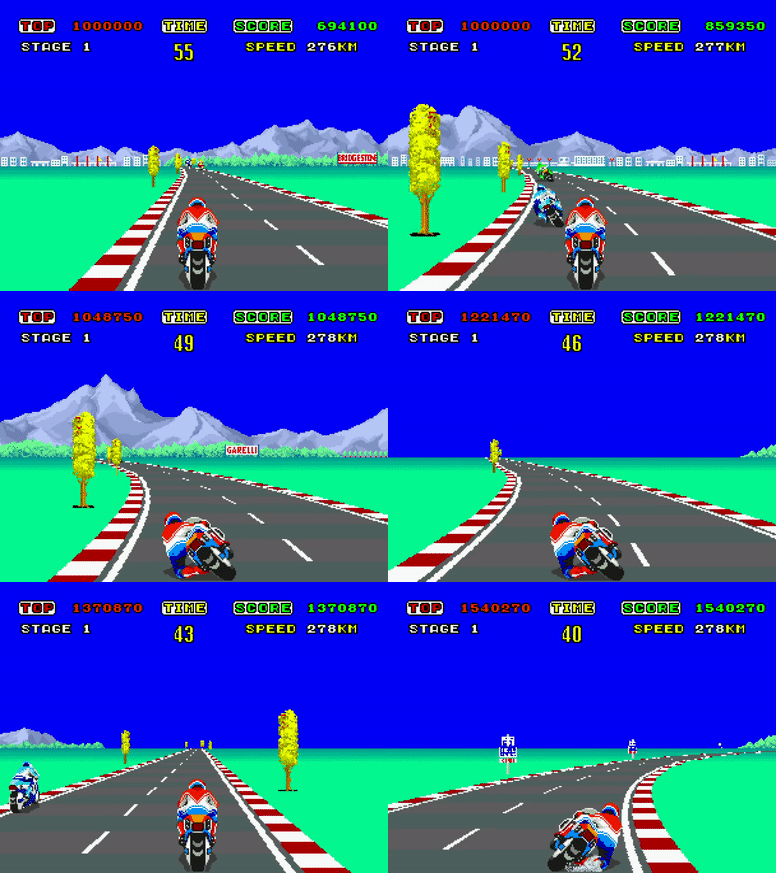 |
| Hang-On (SEGA, 1982) |
Suzuki and his team used the new Super Scaler hardware to create Hang-On (1982). The game is often remembered for its distinct motorcycle-shaped control mechanism that pioneered SEGA's genre of "taikan games" with moving cabinets. This post focuses solely on the game's graphic techniques.
Hang-On was described at the time as having "the superb graphics of a Pole Position style race" (Clare Edgely, "Arcade Action," Computer & Video Games, Dec 1985, pg. 89). The roadside billboards, the shape of the curving road, and the distant mountain range in the background are all similar to Pole Position. The vehicle sprites are bigger and the background has a multiplanar parallax effect for added depth, but the graphic similarities outweigh the differences.
 |
| The raw Hang-On road (image source) |
Lou Gorenfeld wrote an excellent overview of the graphic techniques used by these games and he extracted the raw road image used in the game (see image above). As described earlier in this post, this image is modified in memory before it is drawn to the screen. Shifting the entire road left or right on the screen gives the impression that the player is steering right or left. The colors of the tarmac, curbstones, and lane dividers alternate along horizontal scanlines to give the illusion of moving down the road. The vertical lines of the road are skewed left or right to give the impression that the road is curving.
It is unclear how much Suzuki was intentionally influenced by Pole Position. When asked what he thinks about other games, he often replies, "I don't play other games" ("TBS Interview with Yu Suzuki: Arcade Game Development at SEGA," X Years Later: Those Who Were Involved (X年後の関係者達), TBS, Feb 2022, translation: https://www.phantomriverstone.com/2024/06/tbs-interview-with-yu-suzuki-arcade.html) ("Interview with Yu Suzuki, Producer of the 'Shenmue' Series," Tokyou Otaku Mode, 1 Sep 2015, https://otakumode.com/news/55c62e97887d92a516b043ae/Interview-with-Yu-Suzuki-Producer-of-the-%E2%80%9CShenmue%E2%80%9D-Series). However, there was a desire to compete directly with NAMCO in their dominant genre, as Suzuki described the situation behind the creation of Hang-On, "Namco had games like Pole Position, and there was a general perception that racing games were Namco's thing. So when [SEGA President] Mr. [Hayao] Nakayama said, 'Don't we have a racing game?' I thought, "I should make one.'" ("Yu Suzuki Interview," Sega Hard Historia, Mar 2021, translation: https://www.phantomriverstone.com/2021/08/march-2021-yu-suzuki-interview-part-two.html ).
Hang-On was just the start for Suzuki and the Super Scaler technology. The next games fulfulled players' fantasies of soaring over a science fantasy world, piloting an F-14 Tomcat, and getting behind the wheel of a Ferrari Testarossa.
Part 4 of this series will look at early single-screen racing games and how they may have influenced the maze game genre.


No comments:
Post a Comment