Tuesday, February 28, 2023

Jumping Part 2: Studies of Leaps and Bounds

Continued from Jumping Part 1

The following is a review of selected literature about jumping in digital games.

"Moon Patrol requires players to jump their buggy over craters and other hazards." (Begy, 2010)

Jason Begy. “The History and Significance of Jumping in Games.” GAME//PLAY//SOCIETY: Contributions to Contemporary Computer Game Studies. Proceedings of the 4th annual Vienna Games Conference. Kopaed: Munich, Germany, 2010.
https://web.archive.org/web/20140207165134/http://www.jasonbegy.info:80/Begy_Jumping.pdf

Begy uses Ian Bogost's Unit Operations (2006) text as his guide and analyzes linguistic metaphors ("GOOD IS UP") for the appeal of both jumping and climbing in digital games. He also shows a relation to tabletop games where climbing up levels (snakes and ladders) and jumping over obstacles (chess knight) and "leaping captures" (checkers/draughts, alquerque, hala-tafl) are primary game mechanics.

Begy asserts that Mario's static jump in Donkey Kong, while only a defensive means of avoiding an obstacle, should be considered as an "act of dominance: once leapt over they effectively become harmless" (pg. 15). This may be true of the barrels that continue rolling down the platforms of the first stage, but fireballs may change direction and chase Mario.

The paper includes short analyses of Pitfall, Moon Patrol, Manic Miner, and Super Mario Bros. Like Swink in Game Feel, Begy ignores the arcade game Mario Bros. (1983) and confusingly refers to SMB as "Mario Bros."

Begy concludes that humans have a positive orientation metaphor with height (GOOD IS UP) that may be an embodied metaphor, something more than cultural in origin. This metaphor gives meaning to the action of jumping and may be key to the mechanic's popularity in digital games.

"Mario Jump" (Butler, 2014)

Tom Butler. "The Rise of the Jump." Polygon. 2014.

Butler's history starts with the Universal arcade game Space Panic (1980), probably the first "platformer" game, though the game has no jumping. There are quotes from researchers, such as Begy, and a guide to finding examples of different aspects of jumping in games (double-jump, jump attack, triple jump, partner-assisted jump, etc.).

"Players control a rolling ball. Their task is to collect three stars." (Dahl and Kraus, 2015)

Gustav Dahl and Martin Kraus. "Measuring How Game Feel is Influenced by the Player Avatar's Acceleration and Deceleration: Using a 2D Platformer to Describe Players' Perception of Controls in Videogames." AcademicMindTrek '15: Proceedings of the 19th International Academic Mindtrek ConferenceSeptember 2015. Pages 41–46.

https://dl.acm.org/doi/10.1145/2818187.2818275


Dahl and Kraus were directly influenced by Swink's Game Feel (hence, the title of their paper) when they designed their experiment in changing parameters of a platformer's "game feel" and measuring player experiences. As important as this notion is to the aesthetic pleasure of experiencing a digital game, we still don't have a robust vocabulary for critiquing or analyzing game feel.


The results were somewhat inconclusive. The vocabulary the participants used to describe game feel was varied ("heavy," "slow," "realistic," etc. (pg. 15)), as I would have expected. Some users were sensitive to small changes in game feel while others didn't notice and difference. The experimenters note that "game feel" is still an odd term for users, one they compare to "mouthfeel." Users did note an inability to find the right words to describe their experience, another sign that we are lacking in language to define these aesthetics.


"Subtle implementation details found while measuring the jumps." (Fasterholdt, Pichlmair, & Holmgard, 2016)


Martin Fasterholdt, Martin Pichlmair, & Christoffer Holmgård. "You Say Jump, I Say How High?" DiGRA/FDG '16 - Proceedings of the First International Joint Conference of DiGRA and FDGDundee, Scotland: Digital Games Research Association and Society for the Advancement of the Science of Digital Games, August, 2016, Number: 1. Volume: 13. ISBN / ISNN: ISSN 2342-9666

This thesis is a deep dive analysis of subtle details of jumps in different games. The analysis is focuses on Super Mario Bros. 3, Super Meat Boy, and Limbo, but also looks at some other games.

Fasterholdt designed his own tools for creating precise, simulated controls in a game for measurement and analysis. He used Unity to build his own replications of the games he analyzed, much like I've been doing with my own Traversing Virtual Dimensions project.

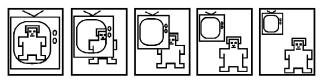
The study shows how differences in gravity, terminal velocity, friction, take off velocity, "jump release," and other parameters change how a game character feels while jumping. He also found helpful jump allowances that enable a player to jump even when the character is not on the ground. Some games use a "jump cache" (image a, above): when a player presses the jump button while in mid-air just before landing, the game will "cache" that jump command and jump as soon as the character lands. Similarly "edge jump" (what I call "coyote time") lets the player still jump after they've just stepped off the edge of a ledge.

Fasterholdt also gave a talk about his paper at Nordic Game 16: https://www.youtube.com/watch?v=zK6MNPhwndM

"Demonstration of some neat tricks to make platforming games feel better." (Strachan, 2020)

David Strachan. "Analysis of Platformers." Dave Made a Game (blog). 2020.
http://www.davetech.co.uk/gamedevplatformer

Strachan created a platformer game template in Game Maker that exemplifies some of the "subtle implementation details" that Fasterholdt identifies in his thesis. This sample template is playable on his blog page and the project is freely available on his Git Hub repository.

In addition, Strachan analyzes the jump arcs of a number of 2-D platformers, complete with time in the air, the number of frames of animation, and other information about jump parameters.


Saturday, February 25, 2023

Jumping Part 1: A Tale of Two Jumps

Jump button from a Donkey Kong (Nintendo 1981) arcade game cabinet 

Jumping is such a quotidian action in digital games that it seems like its been a part of gaming from the start. However, it wasn't until 1981 when Nintendo released Donkey Kong in the arcades, the first game to feature jumping (and the jump button pictured above). Sega's Jump Bug (1981) was released a few months later, the first game to feature both jumping and a smooth-scrolling screen frame. Jumping became the defining action of the platfomer genre, even though that genre predates jumping (platformers saw their debut back in 1980 with arcade titles Space Panic and Crazy Climber).


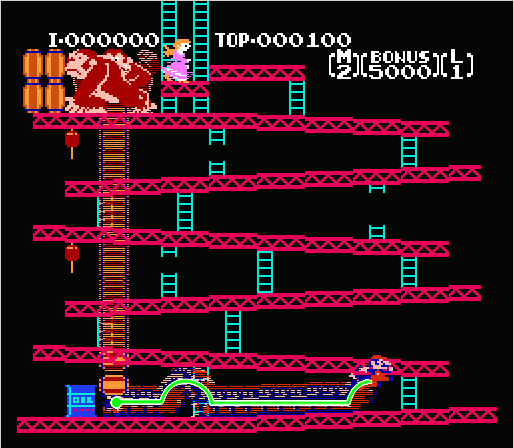
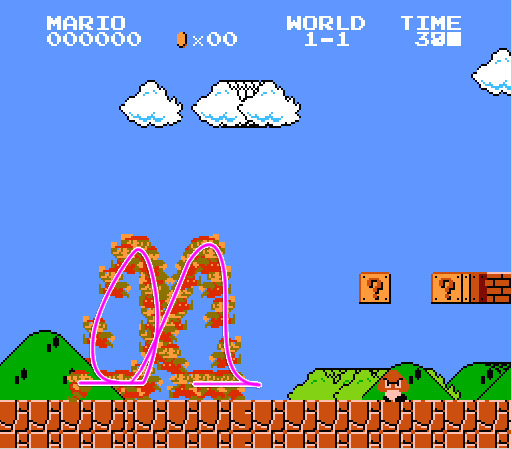
Jumping in Donkey Kong vs. jumping in Super Mario Bros. (images by Steve Swink, 2007. source: https://www.gamedeveloper.com/design/game-feel-the-secret-ingredient)

Mario's first Donkey Kong jump (and that of Donkey Kong Jr. (1982)) is very simple, mechanically speaking. Mario will always jump the same distance and to the same height every time, no matter how long the jump button is held down or how hard it is pressed. It follows a "specific, predetermined arc" (Swink, Game Feel (2009) pg. 201). Once jumping in a particular direction, there is no way to move the joystick in opposite direction to cancel the jump. This is what I refer to as a static jump, what Joshua Bycer calls a "commited jump" in his book, Game Design Deep Dive: Platformers. Additionally, Mario always runs at the same speed and stopes instantly, with no acceleration or deceleration. Similar static jumps are featured in jumping games that followed, like Irem's arcade hit Moon Patrol (1982) and Activision's Pitfall (1982) for the Atari VCS and Namco's Pac-Land (1984).

The static jump began as a purely defensive or navigational action to avoid threats, clear obstacles. or leap to a higher platform. Touching an enemy character typically meant instant death, so there was no concept for jumping onto enemies to defeat them.

By the time Shigeru Miyamoto and his team worked on Mario Bros. (1983), they started experimenting with Mario's (and brother Luigi's) movement. Gunpei Yokoi convinced Miyamoto that Mario should be able to jump with superhuman strength and fall great distances without fear of injury. Donkey Kong's short jumps and deadly falls feel cruel and punishing in comparison to Mario Bros.' tremendous leaps. Mario and Luigi also accelerate quickly from stopped to walking speed to running speed as they move horizontally (Swink 2009, pg. 202). Mario and Luigi also made a little slide as they decelerated to change directions. These jumps were still static, but the player characters were more controllable in their movement.

Nintendo's Super Mario Bros. (1985) offered an unprecedented level of control to the player during jumps with what I dub a dynamic jump. The longer the jump button is held down, the higher the character jumps. Depressing the "run" button lets the player accelerate their character from a walking speed to a fast running speed (walking max. speed is about 3/5 of running max. speed). The player is also able to accelerate horizontally, or "steer" their character in mid-air, during a jump. This opens up player control and gives the game a "highly fluid motion" (Swink 2007).

Note: Steve Swink's Game Feel (2009) is a book that I've referenced before and will likely return to many times. It still stands as the default text on the subject, but  hope that Swink gets the opportunity to create a 2nd edition for the book (something he's been hoping to do in order to update some information "where the thinking has evolved" (2010)). I bought the book new back in 2009 while I was working on fine-tuning controls for a console FPS game and thought it was a great leap forward in thinking and creating a language to think, plan, and talk about my design. His works define games around three principles of real-time control, spatial simulation, and polish. However, his work is different in examining the static/dynamic jump I analyze above.

The dynamic jump did not immediately change the world of platformers; many games created soon after SMB still featured the static jump (and some still do to this day). I see this additional control in jumping as a major evolution in the platformer genre, adding expressiveness and agency to the game action. Some of the most influential platformer series of the 1980s feature their own variations on the dynamic jump, like Mega Man/Rockman (full horizontal control during jump) and Sonic the Hedgehog (momentum-based movement, "vertical jumps" at same angle of slope character is standing on).

Continued in Part 2...

Thursday, February 16, 2023

Game or Watch: The Effect of Interactivity on Arousal and Engagement in Video Game Media

A recent paper in the IEEE Transactions on Games featured research on player engagement that may have some good techniques for measuring player engagement in my own research.

Change in pupil size from baseline during the online shark encounter for the interactive and spectator conditions. (Juvrud, Ansgariusson, Selleby, and Johansson 2022)

J. Juvrud, G. Ansgariusson, P. Selleby and M. Johansson, "Game or Watch: The Effect of Interactivity on Arousal and Engagement in Video Game Media," in IEEE Transactions on Games, vol. 14, no. 2, pp. 308-317, June 2022, doi: 10.1109/TG.2021.3073084.

The researchers measured the levels of arousal of game players ("on-line" viewers) and game spectators ("off-line" viewers) as they either played games directly or watched recordings of gameplay (like over Twitch or a "Let's Play" video). The researchers used equipment to measure the participants' heart rate, eye movement, and pupil dilation. Additionally, the participants were asked questions so they could report on their own feelings of engagement. The researchers mentioned that there are other biofeedback measures for arousal, such as galvanic skin response, that they did not use.

Both sets of participants showed elevated levels of engagement and arousal when interfaced with the digital gameplay. Unsurprisingly, the active game players were more engaged than the other group. One novel contribution the experiment shows is that both groups showed fairly equal levels of engagement during non-interactive cutscenes (which tell me that you don't feel that you are "playing" during a game's cutscenes... a logical conclusion but it is good to see the data for this).

This research shows that the methods used are effective tools for measuring a player's sense of engagement with a game. Pairing this with research on measuring presence in games could lead to an overall holistic sense of engagement and embodiment with a digital game.


Wednesday, February 8, 2023

Presence in Digital Games

An overview of some of the works of measuring a player's sense of spatial presence in digital games.

"Self Assessment Manikin" used to measure subjective telepresence (David Weibel, 2008)

When and How to Assess Subjective Overall Judgments of Presence

Bartholomäus Wissmath, David Weibel, Daniel Stricker (2008)

Abstract:

This study investigates differences between subjective on- line- and post-immersion measures, verbally and pictorially anchored scales, and the effects of content on those different measures. These factors were investigated by means of a 2x2x2 within-subjects-design. Participants (N = 162) evaluated two video clips. Against our expectations the findings suggest on- line- and post-immersion measures to be interchangeable. In line with findings from other fields than presence, pictorially anchored items seem to have major advantages when overall judgments are to be assessed. The advantages of pictorially anchored items apply in particular for language-containing environments.

Conclusions:

This piece of research suggests the adoption of post-rating scales as participants seem to be able to provide ex post highly accurate overall estimation of the presence experienced. However, when temporal variations of presence are of particular interest, our study suggests that overall on-line ratings do not interfere the sense of presence.


This study contributes to findings suggesting advantages of visually anchored measures in terms of efficacy and validity. The presence community could try to establish and investigate more specific (i.e. addressing sub-dimensions of presence) non- verbal subjective rating tools.


When assessing an overall estimation of presence, the advantages of visually anchored measures seem to pay off especially with language-based environments. Researchers should keep that in mind when setting up an investigation focusing on such environments.

A Cognitive-Heuristics Approach to Understanding Presence in Virtual Environments

S. Shyam Sundar, Anne Oeldorf-Hirsch, Amulya Garga (2008)

Abstract:

A strange paradox surrounds the role played by technology in inducing presence. The more sophisticated the technology, the greater the presence, which means greater invisibility of the technology. While we know that advancements in media technology, from larger screens to more interactivity, can enhance the sense of presence, the theoretical mechanisms by which this occurs are yet to be specified. We address this shortcoming by proposing that user interpretation of technology critically mediates the relationship between technological factors and a sense of presence. In particular, we adapt the MAIN model [1] to propose that technological affordances transmit cues that trigger cognitive heuristics leading to perceptions of presence. This paper identifies and describes a sample of heuristics triggered by modality, agency, interactivity, and navigability. Applications to 3D environments exemplify this approach by identifying specific cues and demonstrating the operation of the proposed heuristics en route to generating presence.

Immersion in Computer Games: The Role of Spatial Presence and Flow

D. Weibel, Bartholomaus Wissmath (2011)

Conclusion:

We attempted to examine the relation between presence and flow. The results of exploratory as well as confirmatory factor provides empirical evidence that flow and presence are distinct constructs, the first referring to the sensation of being involved in the gaming action, the latter referring to the sensation of being there. Furthermore, we could show within three different computer games that immersive tendency and the (pre)motivation contribute to presence and flow. Flow in turn influences enjoyment and performance. In addition, flow mediates the relationship between presence and enjoyment. In two of the three studies, flow also mediates between presence and performance. Our study shows that flow is a central construct and may explain the popularity of computer games. Computer Games seem to be ideal to induce flow experiences. This might be because the difficulty level of a computer game is usually varying. As a consequence, it is likely that the balance between challenge and skills is rather given compared to other applications. However, this a mere speculation which should be tested in future studies.

Sunday, December 4, 2022

Terminology Analysis of Digital Games, part 12

Continued from part 11.

Virtual Subjectiveness: is a model of the "whole user experience" of being in virtual space.

The Visual Subjectiveness (VS) is the mediation element composed of the physical interfaces, the mappings, the logical interface, and the behaviors [of the above, with respect to the Virtual Environment (VE)]. The VS not only mediates the user's experience at a cognitive level, defining for her a specific understanding of the VE, but also... what potentiality she has and how she can apply it in her activity and reactions within the experience. Hence, the user does not directly interact with a VE to obtain an experience; rather, the experience of the user is actually mediated by an intermediary entity that we call the VS (Parés and Parés "Towards a Model for a Virtual Reality Experience: The Virtual Subjectiveness" Presence: Teleoperators and Virtual Environments 2006 vol. 15 no. 5 pp. 532-33).

VS is the relationship between the user and the VE based on the transmission of semantic information to the user through the VS. A VR experience is under control of the user, but VR application creator maintains control over that experience by changing the properties of how the user will "unfold" their participation (how their affordances will be moderated or change throughout the virtual experience (2006 pg. 532)), thus designing the user's VS.

As a digital game level designer, I am intimately familiar with the need to shape and control the user's experience. We create an illusion of a full, rich, vibrant world, but limit the experience to the amount of the world that can be loaded into computer memory at one time. The virtual world only exists around the player's extent of perception, with sections of the world being loaded as they come into view and deleted from memory as they recede into the distance. We use tricks adapted from stagecraft, like facades and forced perspective, to create Potemkin villages of detail that are just beyond the player's reach. We limit the player's freedom of perception to prevent them from seeing "the man behind the curtain," breaking the illusion of their virtual world by seeing that behind apparent solid, brick walls of virtual reality, there exists only void. Players are subjected to the designer's will in order to maintain the illusion of a cohesive world.

N. Katherine Hayles notes that our embodied, cybernetic connection to computers changes our perception and makes us virtual subjects.

We do not need to have software sockets inserted into our heads (as William Gibson envisions in Neuromancer) to become cyborgs. We already are cyborgs in the sense that we experience, through the integration of our bodily perceptions and motions with computer architectures and topologies, a changed sense of subjectivity (Hayles "The Condition of Virtuality" The Digital Dialectic 1999 pg. 91).

Hayles' early look at of virtual subjectivity sees its construction in the adaption of the physical and virtual interfaces into the body schema.

Although the shape of virtual subjectivity is only beginning to emerge and is therefore difficult to envision clearly, certain features are coming into focus. Proprioceptive coherence in interplay with electronic prostheses* plays an important role in reconfiguring body boundaries, especially when it gives the user the impression that her subjectivity is flowing into the space of the screen. When the interface is configured as keyboard and screen, the user will perceive that space belongs to the computer, and flow to the user... whatever the symbiosis is taken to mean, it seems clear that the virtual subject will in some sense be a cyborg (Ibid. pg. 92).

* I prefer to refer to these embodied technological extensions as augmentations rather than prostheses. A prosthesis implies a replacement for a lost body part while the computerized apparatuses I write about are created to extend a human's abilities beyond normal capacity. The metaphor of the cyborg prosthesis is common with digital media academics yet, as Elizabeth Petrick points out, their writings rarely take people with disabilities into account (Petrick "The Computer as Prosthesis?" Abstractions and Embodiments: New Histories of Computing and Society 2022 pg. 401).

Daniel Vella and Stefano Gualeni declare that virtual subjectivity arises, not from affordances and limits, but from the explicit or implicit goals the player pursues in the game world. To many, goals are a defining characteristic of games and few examples of games do not feature set objectives (they cite Proteus (Key and Kanaga 2013) and Second Life (Linden Labs 2003) as exceptions). However, achieving the goal doesn't matter. "On the contrary, its status as an existential project lies in the fact that... the goal is only a pretext that serves to shape the player's comportment in the virtual world into a particular form and, as such, to constitute a particular project of being in the virtual world"  (Vella and Gualeni "Virtual Subjectivity: Existence and Projectuality in Virtual Worlds" Techné: Research in Philosophy and Technology 2019 vol. 23 no. 2 pg. 122). The virtual world exists in order to enact such goals.

Note that digital games have a distinct difference from other forms of computer applications with regard to goals. With productivity software, for example, the user brings their goals to the application (I use accounting software in order to keep track of my business expenses for tax purposes). With games, the application assigns goals to the user (many games give a checklist of mission objectives the user must accomplish in order to advance) (Marc LeBlanc "Mechanics, Dynamics, Aesthetics: A Formal Approach to Game Design" Lecture at Northwestern University 2004).

Of course, a player often has the freedom not to pursue the explicit proscribed goals that the game assigns. They have agency to pursue their own goals and wander the virtual world aimlessly, attack their own allies, or simply hop up and down in one place. In fact, pursuing a game's proscribed goals when they do not align with the player's personal goals might be seen as acting in bad faith, as Sartre would put it: being what one is not. Marta Kania sees this concept of "bad faith" as characterizing the self-avatar's (Kania's term that aligns with virtual subject) condition -- a player must assume the role of the avatar, to be what one is not, in order to realize the self-avatar's condition. "This way, the point of view of the self-avatar participating in the gameplay situation; i.e. her situatedness within the gameworld; constitutes a basis for meaning-making in a game" (Kania Perspectives of the Avatar 2017 pg. 100).

But, argues Kania, the self-avatar/virtual subject is only acting in bad faith when observed from a perspective external to the gameworld. Within the gameworld, the player's situation has the characteristics of an actor. What is otherwise seen as bad faith provides a perceptual frame for the player acting as a self-avatar, and allows the player to perceive meaning and fulfillment in the gameworld (Ibid. pg. 107).

Friday, December 2, 2022

Terminology Analysis of Digital Games, part 11

Continued from part 10.

We always have an incomplete view on the virtual environments of digital games as they are projected onto the flat, two-dimensional surfaces are our display screens. In the case of two-dimensional games, we might only see these virtual agents and objects from the front view or from one side. These objects may not even have a "back" side, yet we do not tend to see them as incomplete objects. We still have an impression that they are whole and have extents into the virtual space.

Philosopher Alva Noë explored aspects of human perception of actual objects and concluded that we perceive three-dimensional objects in this same way.

"For example, you look at a tomato. You have a sense of its presence as a whole, even though the back of the tomato (for example) is hidden from view. You do not merely think that the tomato has a back, or judge or infer that it is there. You have a sense, a visual sense, of its presence... How can the tomato's back show up in experience when we manifestly do not see it?" (Noë "Curious Reference" The Philosophical Quarterly vol. 59 no. 236 2009 pp. 470-71 emphasis original).

We do not see the back of the tomato, yet we perceive the fruit as a whole object, voluminous and extended in three dimensions.

"You can only see part of the tomato's surface... [but] when you look at a tomato, what you see is not part of it (the facing surface), but it" (Noë Action in Perception 2004 pg. 76 emphasis original).

We have a "sensorimotor knowledge" about experiencing objects like tomatoes, which enables us to perceive an object that we only see a portion of it.

"These features of the world... fall within the scope of your perceptual awareness despite the fact that they are, in a straightforward way, out of view... They are present in experience -- they are there -- despite the fact that they are absent in the sense of being out of view. They are present precisely as absent" (Noë "Curious Reference" The Philosophical Quarterly vol. 59 no. 236 2009 pg. 472 emphasis original).

Our perception fills in the unseen aspects to experience a whole; we don't need to see the back because our sensorimotor systems understand that changing our subjective view of the object will bring the hidden portions of the tomato into view.

"My sense of the visual presence of the tomato's back -- in contrast, say, with the tomato's insides -- consists in practical understanding that simple movements of my head and body in relation to the tomato would bring the reverse side into view. It is visually present to me now" (Noë "Curious Reference" The Philosophical Quarterly vol. 59 no. 236 2009 pg. 474).
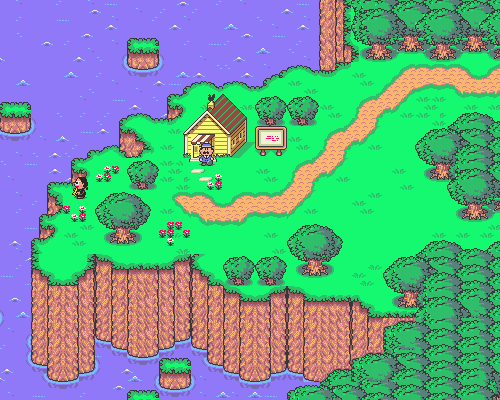
Vacant House in Onett
Ape and HAL Laboratory Earthbound 1995

Brendan Keogh reminds us of a moment where a digital game directly confronts our perception by sensorimotor knowledge (Keogh 2018 pp. 35-39). In the Super Nintendo role-playing game Earthbound (1995, released as Mother 2 in Japan), the buildings in the player's hometown of Onett are all displayed on the town map in an oblique projection (the roof and the front and right side walls are all visible from outside, but the player can never see the other exterior sides). There is a "vacant house" for sale on the outskirts of town for an expensive price, well beyond the player's budget at the start of the game. There is no way to go inside the house without buying it, and if the player waits too long into the game's story, the real estate agent will disappear and the house will no longer be for sale.

It is possible for the player to stay near the start of the game, saving up enough money to buy the house. Once paid, the real estate agent runs away and the player may walk their character into the house through the front door.

Vacant House Interior

Once inside, the player sees that the house is a dilapidated, run down mess. There are holes in the flooring and, most importantly, there is no wall on the rear of the house. It is easy to say that the game creators were breaking the fourth wall because there is no fourth wall. Logically, the characters in the game would have surely noticed that the house is incomplete before buying it. The joke is on the human player and their incomplete view into the game's world.


Note: Earthbound/Mother 2 is constantly changing the player's perception of the game world by using different projections for different aspects of the game. Onett and most other exterior locations are displayed in a typical "cavalier" elevation oblique projection. The unusual village of Saturn Valley uses a vertical oblique projection. Fourside uses a "military" oblique projection that accentuates the sense of height in its tall skyscrapers. Building interiors often use opposing oblique projections of the right and left walls to convey a naïve image of converging lines of perspective, as if the walls are converging in the distance. Finally, battle scenes are set in a hazy, fog-like environment: an ambiguous space.


Noë agrees with philosopher Maurice Merleau-Ponty that we have more than a "pictorial" perception: seeing a retinal image of the object and recognizing it as a tomato (Noë "Pictures in Mind" Action in Perception 2004 pp. 35-74). Merleau-Ponty's examples use a cube, not a tomato, 

"I express the carnal presence of the cube that is there before my eyes... in its perpetual evidentness. The sides of the cube are not projections of it, they are nothing other than "sides." When I see them... according to perspectival appearance, I do not construct the idea of a geometrical plan [alternately translated as "flat projection"] that would account for these perspectives; rather, the cube is already there in front of me and unveils itself through them" (Merleau-Ponty Phenomenology of Perception 1945 trans. 2012 pg. 211).

Merleau-Ponty similarly writes about actively perceiving a drawing of a cube on a piece of paper as if it is an object with dimensional extents.

"Depth is born before my gaze because my gaze attempts to see something"  (1945 pg. 274 emphasis original).

The drawing, a projection of a cube on a flat surface, gives the impression of a whole object, even when the method of projection (oblique, orthographic, or isometric, for example) does not match the subjective perspectival experience we have when observing an actual, material cube.

"The six faces and twelve edges can only simultaneously coexist and remain equal for me if they are arranged in depth. The act that corrects appearances, giving acute or obtuse angles the value of right angles, or to deformed sides the value of a square, is no the thought of geometrical relations of equality and of the geometrical being to which they belong -- it is the investment of the object by my gaze that penetrates it, animates it, and immediately makes the lateral faces count as "squares seen from an angle," to the extent that we do not see them according to the extent that we do not even see them according to their diamond-shaped perspectival appearance" (1945 pg. 276).

Similarly, we accept digital game objects projected on our display screens, be they an animated sprite character or vacated house with a missing wall, as complete objects with some sense of depth and dimensionality in their virtual environments. Their spatiality should make sense within the logic of their particular virtual spaces.

Note that digital game graphics tend to be varied and hybridized, even within a single game. A single frame of a game is often constructed of numerous images, arranged in order to construct a cohesive scene. Especially in the era when games were shifting from 2-D to 3-D, various objects may use different methods of projection, yet still read as part of a single organized space.

For example, in Doom (Id Software 1993), the player explores the game world from a first-person perspective viewpoint. The environment is drawn the the screen via a raycast 3-D method, essentially creating a two-point perspective view by rendering the view in vertical strips. This works well maneuvering laterally and looking left or right, but the player cannot tilt their view up or down. Objects in the game (keys, pieces of armor, exploding barrels, etc.) overlap each other and recede into the distance, but they are simple orthographic sprites that are always seen as if from the same direction. Creatures are similar to objects, but use different sets of sprite animations that mimic displaying them from eight possible directions. The sky and mountains in the distance are simply a flat background image displayed behind all other objects and environmental elements.

Researcher Dominic Arsenault and his team at the Université de Montréal created a framework for analyzing this many and varied projection methods that create hybrid visual modes in game graphics ("The Game FAVR: A Framework for the Analysis of Visual Representation in Video Games" Loading... The Journal of the Canadian Game Studies Association 2015 vol. 9 no. 14 pp. 88-123). It is an effective toolkit for defining the varied graphical presentations of elements in a digital game image, but it is not intended for analyzing a game's spatiality. For that, I've incorporated some of the Game FAVR concepts into my own system of defining virtual spaces (Rowe "A Taxonomy of Virtual Spaces" unpublished).


CYBORG:

Additional quotes about the concept of digital games as cyborgian play.

"Computer games, like most computer applications, work through feedback between user and software. It has been argued that these games, or, more precisely, the circuit of game and player in the act of playing, are literally (for the duration of the game at least) cybernetic. Computer games... produce the game player as cyborg" (Kennedy "Illegitimate, Monstrous and Out There" Feminism in Popular Culture 2006 pp. 188-89).

"There is no player separate to the interface and game world, there is a fusion of the two into a cyborgian subjectivity -- composed of wires, machines, code and flesh" (Kennedy "Female Quake Players and the Politics of Identity" Videogame, Player, Text 2007 pg. 126).

"From my experience with... virtual reality simulations... I can attest to the disorienting, exhilirating effect of the feeling that subjectivity is dispersed throughout the cybernetic circuit. In these systems, the user learns, kinesthetically and proprioceptively, that the relevant boundaries for interaction are defined less by the skin than by the feedback loops connecting body and simulation in a technobio-integrated circuit" (Hayles "Virtual Bodies and Flickering Signifiers" How We Became Posthuman 1999 pg. 27).

Thursday, December 1, 2022

Terminology Analysis of Digital Games, part 10

Continued from part 9.

Brendan Keogh uses N. Katherine Hayles' media criticism techniques to understand digital games as an embodied textuality. I believe it is this sense of embodiment that digital games convey that is key to understanding the unique aesthetic qualities of digital games. While all forms of texts may be said to be embodied (films, plays, novels, music, etc.), digital game players enter a cyborgian circuit with the game machine, through its physical interface, integrate into an algorithmic coupling with the simulated world, and experience a sense of navigation through virtual space that I call cyberkinaesthesia.

The author interfacing with a game controller (2018)

Maze Games to Platformers (again?) (Racing Games pt. 5)

Taxonomy of Virtual Spaces This is a continuing history of the evolution of early car racing games as analyzed according to each game's ...