Taxonomy of Virtual Spaces
This is a continuing history of the evolution of early car racing games as analyzed according to each game's visuo-spatial configuration. Be sure to read part 1 and part 2 and part 3 before continuing.
This post covers the earliest racing games and shows how they may connect to the genre of maze games.
The Grandaddy of Them All: Gran Trak 10
Atari pioneered the racing genre with the arcade game Gran Trak 10 (1974) (shown above). The game put players behind the steering wheel of a Formula One race car, complete with gear shift and gas pedal. The car is drawn to the screen in plan orthographic view with its extended axles and big tires making a distinctive silhouette. The car's "sprite" graphics data is stored in ROM (a first for a video arcade game) with enough image data to rotate the car in 32 different directions.
 |
Gran Trak 10 (Atari, 1974)
image sourced from this video
|
The race course is also drawn in plan orthographic view with the entire circuit on one screen - no scrolling needed. This gives a sense of having an elevated view of the course, as if watching the race from the grandstands instead of seated in a car on the track.
 |
"Cartopia" remote controlled car installation by Kansei Seiki Seisakusho (a.k.a. KASCO)
probably from a sales flyer (1975) (image source) |
This feels more like controlling a remote controlled car from afar (see above). This isn't necessarily a bad thing; the all-in-one view allows multiple players to share the same screen.
This same plan orthographic visuo-spatial configuration was repurposed for Atari's Le Mans (1976) and Sprint One (1978) while secret Atari subsidiary Kee Games released Formula K (1974). The two companies reused the overhead view in a number of multiplayer racers: Gran Trak 20 (1974), Twin Racer (1974), Sprint 2 (1976) (the "2" in the title is for the number of players), Sprint 4 (1977), and the astounding eight-player games Indy 800 (1975) (see above) and Sprint 8 (1978).
As explored previously, Atari co-founder Nolan Bushnell wanted to develop a game that gave more of a first-person driving video game experience like some exciting electromechanical racing games he had played. Atari later met and exceeded those expectations with Night Driver (1976) and by licensing NAMCO's Pole Position (1981). But, that doesn't mean that the overhead view of Gran Trak 10 disappeared from the video landscape. Destruction Derby and Car Polo
 |
| Crash 'n Score (Atari, 1975) |
Crash 'n Score (1975) is Atari's modification of a destruction derby competition. In this one or two-player game, the goal is to drive your car through as many illuminated, numbered flags as possible while avoiding oil slicks and collisions with the other car. The controls and plan orthographic car graphics are nearly identical to those of Gran Trak (the two games may have some of the same data in their graphics ROMSs). The race course circuit is replaced by an open arena littered with flags and hazards. The big difference is that Crash 'n Score uses a toroidal topology: driving off one side of the screen causes your car to reappear on the opposite side (just like in Asteroids (1979)).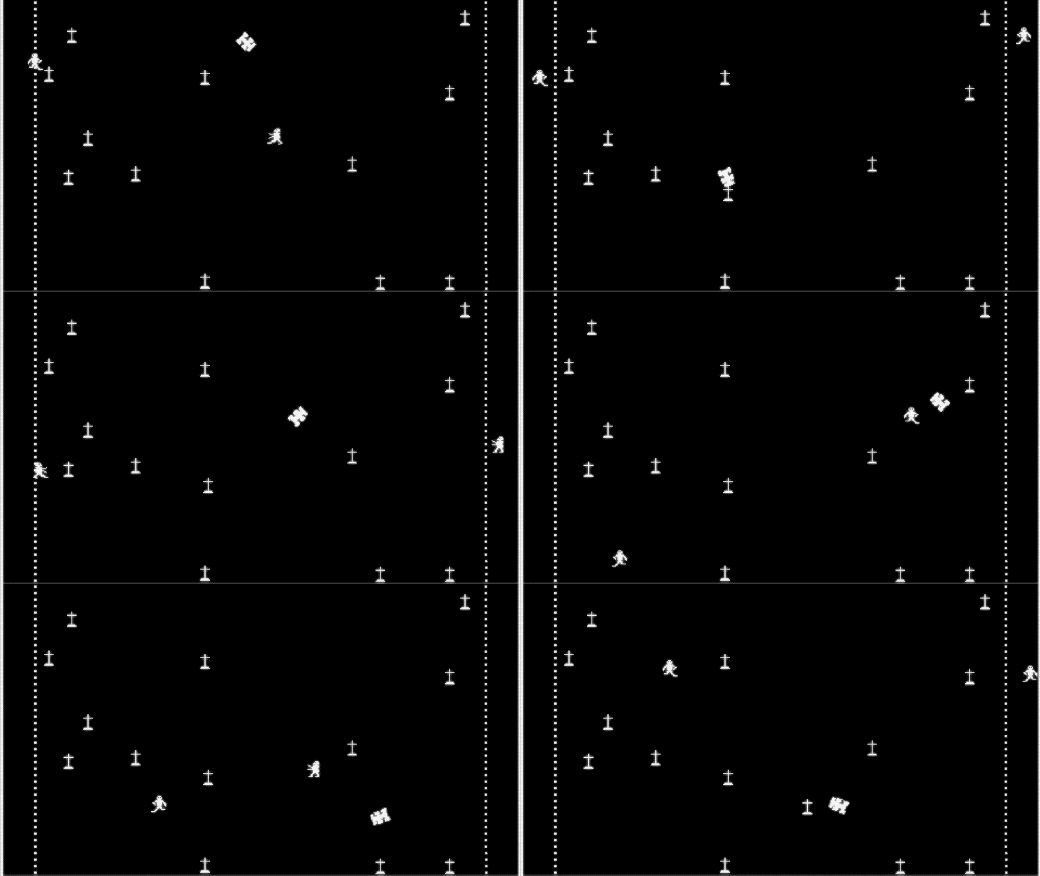 |
| Death Race (Exidy, 1976) |
The story behind Death Race (Exidy, 1976) is well known and oft-told, so I won't dwell on it here. Exidy was a small arcade game company when it developed Destruction Derby (1975). The game became popular, but Exidy was too small of a company to meet with demand, so the company gave Chicago Coin an exclusive license to make the game as Demolition Derby (1975). Unfortunately, Chicago Coin went out of business soon after, taking its exclusive license on the game into oblivion. Exidy needed a new design to bring in money, so they turned to hotshot game designer Howell Ivy, fresh from his stint at Ramtek designing games like Clean Sweep (1974) (inspiration for Breakout (Atari, 1976)), to create a new take on the old game. Ivy added "stick figure" targets to the destruction derby arena and a cylindrical topology that allowed players to freely drive between the top and bottom edges of the screen.
 |
Car Polo (Exidy, 1977) |
With a color screen and four driving controls, Howell Ivy was able to repurpose the old Destruction Derby design into Exidy's Car Polo (1977). The game features two teams of cars driving to knock a large ball into their opponent team's goal, which seems to be based on the dangerous sport of auto polo from the early 20th century. While the game is not well remembered today, it does eerily predict the success of Rocket League (Psyonix, 2015).Atari Sprints Into the '80s
 |
| Track 7 from Super Sprint (Atari Games, 1986) |
Atari returned to the Gran Trak/Le Mans/Sprint arcade racing game series eight years after the previous titles, Sprint One and Sprint 8. Super Sprint (1986) featured the same general overhead view of a racetrack circuit in one screen, but the environment uses vertical orthogonal rendering to give a sense of elevation change on the course. This allowed for banked turns (see the last two hairpin turns, above), jump gaps, and overpasses (see below). The environments are also drawn with perspectival clues, like slightly receding lines at the left and right edges of the image, though this is inconsistent with the rest of the imagery (cars do not reduce in apparent size when they are at the far side of the screen).
 |
Track 8 from Super Sprint (Atari Games, 1986)
|
The game supported up to three human players to race against one or more computer-controlled "drone" cars.
 |
| Badlands (Atari Games, 1989) |
The quickly-released sequel Championship Sprint (Atari Games, 1986) included a few new obstacles and numerous new race courses, but did little to change the Super Sprint formula. Badlands (Atari Games, 1989) (above) added armed and armored cars for autoduelling in a post-apocalyptic future hellscape, but the Sprint series seemed to be overshadowed by a new racing upstart released in the same year as Badlands.
Ivan 'Ironman' Stewart's Super Off Road
 |
| Ivan 'Ironman' Stewart's Super Off Road (Leland Corporation, 1989) |
The Leland Corporation was a video game company that rose from the ashes of former vector and laserdisc game pioneer Cinematronics. Leland produced the 3-player off-road arena racing game Super Off Road (1989) with a license to use racing star Ivan 'Ironman' Stewart's name and likeness. The smooth race courses of the Super Sprint games are replaced by dirt tracks with hills, jump ramps, pits, water hazards, slopes, corrugations ("washboards"), water hazards, and other challenges. The Super Off Road environment is rendered in an elevation oblique style, where the face of the back wall is co-planar with the screen. This makes it easier for the players to see these changes in elevation in contrast to the Super Sprint series, where the ground plane is co-planar to the screen.
 |
| Super Off Road: The Baja for Super Nintendo (Leland Corporation, 1993) |
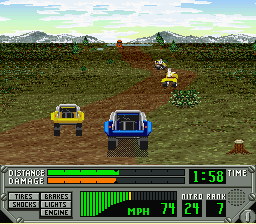
Later games in the Super Off Road series abandoned multiplayer, the video arcade, and the overhead view for single-player home console games with depth horizon/Super Scaler inspired visuals. This line of single screen multiplayer racing games largely disappeared after 1989. Head-On?
Let's rewind time back to the late 1970s, in the heyday of Atari's original Gran Trak 10 inspired games. I argue that the lineage of maze games that became so prevalent in the early 1980s owes some inspiration to these single-screen racing games.
 |
| Head-On (SEGA/Gremlin, 1979) |
As I wrote about extensively in a previous blog post, Head-On (1979) was a successful and influential maze game, probably the first of the "dot eater" genre. Game designer Lane Hauck said the idea for the game "just came to him," but it is hard not to see a Gran Trak 10 influence in the game's Formula One-style car graphics. The connection between the games is not explicit, but Atari's racing games were popular in the arcades and Hauck would have certainly been aware of them. This move from complex driving controls to a simpler single-joystick and "accelerator" button for movement that was both easier to learn and less expensive to manufacture.
The dot-eating (an early form of item collection) of Head-On was somewhat unusual in the post-Space Invaders (TAITO, 1978) era where clearing a game stage required eliminating all enemy targets. This is more similar to the Crash 'n Score flag-collecting model.
 |
| Car Hunt (SEGA, 1979 or 1980) |
SEGA quickly followed up on the game's success with sequels Head-On 2 (1979) and Car Hunt (dated 1979, but probably 1980). Car Hunt introduced layered 2-D space to Head-On with the inclusion of an overpass.Head-On was successful in the US and Japan and certainly influenced game designers in both countries. The orthogonal movement, tight passageways, dot-eating, and enemy avoidance are all elements of Pac-Man (NAMCO, 1980). I don't think Toru Iwatani ever admitted to being influenced by Head-On, but it would be quite a coincidence if he wasn't thinking about it when he created Pac-Man. Again, you can read more about this lineage of game development in a previous blog post.
NAMCO's Other Maze Game
 |
| Rally-X (1980) |
Pac-Man is not the only NAMCO maze game of 1980 that appears to have a strong Head-On influence. Rally-X has the player driving a Formula One inspired car along orthogonal roads avoiding collisions with enemy cars. The player can only move in the four orthogonal directions, though there is a slight diagonal movement for about one frame when turning corners. A set of flags replace the dots to eat/run over (not unlike Atari's Crash 'n Score), but the primary player goal is to complete an exploration of the maze.Note that a major change with this game is the player is not moving an object on the screen, they move the frame around the game environment. The player car remains stuck in the center of the view and the world moves around it. This frame navigation is not dissimilar to how Pole Position (1982) functions (and NAMCO programmer/hardware designer Kōichi Tashiro worked on both games). It also means that the Rally-X world does not have to be confined to a single screen.
The Rally-X maze absolutely dwarfs the one in Pac-Man as seen in the comparison image above from the Retrogame Deconstruction Zone. This massive environment is far more than can be viewed on the screen at one time, which spurned the creation of a mini-map in the lower right corner of the screen. It acts like a radar screen, showing the locations of off-screen cars and flags, not the layout of the maze, and is similar to the one seen in Battlezone (Atari, 1980), released in the same month.The concept of a game with a consistent "off-screen space" was still fairly new. You could not turn your car around and revisit an environment in an upscroller game. Rally-X and Battlezone both feature lasting game environments that don't disappear when you stop looking at them. The mini-map/radar displays enabled the user to think about the gameworld in two different scales: both what is currently in frame and the surrounding area beyond the edge of the screen. This is similar to using an in-car GPS navigation aid while driving, focusing on the road with a mini-map in the corner of your vision.
Beyond the Maze
 |
| Bosconian (NAMCO, 1981) |
NAMCO's Galaxian (1979) and Galaga (1981) both innovated on the Space Invaders-style "upshooter" game design, but Bosconian (1981) (released a few months after Galaga) combined space shooting action with the free roaming environment and some visual technology of Rally-X.
The player is tasked with flying their "Starfighter" through open space, hunting down the large Death Star-like enemy "Bosco Bases." The visuo-spatial configuration of the game is almost identical to Rally-X, with frame navigation, frame mobility in any direction, plan orthographic projection, and a mini-map. The only real differences are that this game adds 8-way movement and toroidal "wraparound" topology.
Bosconian uses a combination of a Galaga PCB with a Rally-X video board. It appears that NAMCO was working to develop games with more interchangeable technologies, so one game can be replaced by another by swapping out the ROM chips and maybe other minor modifications.
Bosconian multidirectional movement with a simple joystick marked a step away from the momentum-based shooter movement of Asteroids (Atari, 1979) and other games inspired by Spacewar! (1962). Bosconian was likely a direct influence on Time Pilot (Konami, 1982) and Sinistar (Williams Electronics, 1982), though the last game uses object navigation instead of frame navigation.
Next post starts with Head-On once again, as that game's influence hasn't adequately been explored here yet.


