Taxonomy of Virtual Spaces
This is a continuing history of the evolution of early car racing games as analyzed according to each game's visuo-spatial configuration. Be sure to read part 1 before reading this blog post.
As a refresher, Atari pioneered the genre with the arcade game Gran Trak 10 (1974). Its overhead view shows the entire race course on one screen. That works great for multiplayer games, but doesn't give the player the feeling of being in the cockpit and behind the wheel of the car as they drive it through the race course.
First Person German Engineering
Dr.-Ing. (Doctor of Engineering) Reiner Foerst working on creating a driving simulator when he ended up inventing the first first-person arcade video game. It was nigh impossible simulate a three-dimensional view through a car's windshield using cost-effective 1973-era technology, but Foerst was encouraged when he acquired a Pong (Atari, 1972) arcade machine. The machine was capable of generating white rectangles at different points on the screen. Foerst realized that the rectangles could be repurposed into reflective road markers, illuminated by headlights as one drives along a winding road at nighttime.
 |
| Nürburgring 1 (Dr.-Ing. Reiner Foerst GmbH, 1976) |
Soon enough, Nürburgring 1 (1976) was born. The game is named for the Nürburgring motorsports track in the German town of Nürburg. Like Gran Trak 10, it includes a steering wheel and gas pedal, but the visuals are completely different. The rectangle "road markers" scale in size and move down the screen in a convincing emulation of driving down a winding road at night.
The graphic techniques are similar to SEGA's Moto-Cross and related games analyzed here. The edges of the road appear to converge in the distance and smoothly adjust left or right to simulate curves in the road. Unlike with other games, Nürburgring 1 has the player navigating the frame across the game world rather than navigating an object on the screen. The front of the driver's car is displayed but it doesn't move. In fact, the car hoodis just part of the plastic screen overlay that includes the speedometer. As the player steers to the right, the road markers move left on the screen in an example of induced movement.
Foerst released a few sequels in the following years, including Nürburgring 2 (1979?) with a motorcycle handlebar replacing the steering wheel and Nürburgring 3 (1980) with a daytime scene and a full color display. In fact, Foerst's company is still working in the car simulation business to this day.
Early Copy Cats
It is said that arcade game developer Ted Michon of Digital Games played an early Nürburgring 1 cabinet in a West German bowling alley and met with Foerst. Upon returning home, he designed a simpler clone version of the game titled Night Racer (1976). Digital Games went out of business by summer 1976 and its assets were bought up by a new company named Micronetics, which manufactured Night Racer. It looks like Micronetics didn't stay in business long, either, as industry magazine Play Meter stopped listing Micronetics' contact info. after January 1978.
Before Digital Games closed its doors, Michon's boss licensed the design to Midway (the video game division of Bally) as Midnite Racer (1976). Midway hired Dave Nutting Associates (not to be confused with Nutting Associates founded by Dave's brother Bill) to develop it. Midnite Racer was renamed as 280 Zzzap (1976) when Midway entered into a tie-in promotion with Datsun for a special edition 1977 Datsun 280Z.
Atari Takes "Inspiration"
Atari co-founder Nolan Bushnell stated in a 2017 interview (pg. 33) that he had planned to make a "driving game" "in a week" based on the same methodology used to create Computer Space (Nutting Associates, 1971). He cited Chicago Coin's electromechanical (EM) game Speedway as a direct influence. This driving game would be "the magnum opus," "the big kahuna" hit game design for his burgeoning new Atari company.
 |
| Speedway (Chicago Coin, 1969), image from this video |
Speedway has no video screen. The image of a looping race track is projected from a spinning plastic disk. This gives the game a "3-D effect" with "spectacular realism" according to a Chicago Coin sales flyer. The player steers the red race car left and right to pass six other projected car images moving independently on the track. It is not quite a first-person view, but it was an impressive effect for late 1960s technology.
Bushnell's vision of creating a video arcade version of Speedway took much longer than "a week," and it appears that Nürburgring 1 that served as Atari's ultimate inspiration. In an undated quote, Atari designer Dave Sheppard remembers being shown "a piece of paper with a picture of a game cabinet" that he remembers being "a German game" with "a few little white squares showing." This was probably Nürburgring 1, and the game may have been "based on a license from a German affiliate" (Atari Inc. - Business is Fun (Goldberg and Vendel, 2012, pg. 211)).
 |
| Night Driver (Atari, Oct? 1976) |
Sheppard developed Night Driver (1976) using the same techniques as Nürburgring 1. An illustrated plastic overlay over the screen serves as the player car's hood (it's hard to see in the above image. I think the cabinet uses a fluorescent black light hidden under the monitor bezel to illuminate the orange car hood image, but it doesn't appear to be functioning in this example).
This was like Bushnell's vision of a video Speedway, but in some ways better. The Night Driver curves left and right, not just turning left in a circle. The screen flashes bright white if the player crashes into the side of the road. There is only one thing missing in this racer: other cars.
Chicago Connections
At least two of these games made their debut at the AMOA (Amusement & Music Operators Association) show held in Chicago in November 1976. Midway brought Midnite Racer, newly renamed as 280 Zzzap (pronounced "zap"), and Atari debuted Night Driver ("Chicago Chatter" and "Eastern Flashes," Cash Box (18 Dec 1976, pg. 43)). Micronetics may have also featured Night Racer as one attendee noted that there were "about four different night driver games" at the show ("Projection Racing," Play Meter, Jan 1977, v. 3, n. 1, pg. 14).
 |
| Midnite Racer sales flyer announcing the name change to 280 Zzzap (Midway, 1976) |
In the long run, Atari's Night Driver beat out all competitors in the American market. Play Meter's operator poll of top-earning arcade video games for 1977 ranked 280 Zzzap as #9 and Night Driver as #6 ("Mr. Average and his Operation," Play Meter, Nov 1977, v. 3, n. 21, pg. 25). While 280 Zzzap quickly fell out of the poll rankings, Night Driver was a top 10 earner through 1978 and ranked #11 in 1979.
The Road Home
 |
| 280 Zzzap/Dodgem for the Bally Astrocade (Bally, 1978) |
The home version of 280 Zzzap took advantage of the Astrocade's built-in ability to display 5 x 7 pixel text characters to add text like "FINISH LINE" when a game is complete. The lower HUD displays time remaining, a speedometer (evidently rated in km/h), and distance traveled.
 |
| Night Driver for Atari VCS/2600 (Atari, 1980) |
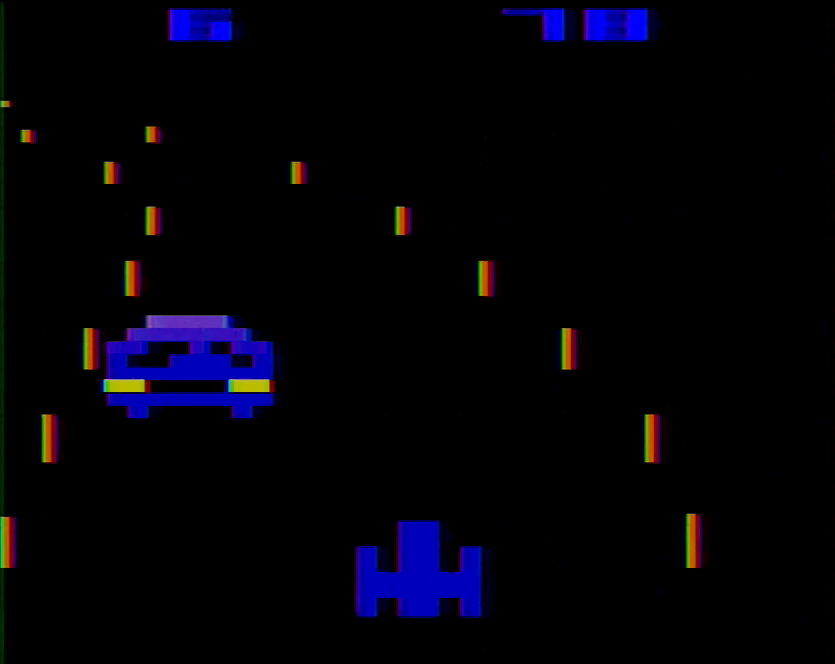
In 1980, Rob Fulop ported Night Driver to Atari's home game console, the Atari VCS (later known as the Atari 2600). Fulop made several improvements to the original design by adding color (while still making it look like a nighttime scene), roadside terrain (houses and trees), and oncoming cars with their own headlights (see above). This was another hit for Atari, becoming one of the top-selling VCS games of the year (although it couldn't compare to Fulop's unprecedented hit Space Invaders VCS port (Atari, 1980)).
Atari Leaves Orbit
The "night driver" game formula worked well for creating a fast-moving world from a first person view while restricted by 1970s game graphics technology. The nighttime scene eliminated the need for an environment, background, or horizon line to be displayed; it's too dark to see them! The entire scene is created from scaling, white rectangles: simple "spots" of light that define the edge of the navigable environment. The difficult part was creating a system that calculates the positions to display those spots according to the player's speed and steering, giving the appearance of moving through a continuous, three-dimensional space while traveling across the two-dimensional ground plane of a flat road.
 |
| Starship 1 (Atari, 1977) |
Atari's Ron Milner, a member of the Night Driver engineering team, used a similar approach when he designed Starship 1 (Atari, 1977). The player flies through the inky blackness of outer space, as distant points of starlight zip past the player. A sales flyer boasts the game's "realistic 3-D graphics" with spacecraft and planets that "[grow] larger as they approach, giving the player the illusion of speeding through space." The control yoke lets the player pitch their view up and down or yaw left and right, creating the illusion of a full, three-dimensional galaxy to explore. An early viewer of the game noted its similarity to Night Driver, stating "the target ships come out at the player much like the pylons on Night Driver do, thereby creating the illusion of depth" ("AMOA Report '77," Play Meter, Dec 1977, v. 3, n. 23, pg. 23, emphasis added).
For all its visual technical prowess, Starship 1 wasn't much more than a target gallery. This was still in the days before Space Invaders (Taito, 1978) set the precedent that video game enemies should feel like a menacing threat. 1977 was the year of Star Wars, and Starship 1 didn't really reproduce the feeling of piloting an X-wing into a dogfight with Imperial TIE fighters. It didn't help that the spaceships in Starship 1 were clearly inspired by Star Trek.
Star Ship (Atari, 1977) was a launch title for the Atari VCS and a home port of Starship 1. However, it does not appear that the game sold well for Atari and it was discontinued within a few years.
 |
| Star Raiders for Atari 8-bit computers (Atari, 1980) |
Epilogue and Prologue
 |
| Spasim for PLATO (Jim Bowery, 1974) |
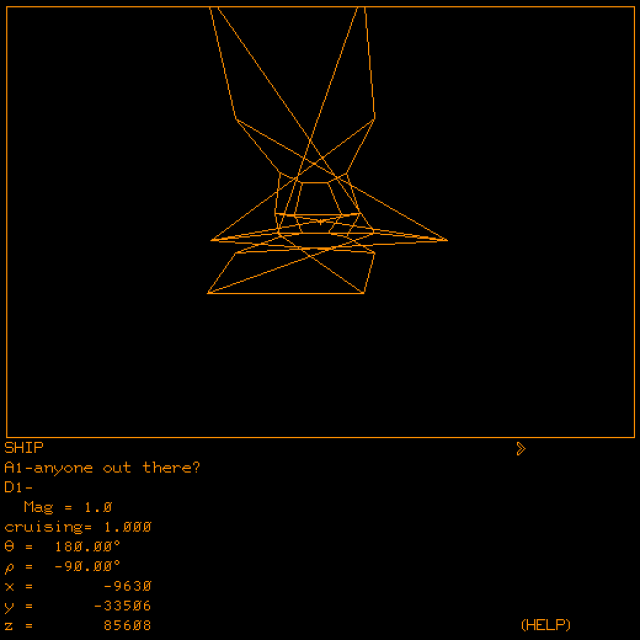
Like so much of computer game history, there is a precedent that can be traced back to the PLATO computer network. Jim Bowery created (and then deleted, and then recreated) Spasim in 1974 at the University of Illinois at Urbana-Champaign, ground zero for the sprawling PLATO IV network. Billed as "An Investigation of Holographic Space," Spasim is a 32-player multiplayer game of realtime dogfights in space with wireframe polygonal graphics.


No comments:
Post a Comment